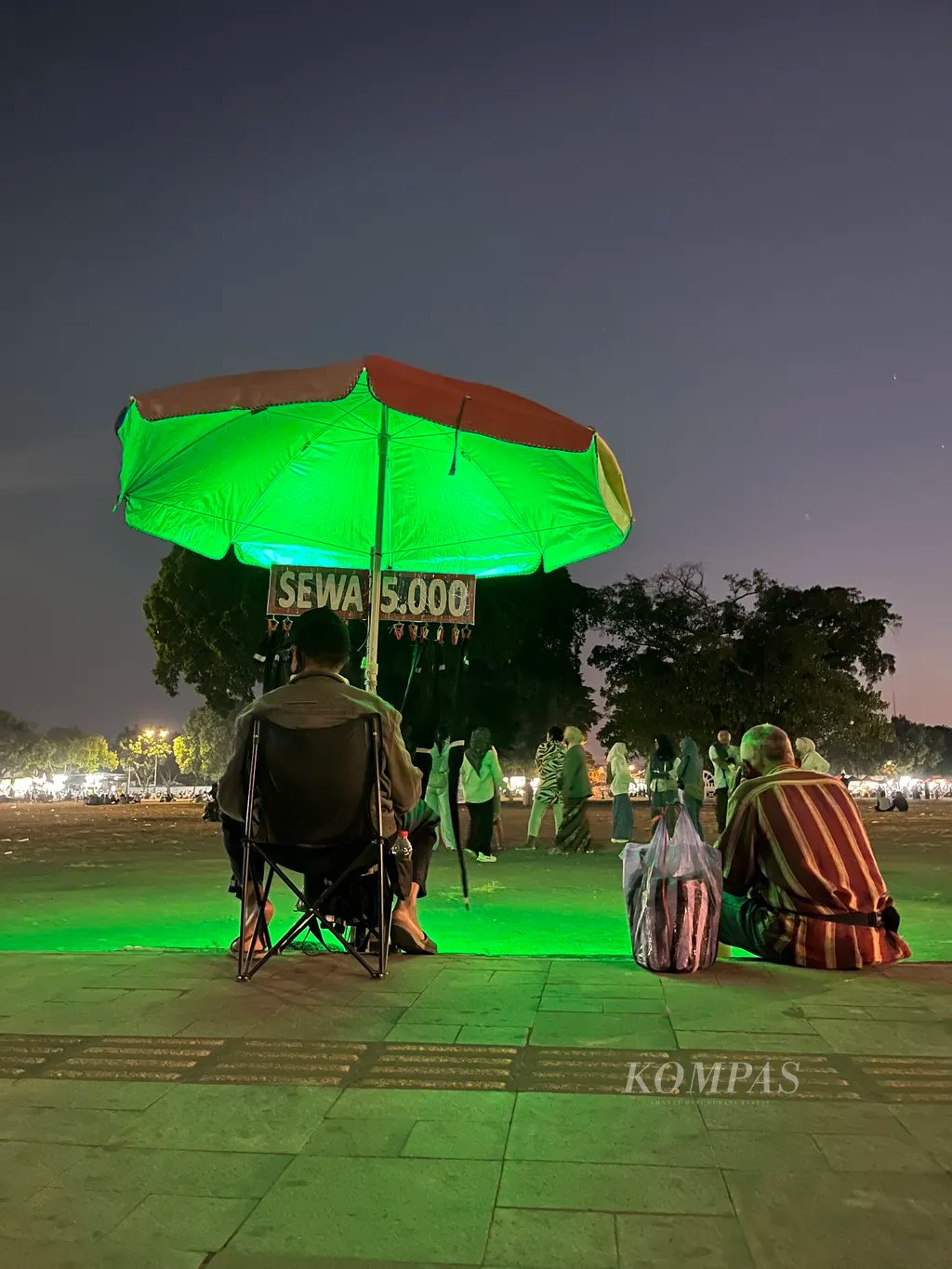
Nandang hesitated when his employer asked him to trim the hanging roots of the banyan tree, which had begun to grow irregularly. While cutting roots is not a difficult task, pruning the banyan’s roots presented a different challenge for him.
“I’m afraid someone will get angry if I cut it,” said Nandang, who works in Sumur Bandung, Bandung City, West Java, on Thursday (5/11/2026).
The phrase “someone is angry” does not refer to a person. It evokes something intangible, believed to inhabit the banyan tree. Nandang is anxious, fearing that disturbing the tree will only provoke something negative.
Nanang admitted that he had no evidence to support that belief. However, he remains convinced. He has heard stories about the banyan tree being a dwelling for supernatural beings many times before.
Her concerns are not without reason. Tales passed down through word of mouth reinforce this suspicion. Like sacred forests and abandoned old houses, the banyan tree is believed to be a dwelling for supernatural beings.
However, some believe that this story is merely a way for ancestors to protect nature. The banyan tree, for instance, is an ideal water reservoir. Cutting it down would diminish nature’s ability to mitigate flooding and preserve water sources.
“I don’t want to believe that banyan trees are haunted. But if I don’t, I’m afraid something will happen,” he said.
The intersection of fear and courage is what keeps Reza (36), a resident of Bandung Wetan in Bandung City, from experiencing mystical tales and ghost stories firsthand, instead opting to view them through social media.
Through their mobile phones, they can watch content creators explore haunted locations and produce various horror stories without direct involvement. What was once avoided is now being approached, albeit only through a screen.
“It feels like watching a horror movie. If you’re scared, just turn off the TV or your mobile phone,” she said, expressing her enjoyment of watching content from Jurnal Risa on YouTube and Sasaka by aini on TikTok.
The contrasting issues within society were explored in depth at the 7th National Seminar on Cultural Anthropology, themed “Digital Ghost: Dissecting Modern Mythology In The Algorithmic Era,” held by the Indonesian Institute of Arts and Culture in Bandung on Wednesday (4/11/2026).
The speakers included Ira Indrawardana, Head of the Center for Cultural Dynamics, Development, and Social Change at Padjadjaran University; content creator Syifa Salma Zatun Aini; and Muhammad Zamzam Fauzanafi, Head of the Doctoral Program in Anthropology at the Graduate School of Cultural Sciences, Gadjah Mada University. All speakers aimed to explore how digital technology and algorithms shape myths, beliefs, and cultural realities in the modern era.
Digital ghost
So, what exactly is a digital ghost? This term does not have a single, definitive meaning. A digital ghost often refers to mystical experiences that manifest through mobile phone screens, technology, and social media.
However, the same term can also be used to describe technology that has lost its function, been abandoned, and ultimately become something foreign to humans.
One definition of a digital ghost is linked to the belief in invisible entities. In the past, these beings were thought to inhabit haunted places that should be avoided. Today, however, their presence is approached and mediated through social media, mobile phones, and the internet.
While previously avoided, some people are now seeking, exploring, and even sharing experiences related to the mystical world.
Ira views this phenomenon as a paradox of digital culture. A person may feel fear, yet at the same time, still have a desire to seek out information.
He stated that through the aid of technology, viewers can experience the tension as creators enter dark rooms or hear mysterious sounds. However, they still prefer to remain in a relatively safe space, behind the screens of their mobile phones.
In this process, algorithms play a crucial role. Rather than inciting fear, they enhance users’ exposure to content that captures their interest. When someone repeatedly watches, likes, or shares horror content, the likelihood of encountering similar material increases significantly.
This, Ira noted, is what prevents the Sundanese mystical world from disappearing in the face of digital modernity. She acknowledged that the way these stories are conveyed may have shifted from local oral traditions to audiovisual narratives and cross-platform content.
Currently, there are negotiations regarding the sacred meaning and its truth. However, this does not diminish human fear and curiosity. In fact, as it becomes more popular and widely discussed, the supernatural world has the potential to stimulate economic opportunities.
Ira cited the Ghost Ranger Indonesia channel, which sold an exclusive episode titled “Scariest Case of Ghost Ranger Indonesia” through the Noice platform. Priced at Rp 20,000 per viewing, the channel recorded approximately 10,000 transactions in less than a week, resulting in a reported gross transaction value of around Rp 200 million.
Bridge of Atmosphere
Behind the circulation and economic value of mystical content, technology is transforming how people experience a story. Audiences are no longer just hearing it through word of mouth; they are invited to immerse themselves in the atmosphere created by the creators through visuals, sound, and music.
Syifa Salma Zatun Aini and her team are well aware of these changes. They leverage algorithms to map audience preferences regarding content ideas. By utilizing technology, they aim to bring various mystical stories closer to the audience through images, sounds, and music shared on social media.
Through the TikTok account Sasaka by aini and the YouTube channel Sasakara Team, she invites viewers to experience a similar atmosphere even if they are not in the same location. Music and precise cinematography serve as the bridge for this connection.
According to him, mobile phones have evolved beyond mere documentation tools. They have become a medium that transforms personal experiences into spectacles that can be enjoyed by others.
Aini acknowledged that when she began her journey as a content creator in 2021, a mystical atmosphere became her trademark. At that time, mystical content was all the rage on the internet and in feature films.
“For example, if the photo was taken at night, it wouldn’t have sparked curiosity if it had been taken during the day,” he said.
The choice has proven to attract viewers, with its content receiving a warm reception from netizens. During a single live session on TikTok, the broadcast garnered at least 10,000 viewers.
“In fact, from the start, I wasn’t looking for ghosts. I was trying to choose a setting that would be appropriate for the audience at the time,” he said.
So, does he mind being labeled as a ghost-hunting content creator? He stated that this actually serves as a significant asset in promoting his original mission: to preserve ancestral wisdom in maintaining a connection with nature and the surrounding environment.
“In the past year, for instance, he has frequently informed the audience about the importance of preserving rivers and forests, all in his own style. He goes directly to the locations, usually conducting these sessions at night,” said a descendant of the caretaker of the Pulo Majeti Cultural Heritage site, an area of wetlands and forests in Banjar City, West Java, which plays a crucial role in flood control for the Citanduy River.
The fear conveyed through images and sound serves as a gateway for Aini to invite the audience to engage with their environment.
What once captivated with its mystique is gradually transforming into a bridge for conveying messages about rivers and forests. This approach mirrors the efforts of ancestors in safeguarding vital areas in their surroundings.
Dead infrastructure
The concept of the digital ghost extends even further. Anthropologist Zamzam Fauzanafi employs it to examine issues related to infrastructure that are at risk of being abandoned when their technology becomes obsolete.
Zamzam illustrates this through the case of a solar power plant (PLTS) in Rewataya Village, Tanakeke Islands, Takalar Regency, South Sulawesi.
According to Zamzam, the solar power plant was established in 2017 through a collaboration between Indonesia and Germany. However, six months later, it ceased operations and was left abandoned. The main issue, Zamzam noted, is that when the equipment breaks down, residents are unable to repair it. He referred to this problem as a digital ghost.
Through the Participation of Women in Renewable Energy (POWERE) program, Zamzam and his team engaged women and other residents of Rewataya to learn about the mechanisms of solar power technology. He described this learning process as an effort to “exorcise” the digital specter that had previously “haunted” the community.
Zamzam stated that after learning to operate the solar power system again, residents are no longer afraid of potential malfunctions. “I’m not worried as long as we take care of it together,” said a resident named Daeng So’na.
Another resident named Frida shared a similar understanding. “Previously, solar power plants failed due to lack of maintenance. The operators were all men, often drinking ballo (a local liquor), so they weren’t as attentive. We women are more capable of maintaining them with care,” she said.
Ghosts are not merely understood as frightening figures like the kuntilanak or genderuwo. Their presence is not limited to abandoned houses or sacred forests.
In the digital realm, it manifests through experiences on mobile screens, exposure to algorithms, and technology that fails, leaving users with unresolved issues.
However, past and present or whatever the media, his figure is still considered “scary” if we are not truly ready to deal with him.