On Tuesday, Nov. 3, Americans from across the country made their voices heard by casting or mailing in their ballots. When the dust settled, Democrats had decisively retaken the House of Representatives and the Senate. A Democratic sweep of Congress was widely expected by prediction markets ahead of the midterm elections.
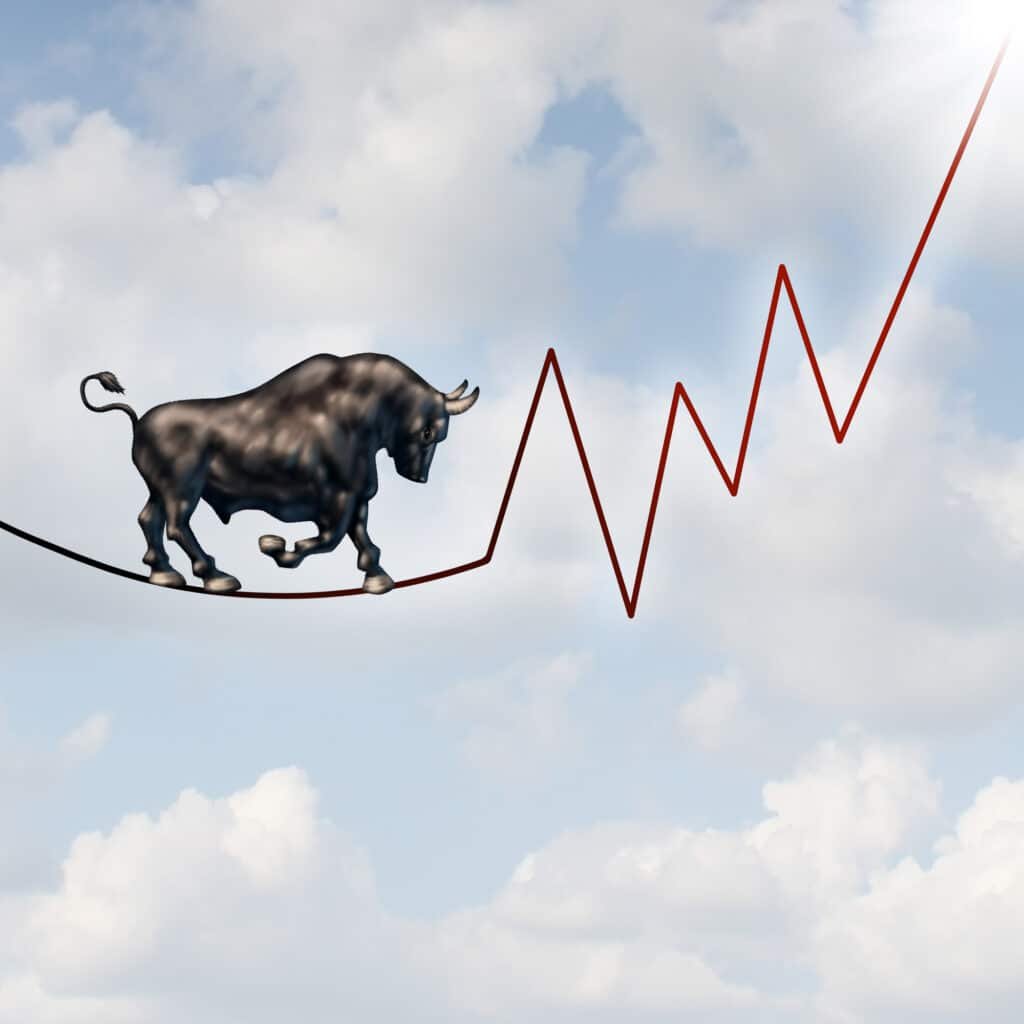
But not everything on Election Night went as expected. Tuesday yielded a dubious surprise for the Trump bull market that may push the Dow Jones Industrial Average (DJINDICES:^DJI), S&P 500 (SNPINDEX:^GSPC), and Nasdaq Composite (NASDAQINDEX:^IXIC) over the edge.
Missed Nvidia in 2009? This Rare Signal Is Flashing Again. In 2009, a “Double Down” signal flashed for a little-known chipmaker called Nvidia. For the first time in years, that same “Total Conviction” signal is flashing for a company 1/100th the size of Nvidia. Continue »
President Trump’s bull market may be running on borrowed time. Image source: Official White House Photo by Daniel Torok.
The Trump bull market’s biggest test has arrived
Several catalysts have lit a fire under the bull market that’s flourished under President Donald Trump, including better-than-expected corporate earnings and record share repurchases by S&P 500 companies. But nothing has been more paramount to the success of stocks than the artificial intelligence (AI) infrastructure build-out.
According to IDC, AI will transform workforces and create an estimated $22.5 trillion in cumulative economic value between 2025 and 2031. This technology is spurring unprecedented investments in AI infrastructure and is widely boosting growth projections.
On Tuesday, the “surprise” came in the form of at least five Democratic governors flipping seats held by Republicans. According to the Associated Press, as of 8 p.m. ET on Nov. 4, Democrats held 28 of 50 governorships, with two races yet to be called. It’s the first time in 16 years that Democrats have clinched a majority of the governorships.
But it’s not this majority, per se, that’s potentially problematic for the Trump bull market. It’s that Democratic governors won elections in several states where massive AI data center projects are underway, including Texas, Ohio, and Georgia.
For example, Democratic Governor-Elect Gina Hinojosa of Texas has publicly stated that she’ll issue a moratorium on data center approvals until the state passes laws governing electricity, water, and air rights. Texas accounts for a significant percentage of U.S. data center capacity that’s under construction.
Hinojosa isn’t alone. Most Democratic governors have expressed skepticism about existing AI regulations and/or the pace of AI data center build-outs.
Image source: Getty Images.
A historically expensive stock market can ill afford an AI data center build-out slowdown
Slowing the pace of AI data center expansion and putting a bright spotlight on AI regulation could be potentially devastating to the Trump bull market’s No. 1 catalyst. Not only would tougher oversight likely slow the AI infrastructure build-out at the state level, but it would also force investors to rethink the premium valuations they’ve assigned to AI stocks.
The stock market entered 2026 at its second-highest valuation in history, according to the S&P 500’s Shiller Price-to-Earnings (P/E) Ratio, also known as the Cyclically Adjusted P/E Ratio (CAPE Ratio). The Shiller P/E Ratio has only topped 40 on three occasions over 156 years, including the present. The previous two instances were eventually followed by unsightly bear markets (the dot-com bubble and the 2022 bear market).
In other words, history shows that Wall Street and investors are unwilling to tolerate premium valuations over an extended time frame.
If Democratic governors clamp down on data center expansion or impose stricter state-level regulation, it could be the catalyst that forces investors to re-rate a historically pricey Trump bull market. While this in no way guarantees a stock market crash will occur, it greatly increases the odds of an elevator-down move in equities.
Should you buy stock in S&P 500 Index right now?
Before you buy stock in S&P 500 Index, consider this:
The Motley Fool Stock Advisor analyst team just identified what they believe are the 10 best stocks for investors to buy now… and S&P 500 Index wasn’t one of them. The 10 stocks that made the cut could produce monster returns in the coming years.
Consider when Netflix made this list on December 17, 2004… if you invested $1,000 at the time of our recommendation, you’d have $358,037!* Or when Nvidia made this list on April 15, 2005… if you invested $1,000 at the time of our recommendation, you’d have $1,229,708!*
Now, it’s worth noting Stock Advisor’s total average return is 897% — a market-crushing outperformance compared to 211% for the S&P 500. Don’t miss the latest top 10 list, available with Stock Advisor, and join an investing community built by individual investors for individual investors.
Sean Williams has no position in any of the stocks mentioned. The Motley Fool has no position in any of the stocks mentioned. The Motley Fool has a disclosure policy.