
People across China have been eager to spend the just-concluded Mid-Autumn Festival holiday from Friday to Sunday traveling as the country rolls out a range of incentives and festive activities to support the culture and tourism market.
Data from the Ministry of Transport shows that about 650 million cross-regional trips are expected during the three-day holiday, averaging 220 million a day. The national railway network peaked in return passenger traffic on Sunday, with an estimated 16.86 million passenger trips. For road travel, more people chose self-drive short-distance trips and rural tourism.
During the Mid-Autumn Festival holiday, average daily sales at key retail and catering enterprises nationwide rose by 6.1 percent year on year, according to the Ministry of Commerce. Visitor flow and turnover in 78 pedestrian streets and business districts monitored by the ministry increased by 6.4 percent and 5.1 percent, respectively. Sales of smart, eco-friendly, and health-oriented products surged; notably, sales of smart wearable devices on major platforms more than doubled, while sales of embodied AI robots, organic foods, and outdoor sports gear grew by 93.1 percent, 36.3 percent, and 30.2 percent, respectively.
In addition, during the holiday period, China’s 200 major wholesale markets for agricultural and sideline products maintained ample inventories, with prices for mutton and fruit remaining largely stable compared with pre-holiday levels.

China’s Mid-Autumn Festival holiday sees surge in tourism enthusiasm
Flocks of crested ibises were spotted foraging in a rice field after the autumn harvest in Hanyin County, northwest China’s Shaanxi Province.
The crested ibis, with its iconic red crest and long black beak, is a first-class protected species in China and was formerly a critically endangered species. Rice fields after the autumn harvest serve as a haven for the birds, allowing them to consume a wealth of fallen grains and insects.
Conservation measures in Hanyin have paid off in recent years, providing a safe place for crested ibises to forage. These measures include fishing bans, water source protection, and the Lake Chief System, a governance model where local leaders take direct personal responsibility for management and protection of lakes.
Since the local forestry department first discovered crested ibises in 2010, the bird’s population in the county has exceeded 130.
In the past, the crested ibis was widely distributed across East Asia and Russia’s Siberia. It was thought to be extinct in China until seven wild birds were observed in Shaanxi’s Yangxian County in 1981, a discovery that prompted captive breeding and enhanced protection of the species. As of the end of 2025, the global population of the crested ibis had exceeded 12,000.
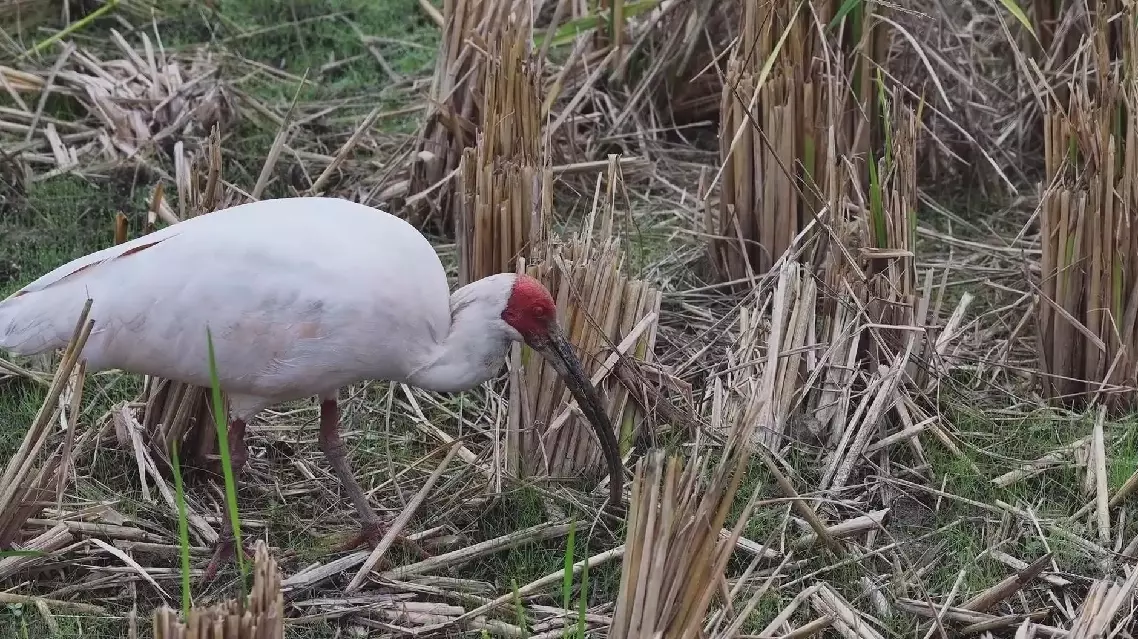
Endangered crested ibises spotted foraging in Shaanxi rice field after autumn harvest