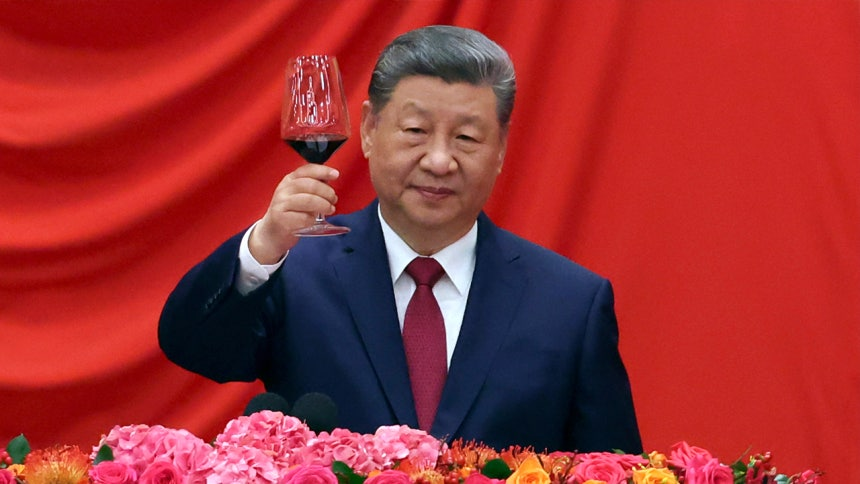

BEIJING — China’s Communist Party opened the fifth plenary session of its 20th Central Committee on the 26th, turning its attention to tightening discipline within the party. Coming a year before next year’s party congress, where President Xi Jinping is expected to secure a fourth term, the meeting is being watched for clues about the country’s future power structure.
The four-day session, known as the fifth plenum, runs through the 29th in Beijing, according to the state-run Xinhua News Agency. It is the fifth full meeting of the Central Committee elected at the 20th Party Congress in 2022, and the forum where the current leadership sets major policy and organizational direction.
Fifth plenums usually take up the next five-year economic development plan, but that was already discussed at last year’s fourth plenum, so the focus this time has shifted to overhauling the party’s management system. Xinhua reported earlier that the main agenda items would be deliberation on a draft decision to continue advancing “comprehensive and strict party governance” and a work report from the Politburo. In an Oct. 22 speech marking the 90th anniversary of the victory of the Long March, Xi also called for a sustained push on comprehensive and strict party governance, saying that “to walk the road of the new Long March well, we must uphold the party’s leadership and strengthen party building.”
The session draws particular attention because it comes roughly a year before next year’s 21st Party Congress, where Xi’s bid for a fourth term is expected to be decided. Drawing on analysts’ assessments, here are three things to watch at this plenum.

1. Will a standing oversight and evaluation system replace one-off purges?
Xi has made his anti-corruption campaign a signature governing policy over the past decade and has escalated it further in recent months. According to the Asia Society, a U.S. think tank, 42 of the 44 Central Committee members with military backgrounds elected in 2022 have been purged or have disappeared from public view. More recently, the campaign has reached senior retired officials, including former Chongqing Mayor Huang Qifan — nicknamed the “phoenix” for surviving the purge of close associates such as former Chongqing party chief Bo Xilai — and former Chengdu Mayor Wang Fengchao, who held the post until last year.
What stands out this time is a move to go further and institutionalize internal party control — building a system of standing oversight and evaluation rather than stopping at one-off purges or crackdowns. In June 2024, Xi called for completing five systems covering organization, education, oversight, institutions and accountability as part of comprehensive and strict party governance. In a January speech released this month in Qiushi, the party’s theoretical journal, he ordered officials to identify and remove “two-faced people” who outwardly obey party directives while pursuing political opportunism, departmental self-interest or factionalism behind the scenes. He also called for closer scrutiny of how cadres carry out core policy goals such as investment in advanced technology and resolving local government debt.
The moves are seen as an effort to tighten the reins on local cadres who fail to properly implement central directives. Last year, 118,000 Chinese officials were disciplined for “formalism” — handling work on paper without substantive results — and “bureaucratism,” or passing responsibility to other departments, roughly triple the figure a year earlier. Neil Thomas, a senior fellow for Chinese politics at the Asia Society, said Xi would use the plenum to take aim at “disloyalty and incompetence” that is widespread down the chain of command.
Specifically, attention centers on whether the oversight framework for the party’s own disciplinary bodies will be restructured. Also in focus is what new institutions emerge from this year’s party-wide campaign to establish a “correct view of political performance,” and whether new formulations or anti-corruption mechanisms tied to comprehensive and strict party governance will appear. Hou Yichao, a researcher on Chinese politics and economics, told Singapore’s Channel NewsAsia that “institutionalizing anti-corruption could become a key task ahead of the 21st Party Congress.”
2. Will Mao’s “party chairman” title return after 44 years?

The plenum is also read as the start of full-scale preparations for next year’s 21st Party Congress, where Xi is expected to win a fourth term. Already regarded as China’s most powerful leader since Mao Zedong, Xi may take additional steps to cement his political legacy. Some observers suggest he could lay the groundwork for reviving the post of party chairman.
The party chairmanship was the Communist Party’s top leadership post during the Mao era, held by three people: Mao, Hua Guofeng and Hu Yaobang. It was abolished in 1982 under Deng Xiaoping as part of institutional reforms meant to guard against the concentration of power and the cult of personality. Reviving it would carry symbolic weight, signaling a departure from the collective leadership system maintained since Deng and a further concentration of power in a single top leader. Christopher Nye, a researcher at the U.S.-based Jamestown Foundation, said the plenum could adopt the title of “people’s leader” for Xi across the party, the military and the state, adding that “if it does, reviving the party chairmanship at next year’s 21st Party Congress would emerge as a realistic possibility.”
Similar predictions circulated around the 19th Party Congress in 2017 and the sixth plenum of the 19th Central Committee in 2021, however, and did not materialize. Skepticism remains considerable, in part because elevating himself to a status equal to Mao’s could carry political costs for Xi. Analysts also note that creating a party chairmanship could stir fresh controversy over whether Xi’s current post as general secretary would survive and over the question of succession.
Xi has meanwhile moved step by step to extend his rule and strengthen his political standing. At the sixth plenum of the 18th Central Committee in 2016, he was formally recognized as the party’s “core.” At the sixth plenum of the 19th Central Committee in 2021, the party adopted a third historical resolution emphasizing the historical status of “Xi Jinping Thought on Socialism with Chinese Characteristics for a New Era.” In 2022, the “two upholds” were written into the party constitution, committing the party to resolutely upholding General Secretary Xi’s core position in the Central Committee and the party as a whole, as well as the authority of the Central Committee and its centralized, unified leadership.
3. Will the next leadership take shape amid a personnel shake-up?
Another question is whether Xi, while tightening party discipline, will signal a generational handover in the leadership ahead of next year’s congress. Many of his closest aides are reaching retirement age, increasing the need for turnover.

The party has followed an unwritten rule known as “seven up, eight down,” under which cadres aged 68 or older at the time of a party congress generally retire while those 67 or younger may stay on. By that convention, several of Xi’s key aides would be in line to step down, including Politburo Standing Committee member Cai Qi, 70, who serves as secretary of the Central Secretariat; Wang Huning, 71, chairman of the Chinese People’s Political Consultative Conference; and Foreign Minister Wang Yi, 73, a Politburo member who does not sit on the Standing Committee. Across the Central Committee as a whole, about two-thirds of members could be replaced at next year’s congress. The actual scale of turnover is uncertain, however, since exceptions to the age convention have been made since Xi took power.
Attention is also focused on whether the top ranks of the Chinese military will be reshuffled. Early this year, Xi removed two members of the Central Military Commission, including Zhang Youxia, the commission’s first vice chairman and the military’s second-ranking officer. The successive purges have left the commission with effectively only two active figures: Xi and one official with a background as a political commissar overseeing corruption investigations.
Hong Kong’s South China Morning Post said the plenum would formalize “one of the most sweeping turnovers of senior personnel in modern Chinese political history.” Some observers say the selection of the core leadership, however, is more likely to take place at next year’s 21st Party Congress than at this meeting.