Modern summit diplomacy had very inauspicious beginnings. Winston Churchill is widely credited with coining the phrase “summit” in 1950 to describe a conference of global leaders. But it was another British prime minister, Neville Chamberlain, who initiated the first actual summit meeting 12 years earlier — with Adolf Hitler, no less.
It didn’t go well.
Over a one-month period, the two leaders met three times over the fate of Czechoslovakia. Hitler threatened war. Chamberlain threatened appeasement. Guess who won?
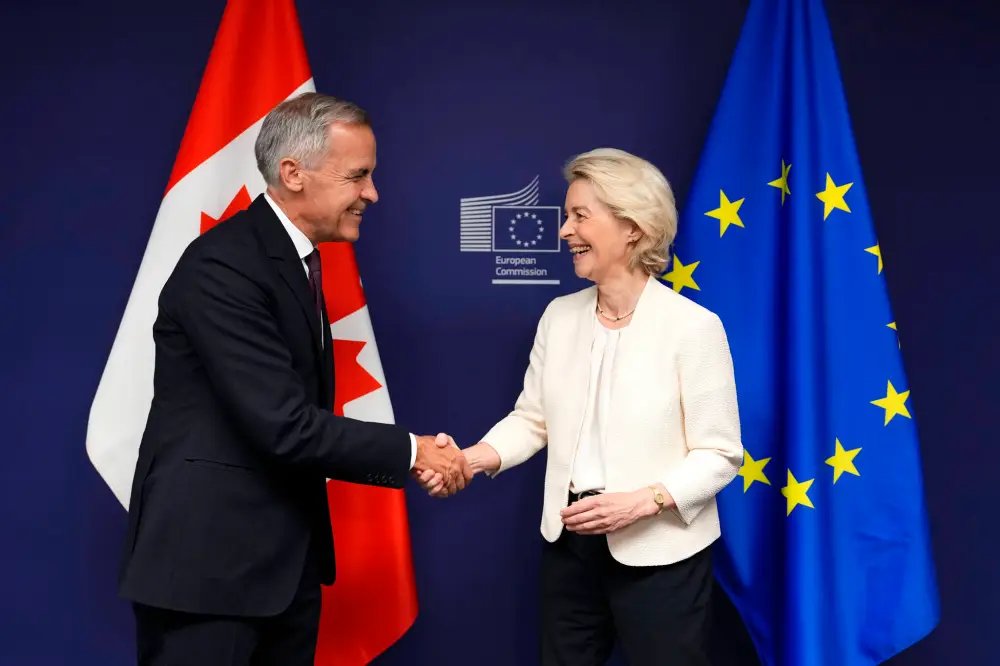
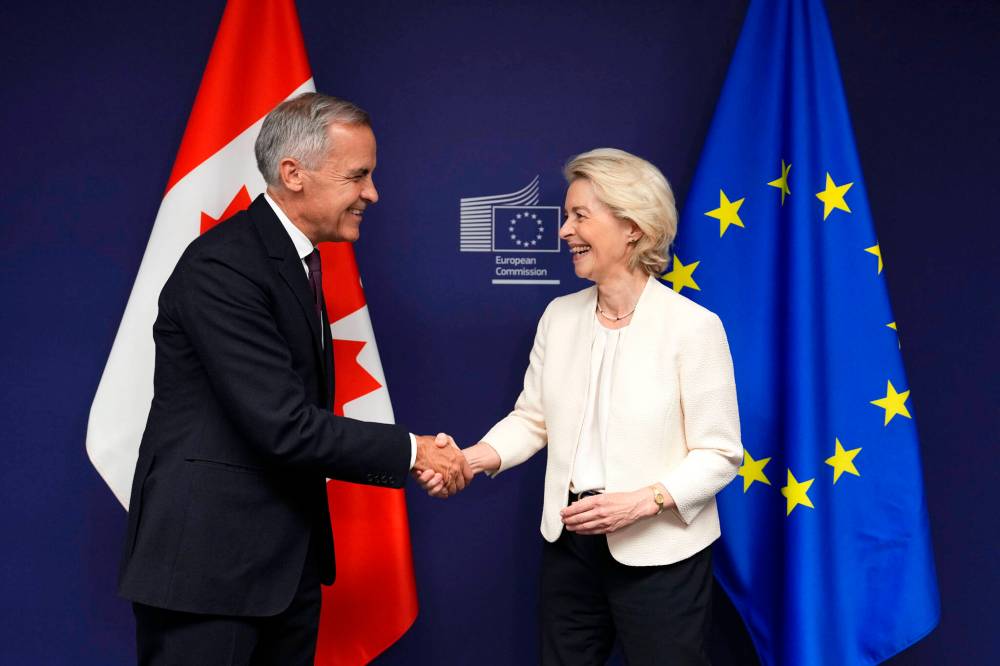
The Canadian Press files Prime Minister Mark Carney, left, and European Commission President Ursula von der Leyen meet at the European Parliament in Strasbourg, France, on Sept. 16. They will meet again in Montreal on Oct. 29 and 30.
Chamberlain was so desperate for a peace deal and so convinced he alone could convince Hitler, that he swallowed his inhibitions and flew in an airplane for the very first time in his life. “If at first you don’t succeed, try, try again” he told reporters, explaining his tenacious summit activity. Skeptical of the spectacle, British Foreign Office wags quietly amended it to, “If at first you don’t concede, fly, fly again.”
The infamous Munich Agreement resulted, Germany occupied Czechoslovakia, and the stage was set for the Second World War to begin a year later.
Which bring us to the next “big” summit: Canada and the European Union. In Montreal, no less. The stakes are much lower. Love is in the air, not war. The leaders are meeting on Oct. 29 and 30 to give effect to a new diplomatic, economic, and political partnership. Associate membership for Canada in the EU — a kind of sovereignty-association (a very Canadian concept) — has been mooted. We simply don’t know yet.
What we do know is that Prime Minister Mark Carney is actively redefining Canada’s place in the world. There is a direct connection from this month’s Montreal summit to President Donald Trump’s “51st state” annexationist mutterings to U.S. tariffs to Carney’s Davos middle power speech, to the PM’s European Parliament speech in Strasbourg to the war in Ukraine.
Just because they are connected doesn’t mean the lines between them are neat and straight. Anything but. Patterns always appear clearer from a distance. Enough distance between the Trump 47 administration and Carney 01 government has appeared that events and circumstances are revealing this new pattern.
That pattern reveals not an independent Canada but a sovereign Canada. Big difference. An independent Canada would eschew entangling alliances and compromises. It would chart its own foreign policy direction outside of NATO, NORAD, NAFTA, the UN and the EU. That’s not in the cards.
Sovereignty is the ability to exercise as much control as possible over your most important interests, typically your land, people, resources, environment, and borders. Sharing sovereignty in a form of mutual control is fine if you trust your partner.
What Carney is doing is finding an economic and political counterweight to a partner he no longer trusts. In the immediate aftermath of the first Trump tariffs and economic damage to Canada, the goal was to repair the relationship by getting the tariffs lifted. Didn’t work.
Next, Carney sought to renew it by adding defence and security elements to it. That effort foundered in August when negotiations halted with mutual recriminations about who was at fault. Now, he’s embarked upon a counterweight strategy to rebalance and then reduce Canada’s reliance on the U.S., economically and politically.
There are two aspects to Carney’s counterweight strategy. First, create political coalitions of middle powers on mutual interests, as signalled in the Davos “rupture” speech to counter American foreign policy dominance. Second, create a formal, integrated economic arrangement with the EU to counter American economic policy dominance. Hence, the Montreal Summit.
Carney’s goal is to make Canada more politically sovereign and economically resilient from a predatory and avaricious America. Our interdependence has put us at risk.
“We are pursuing resilience so no one, no one can control our open markets, impair our sovereignty, threaten our territorial integrity or undermine our freedoms, our democracies, our rule of law,” Carney said.

Since outright independence is a non-starter, given our geographic proximity, economic dependence and military reliance on the U.S., Carney is trying to insulate Canada from the worst effects of a hostile America which values no special relationship with us.
Trouble is, neither he nor the country can afford to stray too far, too fast from Trump’s America, even now. Two phone calls last week prove it. The first to Ukraine’s president Volodymyr Zelenskyy, and then to Trump about his diesel deal with Russian president Vladamir Putin and a supposed energy ceasefire between Ukraine and Russia.
The Zelenskyy readout was firm and direct: “This (diesel) agreement is in direct opposition to the efforts of Ukraine, Canada, and our allies to create peace and stability in Europe.”
By contrast, the Trump readout made zero mention of the nefarious diesel deal but did offer “strong support” for a nebulous energy ceasefire deal. The deliberate omission was to avoid triggering a volatile Trump. In the end, there is no energy ceasefire, and the diesel deal remains.
Summit diplomacy in the Age of Trump still requires some delicate appeasement, if not outright obeisance. The picture is unedifying. But if Canadians don’t like the look, then the faster Carney’s counterweight strategy is secured, the better. No better idea has come up.

Our newsroom depends on a growing audience of readers to power our journalism. If you are not a paid reader, please consider becoming a subscriber.
Our newsroom depends on its audience of readers to power our journalism. Thank you for your support.