Prime Minister Mark Carney’s government is rewriting the rules of its economic immigration system to favour foreign workers in well-paid occupations, allowing employers to bypass looking at the Canadian talent pool first. Returning to a merit-based point system for high-skilled immigrants is a shift economists have long urged after years of high-volume, low-wage intake, but the latest policy change could cause controversy with Canadians given current polling trends.
Immigration Minister Lena Metlege Diab announced last Friday that starting Nov. 3, Express Entry candidates will earn extra Comprehensive Ranking System points for Canadian work experience in a high-wage occupation, or for a qualifying job offer in one. Ottawa’s announcement says the number of points rises with how well an occupation pays.
Crucially, a candidate need not have any Canadian work experience: a job offer alone in a listed occupation earns the new points that bump them upwards in the queue to attain permanent residency in Canada.
Everyone already in the pool will have their scores recalculated automatically. That process could take up to two weeks, and invitations to apply for permanent residency will be paused while it runs.

Which jobs qualify, and the end of the local-hire test
An occupation counts as high-wage if its median pay is at least 1.3 times the median wage of the overall Canadian workforce. Eligibility rests on the occupation, not the candidate’s own salary.
Statistics Canada’s latest figures put the median annual income at $46,300 in 2024, excluding people with no income. At 1.3 times that, the bar would sit at about $60,200. IRCC, however, benchmarks against the median wage of the workforce, which the Globe and Mail pegs at roughly $57,000, putting the threshold closer to $74,000.
IRCC’s high-wage occupations list sorts 186 occupations into three tiers: at least twice the median; 1.5 to two times; and 1.3 to 1.5 times.
The top tier includes physicians, surgeons, lawyers, judges, university professors, petroleum and mining engineers, nurse practitioners, human resource managers, government and senior managers.
The middle tier covers software engineers, data scientists, cybersecurity specialists, civil and electrical engineers, registered nurses, pharmacists, teachers, pilots, and power-system electricians.
The lowest tier includes accountants, web developers, architects, paramedics, industrial electricians, ironworkers, and crane operators.
Ottawa is also scrapping a key safeguard. As of Nov. 3, a qualifying job offer will no longer need a labour market impact assessment, the process in which an employer must show it could not find a Canadian to fill the role. IRCC says it will still vet offers to confirm they are genuine.
The timing is awkward. Canada shed 68,000 jobs in September, and youth aged 15 to 24 lost 48,000 of them. The youth jobless rate sat at 13 percent, near its highest level in 15 years, after averaging 13.8 percent in 2025.

Back toward a human-capital model
Mikal Skuterud, a University of Waterloo economics professor and C.D. Howe Institute fellow-in-residence, has long pressed Ottawa to return to a points system that selects for skill rather than volume. He sees Friday’s change as a move toward that.
“I think it’s a step in the right direction for sure,” Skuterud told The Hub. “I think the intention of it is right.”
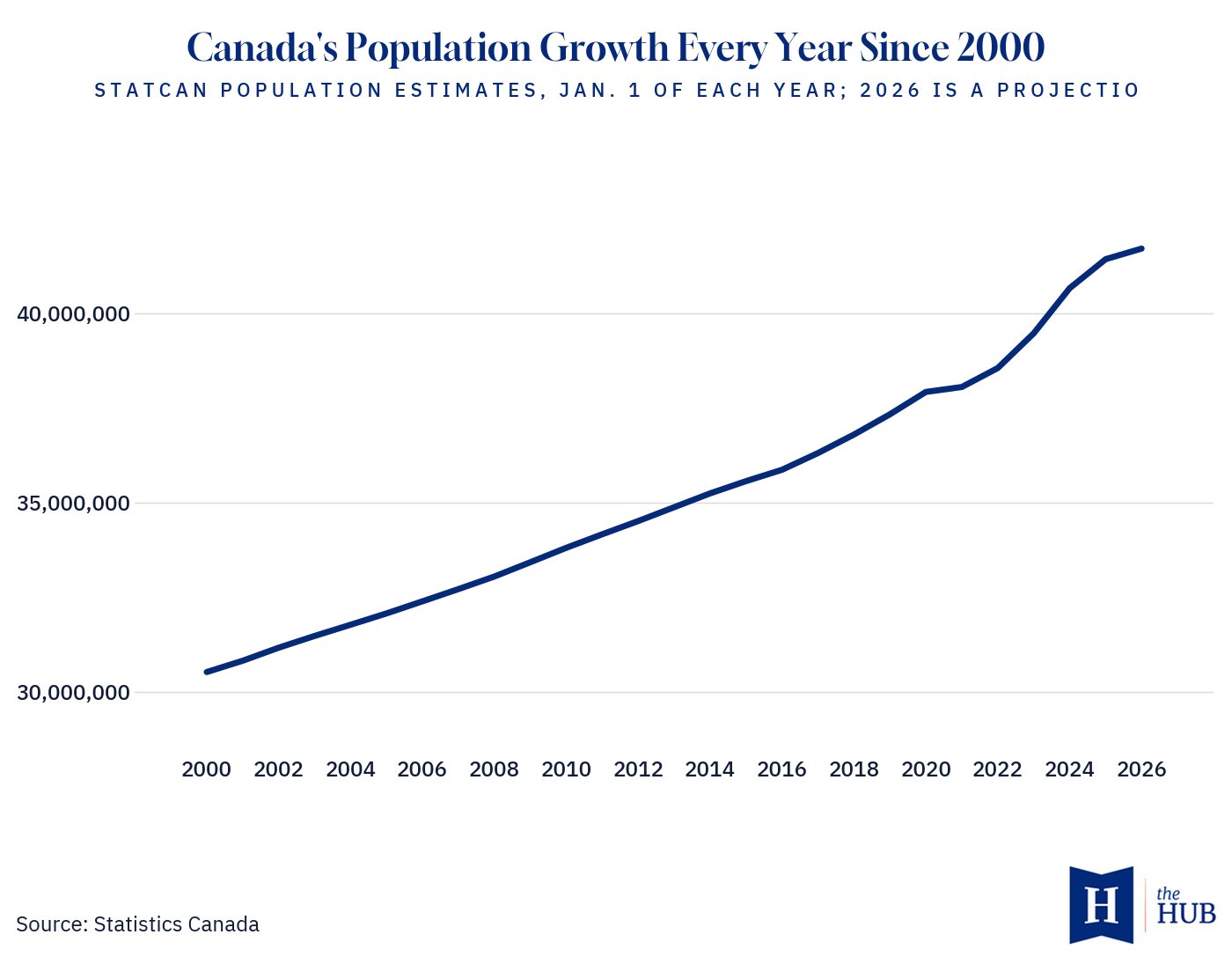
The Trudeau government’s late-term immigration surge pushed annual population growth above 3 percent, adding roughly two million people in a few short years. Yet real GDP per capita barely moved and fell further behind the U.S., with the newcomers concentrated in low-wage work rather than high-productivity jobs.
Skuterud said well-chosen, high-skilled immigrants generate benefits that reach well beyond their own paycheques.
“If you bring in really highly skilled people, there are broader benefits. People that work with those, they do more innovation, they do more productivity,” he said. “They drive productivity growth at the top end, and that can benefit lots of people.”
Keeping that talent is another matter. Canada has long struggled to retain its top earners, with a TD Economics study reported by The Hub finding top-skilled workers, entrepreneurs, and STEM graduates steadily leaving for the U.S. and elsewhere.
CIBC deputy chief economist Benjamin Tal backed the high-skill focus but told the Globe it should extend to trades, where shortages drive up building costs.

Possible loopholes in the job codes
Skuterud’s chief worry is that tying points to occupation rather than pay invites abuse. Occupations are assigned by National Occupational Classification codes, and an employer can label a job as something it is not.
“There’s a real risk of misuse of the system here,” he said. “Now employers have an incentive to say, well, this job is in this particular occupation, and to inflate the occupational coding, when the tasks of the job really aren’t that occupation. It’s something else.”
He would rather IRCC check candidates’ actual T4 earnings. The likely objection, he said, is that discrimination can depress some groups’ pay, which an earnings test would then penalize.
There is recent precedent for abuse in the immigration system. The Globe and Mail previously reported that nearly 50,000 study-permit holders, about 6.9 percent of international students on record, were flagged as no-shows at their schools in spring 2024. Immigration experts warned that many were using study permits as a route into the job market rather than the classroom.
Levels plan looms, and talent drain issue remains
The points shake-up does not in itself change how many people get in, only who. The Carney government’s current levels plan caps new permanent residents at 380,000 a year from 2026 through 2028, down from a target of 500,000, the high-water mark during the Trudeau era.
However, that ceiling may be adjusted upwards. Prime Minister Carney has recently floated a “controlled increase” in immigration once the system is under control, which he claimed to New York Times reporters his government had accomplished. Diab is set to unveil new three-year targets for permanent and temporary residents by early December.
Any push to raise levels will run into a wary public. A Nanos Research poll, conducted March 1 to 8, found 52 percent of Canadians want the country to admit fewer newcomers in 2027 than this year, while fewer than one in 10 want more. An exclusive Hub survey of 1,500 Canadians by Public Square Research and Sago, conducted May 7 to 13, found 67 percent agree there is too much immigration.
Fault Lines examines the pressures pulling Canadian society apart and the principles that can hold it together. We look beyond headlines to understand how institutions, communities, and democratic norms are fraying. Our mission is to show how better choices can repair what is broken.

Graeme Gordon is The Hub’s Senior Editor and Podcast Producer. He has worked as a journalist contributing to a variety of publications, including CBC,…
