If you watched the Las Vegas Grand Prix from home this weekend, you saw angles that would have been nearly impossible to get on TV a few years ago. Back then, most broadcast producers wouldn’t have trusted a cell network with any part of a live race.
Anyone who has tried to send a text on the Strip during race week knows why. The 2024 race brought about 306,000 people to Las Vegas over the course of the week. Nearly all of them had a phone in their hand, and plenty were trying to post/text/tweet or TikTok from the same stretch of the Strip the broadcast cameras were working from. Sounds hectic, doesn’t it?
T-Mobile has spent the last few years trying to change broadcasters’ minds, and the Las Vegas Grand Prix has become its biggest test. The company’s network now carries some of the race’s camera feeds, and according to T-Mobile, broadcasters have started asking for more of it.
Advertisement
Advertisement
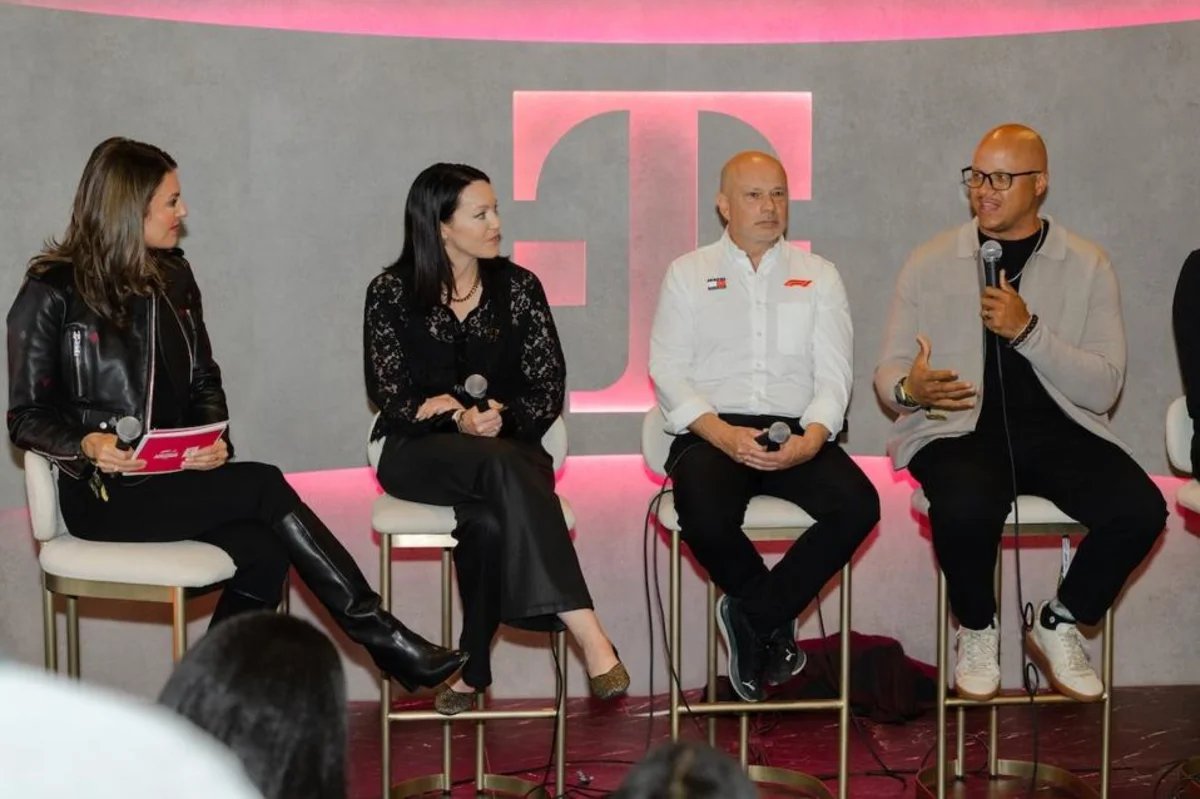
I heard how that happened at a panel in T-Mobile’s Paddock Club suite, one of the many events packed into race week alongside the parties and concerts. Broadcaster Amanda Balionis moderated the conversation and kept bringing it back to what fans at home see on their screens.
Amy Azzi, T-Mobile’s vice president of sponsorships and events, sat alongside three people who rely on that network in different ways. Dean Locke runs broadcast, media and race operations for Formula 1. Royce Dickerson is the executive producer of live sports at Apple TV, and this is Apple’s first season carrying F1 in the U.S. The fourth was Brendan Dolby, who oversees partnerships for the Las Vegas Grand Prix and grew up in the city. For Azzi, the conversation went back about three years, to when T-Mobile started working with the PGA on sending broadcast feeds over its mobile network. She remembered how that idea went over at first.

Broadcaster Amanda Balionis moderates a panel on broadcasting the Las Vegas Grand Prix with leaders from T-Mobile, Formula 1 and Apple TV.
“There was so much skepticism because, you know, traditionally broadcast relied on fiber,” Azzi said during the panel. “There is reliability that is demanded as it relates to broadcasting.”
A live broadcast has no second take, and if a feed drops, millions of people see it happen.
Advertisement
Advertisement
Azzi said the hesitation faded as broadcasters watched the network hold up at event after event, and it has changed the kinds of shots they’re willing to use. Some of that trust was built at golf tournaments. At the 2024 KPMG Women’s PGA Championship, NBC Sports expanded its 5G camera coverage across the course, using a portable private network from T-Mobile. That same summer in Paris, Olympic Broadcasting Services sent HDR feeds from more than 200 Samsung phones over a dedicated 5G network.
Balionis has spent her career in television, and she described what that looks like from inside a production truck. Directors used to cut between big cameras that cost hundreds of thousands of dollars. Now a director can cut from a $250,000 broadcast camera to a device about the size of a phone, and the picture holds up.
Dickerson said Apple uses T-Mobile’s private network for this kind of coverage because it gets priority access, which keeps the feed steady even when thousands of fans nearby are posting videos and streaming. He was also clear that Apple isn’t adding new angles just to say it has them. “You don’t want to just bring in technology for technology’s sake,” he said.
The Las Vegas circuit runs through a working city at night. Concerts, hospitality spaces and fan zones are scattered around the course, and the cars race past landmarks you could pick out from a single frame. Before the first race, Locke flew to T-Mobile in Seattle for a working session that lasted roughly seven hours, just to figure out how to cover everything.
Advertisement
Advertisement
“Everything that makes a broadcast professional shudder is this race,” he said.
He compared it to golf, where the action is spread over a big piece of land and happens in several places at once. In Vegas, the cars are covering that ground at 200 miles per hour. He wanted viewers at home to get a feel for the city’s personality that came close to what fans felt in person, so his team added cameras, put some of them low to the track and opened up coverage of the stages and concerts around the circuit.
Dickerson said he has worked in television production for more than 20 years, and the first time he walked into F1’s broadcast operation, it was the most impressive setup he had ever seen. He described a camera on a car a mile away sending back a clean live picture over the network while the car raced at full speed.

Royce Dickerson of Apple TV and Brendan Dolby of the Las Vegas Grand Prix discuss the fan experience at a panel in T-Mobile’s Paddock Club suite during Las Vegas Grand Prix race week.
Fans aren’t the only ones on the network during race week. Event staff need to stay connected, and so do the teams running shuttles around the city. T-Mobile tracks all of it from an operations command center that Azzi said the company first tried out at the PGA Championship. Balionis said she has been pushing the company to share some of that information with fans, and she’d love to open an app and see which bathroom or concession line is shortest.
Advertisement
Advertisement
The cameras are only one piece of what T-Mobile does in Las Vegas, and the panel also showed how much the company is investing to reach people who might never follow a full F1 season. “It’s not just about the 24 races, it really is about 365 days,” Dolby said. His team builds that year-round pitch with partners like T-Mobile. It starts with tickets and merchandise and continues through the T-Mobile stage concerts that stream live in the app. This year also includes celebrities driving the track with coaching from F1 drivers.
Dickerson made his own promise about this weekend. “This will be the best F1 viewing experience in the world,” he said.
He tied that promise to attention. You have endless options in your pocket, and the U.S. has more live sport than almost anywhere else, so he said a broadcaster has to earn every person who tunes in.
Apple’s first-season numbers are mixed. F1 CEO Stefano Domenicali said U.S. viewing was up 13% year over year in August, based on hours watched. The analytics firm Samba has found that fewer U.S. households are watching since the move from ESPN, although its data doesn’t measure hours watched.
Advertisement
Advertisement
T-Mobile isn’t the only carrier making this pitch. Verizon has used network slicing to keep wireless camera feeds steady at the Boston and New York City marathons. Even so, before Super Bowl LVIII, Verizon’s Joe Russo said the industry still wasn’t taking full advantage of what wireless networks could do for broadcasters. Some broadcasters keep a backup plan. A regional engineering director at Sinclair Broadcast Group said the company still brings microwave or satellite links as a fallback for its biggest events. He has seen cellular feeds break up on air at big events, even after the signal tested strong beforehand.
T-Mobile is betting it can win those holdouts over. Last fall, the company extended its deal as the Las Vegas Grand Prix’s exclusive 5G partner and took on a wider role with Formula 1 in the U.S., which means more race weekends for its network to prove itself.
This article was originally published on Forbes.com