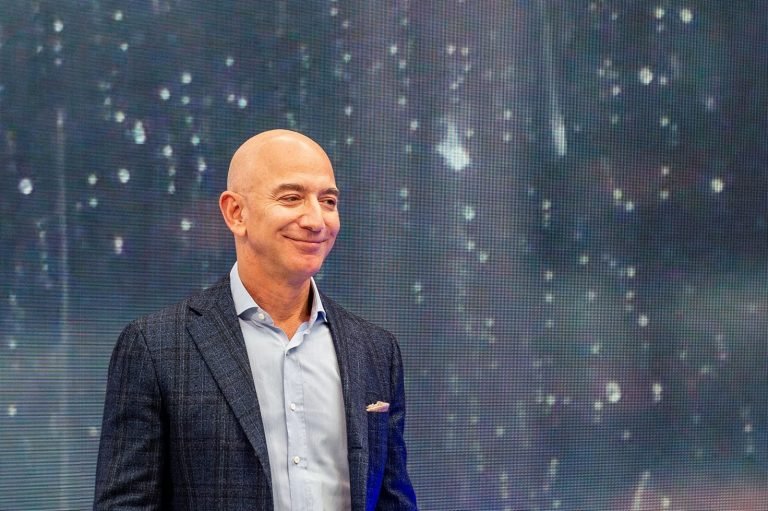
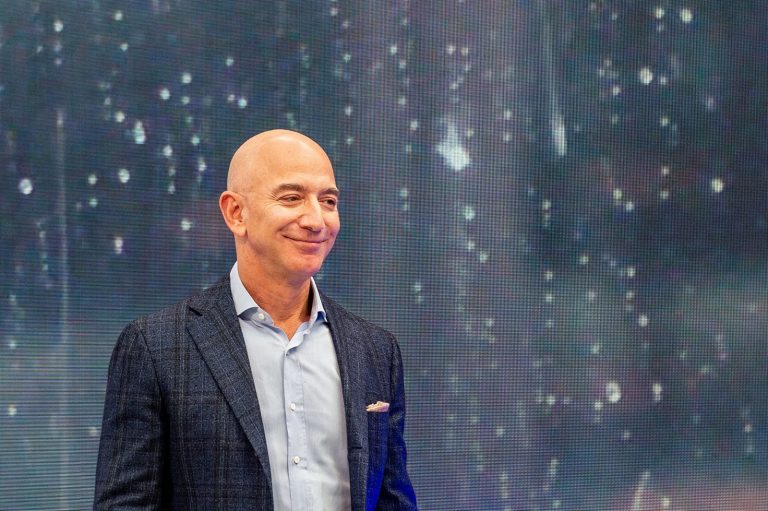
Blue Origin is laying the groundwork for a possible stock market debut in the coming years, with founder Jeff Bezos giving his clearest indication yet that the privately held space company could eventually become a publicly traded business after raising $10 billion from outside investors for the first time.
Bezos said on Wednesday that an initial public offering would likely be several years away but acknowledged that taking Blue Origin public could ultimately make sense as the company expands its ambitions across the commercial space industry.
“I think, someday, Blue Origin will have an IPO… It would be several years from now. But it probably makes sense for Blue Origin to be a public company at some point,” Bezos said on FOX News Channel’s “Special Report with Bret Baier.”
The comments mark a significant shift in the public discussion around Blue Origin’s long-term financing. The company has historically relied heavily on Bezos’ personal fortune to fund its development, allowing it to pursue capital-intensive projects without the pressure of public markets. An eventual IPO would give outside investors direct exposure to one of the world’s most valuable private space companies while providing Blue Origin with another potential source of capital for its expansion.
The timing of Bezos’ remarks is notable because Blue Origin has just raised $10 billion from external investors, its first major outside funding round. The Wall Street Journal reported in September that the financing valued the company at about $140 billion, placing it among the most highly valued private companies in the space sector.
Bezos said he has personally invested $28 billion in Blue Origin since founding the company in 2000. That level of financial backing has enabled the company to develop rockets, engines, lunar systems and other space technologies over more than two decades while operating outside the scrutiny and quarterly performance demands faced by public companies.

Blue Origin Looks to Narrow the Gap With SpaceX
Blue Origin’s potential IPO would also come as investor interest in the commercial space industry intensifies. Rival SpaceX, founded by Elon Musk, remains the dominant force in the sector and listed in June, giving public-market investors direct exposure to the rapidly expanding space economy.
Blue Origin was founded roughly 18 months before SpaceX, but the two companies have followed very different paths. SpaceX rapidly established itself as a leading commercial launch provider, while Blue Origin spent years developing its technology and infrastructure before moving toward more ambitious orbital and lunar missions.
Blue Origin has nonetheless accumulated major government contracts that provide an important foundation for its business. The company has secured multibillion-dollar agreements from NASA and the US Space Force, including work connected to NASA’s Artemis programme to return astronauts to the Moon.

Those contracts give Blue Origin a significant role in the US government’s broader effort to develop alternative launch and space transportation capabilities. They also provide a potential commercial foundation as the company seeks to move beyond Bezos-funded development toward a business capable of generating sustained revenue.
The immediate test of that strategy will be New Glenn, Blue Origin’s heavy-lift orbital rocket. The company is seeking to resume launches this year after a launch-pad explosion during a static-fire test in May delayed its efforts to establish a stronger position in the commercial launch market.
Bezos said Blue Origin expects to return New Glenn to flight before the end of the year.
“December of this year, we’re going to fly that vehicle again,” he said.
A successful return to flight would be important for Blue Origin not only operationally but also financially. New Glenn is central to the company’s effort to compete more directly with SpaceX in orbital launches, and a reliable launch cadence would strengthen its ability to attract commercial customers and execute government contracts.
For potential public-market investors, that execution will matter as much as Blue Origin’s valuation. The company’s $140 billion reported valuation places substantial expectations on its ability to turn years of investment and development into a scalable commercial operation.
An IPO several years from now would therefore come at a potentially important transition point. Blue Origin would need to demonstrate that its enormous capital requirements can support a durable business model rather than simply sustain a long development programme backed by Bezos’ wealth.
The $10 billion external funding round suggests that outside investors are increasingly willing to finance that transition. It also reduces the extent to which Bezos alone must shoulder the cost of building the company’s launch, lunar and space infrastructure.
For Bezos, however, the prospect of a public listing appears to be a long-term consideration rather than an immediate financing requirement. His comments suggest that Blue Origin still has several years of development ahead before it would be ready to subject itself to the demands of public markets.
It is believed the next phase will largely depend on whether New Glenn can establish a reliable launch record, whether Blue Origin can expand its government and commercial contracts, and whether its investments in lunar and other space systems can translate into a business capable of supporting its current valuation.
If those pieces come together, an eventual IPO would transform Blue Origin from a company funded predominantly by one of the world’s richest individuals into a publicly owned space enterprise, giving investors a new way to participate in the commercialization of space while intensifying the market rivalry with SpaceX.