It’s been a blockbuster two years for Ballard Partners, the federal lobbying giant that’s capitalized on nonstop business from clients seeking connections with President Donald Trump, his administration and his congressional allies.
But is the party winding down?
Democrats won control of both the House and the Senate during the midterms last week. Trump is a lame-duck president entering the final two years of his term. And the president announced last week that he was replacing White House chief of staff Susie Wiles, a Ballard Partners lobbying alumna, with deputy chief of staff Stephen Miller.
Ballard Partners is already experiencing client churn and turnover.
While it registered 165 new federal lobbying clients between Oct. 1, 2025, and Sept. 30, 2026 — more than any other federal lobbying firm — it also filed 127 termination reports through the same one-year period, according to a Washington Sun analysis of federal lobbying records. That includes 18 acknowledged client terminations from July 1 to Sept. 30 of this year.
In all, Ballard has parted ways with more clients than any of its lobbying firm peers during the past year, raising questions about the sustainability of its expansion under Trump.
“A firm that takes on more new clients than any other will also conclude more engagements, and our review of public disclosures shows that our ratio of concluded engagements to new clients is comparable to that of several other leading firms,” Justin Sayfie, a partner at Ballard Partners, told The Washington Sun in an emailed statement.
Sayfie added that “some clients have short-term goals that we are able to accomplish quickly; others have longer-term projects that require substantial work over a longer period of time. When a client’s goal has been met, we are comfortable concluding the engagement. In our view, that is a sign of good service, not a negative reflection on the relationship.”
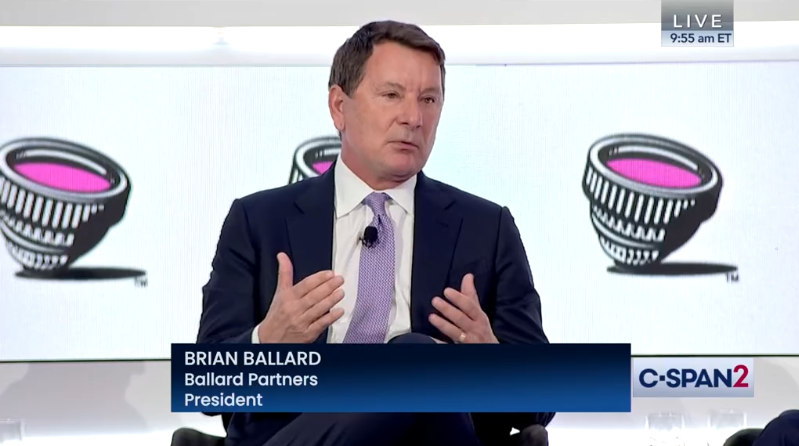
Established in Florida in 1998 as a state-level firm, Ballard Partners has only had a federal presence for less than a decade. The firm, led by Trump ally Brian Ballard, signed its first federal lobbying client in 2017, during the first year of Trump’s first presidential term. It reported about $9.8 million in federal revenue that year, according to federal lobbying data analyzed by OpenSecrets, a nonprofit that tracks money in politics.

Business quickly expanded as corporate and special interests including airlines and weight-loss drug companies relied on Ballard Partners to score big policy wins in Trump’s Washington.
After a dip during President Joe Biden’s administration, business boomed after Trump won the 2024 election: Ballard brought in a record $88 million in federal lobbying revenue last year, according to OpenSecrets data, up from more than $19 million in 2024 — an increase of more than 355%.
Ballard has surpassed $98 million in federal lobbying revenue through the first nine months of 2026, according to federal records. BGR Group takes the No. 2 spot with $65.2 million in federal lobbying revenue, followed by Brownstein Hyatt Farber Schreck, which reported receiving $64.5 million through the same period.
Sayfie noted that Ballard Partners has built a bipartisan team of lobbyists that includes former lawmakers, congressional staff and officials.
Among them: former Rep. Robert Wexler (D-Florida), Rep. Jeff Miller (R-Florida) and former Trump administration official Amaryllis Fox Kennedy, daughter-in-law of Health Secretary Robert F. Kennedy Jr.
Brian Ballard himself is the busiest lobbyist in Washington — at least on paper. Ballard is listed as a lobbyist working on more than 300 accounts from July through September, according to The Sun’s analysis of federal lobbying disclosures.
Whether that remains the case in January when Democrats assume control of the House and Senate is unclear.
Former Trump official Calley Means went on Joe Rogan’s podcast over the weekend and generated a series of provocative headlines by stating that Ballard Partners “entirely dictated” White House policy.
“The secret’s out in D.C.: You have to pay Ballard to get something done, and they’ve generated more revenue than any other firm in American history,” said Means, who until recently served as a special adviser to the Department of Health and Human Services.
In a rare statement issued Sunday, Brian Ballard pushed back on Means’ characterization of his company’s actions and wrote, “our firm’s interactions with Susie Wiles as Chief of Staff have been limited and been the exception.”
“For most of our clients, our work does not involve the White House,” Ballard wrote.
And Sayfie told The Sun, “Our business has never depended on any one person in government.”
The White House is the second-most-cited target of Ballard Partners lobbying, after the House and before the Senate, according to an OpenSecrets analysis of the firm’s federal lobbying disclosures covering the first nine months of 2026.
In some cases, it appears clients were able to quickly achieve the objectives they paid Ballard Partners to address.
The global medical manufacturing giant Tecomet, for example, hired Ballard Partners in March to lobby on “acquisition matters.” Tecomet had announced in January plans to merge with Orchid, an orthopedics manufacturing company.
The merger completed in May, one month after Ballard and Tecomet parted ways in April, just 30 days after the firm started lobbying for the company. Ballard and Tecomet parted ways after just 30 days, in April, and the merger completed in May. Ballard reported receiving $100,000 during the first three months of this year, according to federal lobbying records.
In other cases, Ballard’s clients don’t appear to have achieved their goal.
The cannabis company Stiiizy, for example, hired Ballard Partners in February to lobby for “relief for an exclusion order following a patent infringement action,” according to the firm’s registration.
Just weeks before, the U.S. International Trade Commission had issued a cease-and-desist order to Stiiizy after finding the company had imported vapes that infringed upon patents held by another domestic manufacturer. And in September, Customs and Border Patrol determined Stiiizy’s redesigned vapes still fell under the import ban, according to Law360.
The Sun reached out to more than a dozen former clients who dropped Ballard Partners during the past year, including Tecomet and Stiiizy. None responded to requests for comment.