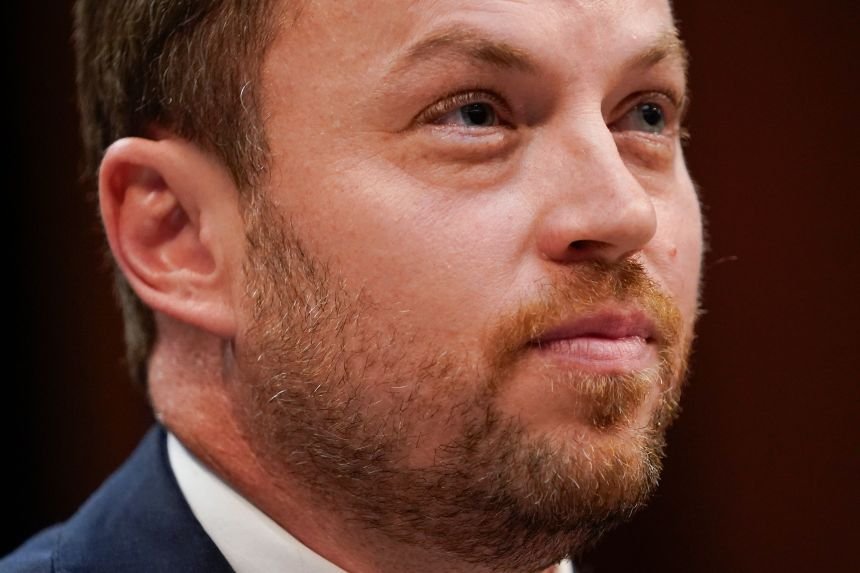
When he left the White House after the 2020 election, immigration firebrand Stephen Miller founded an upstart legal group to take his war against the left to the courts. His outsider firm, America First Legal, sued aggressively to overturn liberal initiatives in his quest to create MAGA’s answer to the ACLU.
With Miller now back in the White House, first as a top adviser to President Trump and now as his chief of staff, AFL isn’t an outsider any longer.
A CNN investigation has found an extraordinary overlap between leadership and policy from Trump’s administration and the group founded by Miller – a quiet collaboration that has made an outsized mark on American institutions and federal policies.
In the process, AFL has pushed the ethical boundaries of the ties between an advocacy group and the White House.
As AFL’s top leaders have taken senior government jobs under Trump or worked as the president’s personal attorney, the administration has acted as a friendly partner in more than a dozen AFL lawsuits – roughly 40% of AFL’s caseload in Trump’s second term. The administration has filed supportive documents in cases brought by AFL, settled AFL cases against federal agencies, and granted requests for probes into private groups at AFL’s request.
In one extraordinary case, an AFL attorney who filed a lawsuit against the State Department later joined the agency as its top attorney before it resolved the case favorably for AFL. In another, the Department of Justice reached a settlement with AFL and Texas’s attorney general on the very same day their complaint was filed in court.

The litigation coordination between AFL and the Trump administration has led to significant legal outcomes. These include the cancellation of aid to the Palestinian Authority, reversal of gender identity policies at school districts around the country, the stripping away of corporate DEI rules and the successful legal defense of sheriffs who helped Immigration and Customs Enforcement.
While many administrations have had friendly relationships with advocacy groups, the overlap between AFL and Trump’s White House far exceeds the norm, some legal and ethics experts said.
“The extent of the overlap between this organization and the federal government’s position seems significantly higher” than with other advocacy groups, said Leah Litman, a professor of law at the University of Michigan Law School.
In a statement to CNN, an AFL spokesperson said that shared politics explain the White House’s collaborative approach to many of its cases – “not because of who at AFL was involved.” The spokesperson added that it stands to reason that “an America First administration has similar priorities and policies to an organization called America First Legal.”
AFL did not respond to detailed questions for this story, but said that its employees followed all rules requiring staffers and former staffers to recuse from cases they previously worked on and to avoid lobbying agencies they’ve recently left. The spokesperson said “everyone involved understood their ethical and legal obligations and complied with them.”
CNN’s investigation found no evidence that those regulations regarding official recusals or lobbying were broken.
Trump has also ditched an ethics pledge nearly every president enforced for the past 30 years, which bans banning appointees from conflicts of interest. And he rescinded a Biden executive order that could have further restricted the actions of AFL’s leaders.
Miller did not respond to requests for comment. A White House spokeswoman said Miller is no longer affiliated with AFL.
“The real story is the multibillion-dollar network of leftist NGOs, like the ACLU, that have waged unrelenting lawfare against the Trump Administration,” said Lauren Bis. “It’s not newsworthy that ‘America First Legal’ is providing pro bono support to America First causes and clients.”

Weeks after President Joe Biden took office, Miller, who is not a lawyer, launched AFL, calling it “the long-awaited answer to the ACLU” – a MAGA advocacy group that explicitly aimed to use the courts to advance Trump’s priorities while he was out of office.
Miller co-founded the group with Gene Hamilton, another hardliner who had helped craft the first Trump administration’s family separation policy. The group started with little money or staff, but a board of well-known Trump acolytes.
AFL started slowly, raising $6.3 million in donations in its first year, and filing about a dozen cases. But it soon notched impressive wins against Biden’s White House, including halting a policy that put White restaurant owners at the back of the line for pandemic relief and killing a loan forgiveness program that excluded White farmers.
AFL built on that early success by taking on school districts, state governments, corporations and universities on culture war issues like gender identity and DEI policies.
Many of those challenges failed. AFL lost a slew of cases in 2022, including many over transgender policies in schools.
But AFL’s fundraising soared, driven by Miller’s high-profile advocacy. In 2024, it pulled in $32 million, according to the latest publicly available tax records. That catapulted the firm past the annual revenues for most other rightwing legal advocacy groups.
The group continued to be a thorn in the Biden administration’s side through the end of his term – suing over the federal vaccine mandate, Hunter Biden’s recovered laptop, and the expansion of Title IX protections to include “gender identity.”
When Trump won a second term, though, both Miller and the group he co-founded quickly shifted from nettlesome DC outsiders to ultimate insiders.

On Inauguration Day last year, Miller left AFL to become Trump’s deputy chief of staff, and the most influential staffer in organizing Trump’s mass deportation plans. Hamilton, then AFL’s executive director, followed suit, taking a job as deputy White House counsel.
This kicked off a striking period of overlap between the small firm’s leadership and the White House. At the same time, Trump skipped an ethics pledge signed by every president since George W. Bush that generally required federal employees to promise to avoid conflicts of interest and to refrain from post-government employment connected to their work. He also rescinded former President Biden’s executive order strengthening bans on government employees working on matters related to previous or future private-sector work.
Other top AFL leaders soon followed Miller, including Hamilton’s No. 2 at AFL, Reed Rubinstein, who became the top lawyer in the State Department. AFL vice president Daniel Epstein stayed at AFL – but also signed on as a personal attorney to Trump. A number of lower-ranking AFL staffers joined the administration, including at least two attorneys who took DOJ jobs.
In one case, an AFL leader took a job in the Trump administration while a lawsuit he’d filed was still ongoing against the very agency he was joining as its top attorney.
When Rubinstein jumped to the State Department, the agency was still battling a case he had filed more than two years earlier at AFL, seeking to block humanitarian funding that could benefit the Palestinian Authority. Less than a year later, the State Department gave in. The agency agreed to abide by a 2018 law signed by Trump to cut financial aid to the West Bank and Gaza that benefited the Palestinian Authority until it stopped sending payments to families of Palestinians killed, injured or imprisoned by Israeli authorities, including those who carried out acts of terror.
A State Department spokesman told CNN that Rubinstein formally recused himself from the case.
AFL and the White House appeared to cooperate on at least four cases while Hamilton worked as a top attorney under Trump, CNN found.
Hamilton’s specific duties as deputy White House counsel aren’t public. But in the private sector, he worked deeply on DOJ-related projects, including authoring the DOJ chapter for Project 2025, the conservative blueprint for a second Trump term published by the Heritage Foundation.
During Hamilton’s White House tenure, the administration launched probes into five school districts that AFL had lodged complaints about, supported sheriffs defended by AFL for working with ICE, and opened a federal investigation into a California law about gender identity school policies as AFL sued over the same policy.
As DOJ also cracked down on companies with DEI policies getting federal funds, the agency’s first target was IBM – a company Hamilton’s firm had twice sued during the Biden administration for anti-White discrimination.
Hamilton left his White House position after five months, returning to AFL as its president in June 2025. Shortly after his return, AFL brought a third suit challenging DEI policies at IBM; Hamilton was quoted in a Fox News story about the case. Less than a year later, the DOJ announced the penalty against IBM: $17 million for its “illegal DEI practices.”
Federal law barred Hamilton from seeking to influence the White House as AFL’s leader before a cooling-off period expired this summer, or to ever work on any matters at AFL that he directly worked on in the administration.
AFL said Hamilton followed all those rules in his official role at the White House – and since returning to the legal group.
But both AFL and Hamilton failed to address one key detail related to his White House job, CNN found.
Despite indicating in ethics documents that he ended his AFL job in January 2025, AFL’s DC corporate filings effectively continued to identify Hamilton holding a formal role. Its February 2024 filing listed Hamilton as the only “Authorized Person” and a January 2026 filing listed him as the nonprofit’s sole disclosed “beneficial owner.”
The filings are required every two years, but are supposed to be updated if there are changes in leadership, according to a spokesperson for the DC Department of Licensing and Consumer Protection. The spokesperson confirmed no other records were filed by AFL.
An AFL spokesperson said in a statement to CNN that the group believed it only had to file paperwork with DC every two years and that the titles listed on those forms did not correspond to his actual role with the group.
“Hamilton does not, nor did he, own America First Legal,” the spokesperson said. “Moreover, he had no formal agreement with America First Legal to return after his government service ended.”
Rubinstein, too, has now returned to AFL – as its senior vice president – after his yearlong stint in the Trump administration.

The firm has yet to file tax records showing which executives received compensation in 2025. In 2024, Hamilton earned more than $600,000 from AFL, according to tax records. Miller made more than $500,000 from AFL that same year.
Even one AFL leader who didn’t join the administration has helped Trump with some of his most contentious legal efforts. Epstein, in his role as Trump’s personal attorney, signed a settlement with the IRS that would have created a nearly $1.8 billion fund to compensate those Trump said were unfairly targeted by the government.
Critics pounced on the fund as a way for Trump to pay off his allies, and it was scuttled under Republican pressure. Epstein, meanwhile, was sanctioned by a federal judge for his role in the settlement, which the judge found was collusive and “had no viable basis in law or fact.”
He’s barred now for a year from appearing in federal court in the Southern District of Florida, where he lives and serves as interim dean of the Florida International University College of Law. A federal appeals court recently denied his request to pause the sanction.
Because Epstein works for Trump personally, and not in the Trump White House, he is not subject to the same ethics rules by which Hamilton, Rubinstein and Miller are bound.
Epstein, who left AFL in August according to his LinkedIn account, did not respond to requests to comment for this story.

Soon after Trump’s second term began, AFL, which employs about 10 staff attorneys compared to the ACLU’s 500, began punching far above its weight – with help from the administration.
On February 3, 2025, AFL sent a complaint to the Department of Education about five Virginia school districts that allowed students to use bathrooms and locker rooms consistent with their gender identity. Just 11 days later, the department opened a probe – an unusually swift response, experts said. It concluded that all five districts had indeed violated the federal civil rights law.
When AFL sued one of those districts over similar policies, the DOJ attempted to file a motion of support, though it was blocked by a judge. The case was settled in February.
More significant victories soon followed – often with an assist from the White House.
In the first half of 2025, four large organizations targeted by AFL for DEI policies – IBM, CBS Broadcasting, Texas Tech and Ohio Northern University – capitulated after prolonged legal fights as they faced new federal pressure to drop the rules.
In Texas in June, the AFL teamed up with Texas Attorney General Ken Paxton to challenge a Biden-era rule that allowed immigration judges to close deportation cases for undocumented immigrants who were eligible to apply for legal status – a suit the DOJ had invited via an internal memo, obtained by CNN, that said it would not defend the rule in court.
The DOJ then agreed to a consent judgment on the same day the suit was filed. AFL swiftly celebrated the win, saying it killed an illegal “backdoor amnesty program.”
Legal observers said the same-day suit was not a typical use of the courts.
“That’s not really litigation,” said Ben Wizner, a deputy legal director at the ACLU. “There’s no case or controversy.”
Attorneys representing the cities of Baltimore, Columbus, Ohio, and New Haven, Connecticut, also objected, calling it collusive and saying it would trigger a rise in deportations of people who pay city taxes. “Texas did not even have to serve its lawsuit,” the attorneys said in their emergency motion to intervene. “DOJ was ready and waiting.”
The DOJ’s press office did not respond to CNN’s questions about the case.
AFL has had several other notable wins with aid from a Supreme Court stocked with Trump’s picks.
After a 6-3 conservative majority Supreme Court ruling this spring revived challenges against laws forbidding schools from disclosing students’ sexual orientation or gender identities to parents, AFL won appeals in two cases against Democratic states.
And this summer, the Supreme Court agreed to hear a case that AFL had lost twice in the lower courts seeking to challenge a Washington law that could allow minors to receive gender identity care without their parents’ consent.

The Trump administration didn’t invent the concept of working with sympathetic legal advocacy groups to achieve its own policy goals, experts told CNN.
Both the Obama and Biden White Houses settled with environmental groups and supported cases brought by left-leaning groups. However, both also aggressively fought at-times friendly groups like the ACLU or Sierra Club when they challenged administration policies.
Other right-leaning legal advocacy groups have actually taken on Trump. Last year, New Civil Liberties Alliance and the Liberty Justice Center separately sued the administration over tariffs, with the Supreme Court ruling in their favor.
AFL rarely if ever genuinely breaks ranks with the Trump administration.
But it is the Trump administration’s softening of ethics rules – and the AFL’s close ties to the administration – that most concerns experts and watchdog groups.
Cynthia Brown, a senior ethics counsel at the Citizens for Responsibility and Ethics in Washington, said all Americans should be concerned if the new norm is for outside groups and presidential administrations to operate as partners in lock step using the full weight of government against organizations “on their bad side.”
“It’s majority rule with rights for the minority,” she said, referring to a core tenet of American democracy. “It’s important to make sure that we’re treating all citizens fairly and keeping the justice system’s integrity, so that we can all trust that it’s working in our interest regardless of whether the leadership is who we voted for.”