Key Points
-
The S&P 500 and Nasdaq have soared for nearly four years, mostly due to enthusiasm around artificial intelligence (AI).
-
Rising stock prices are pushing valuations to historically high levels, and history suggests this may not be sustainable.
-
Even if a stock market crash arrives, Warren Buffett would suggest buying an S&P 500 index fund.
- 10 stocks we like better than Vanguard S&P 500 ETF ›
After a brutal 2022, the S&P 500 (SNPINDEX: ^GSPC) surged 24% in 2023, 23% in 2024, and roughly 16% in 2025. The technology-heavy Nasdaq Composite (NASDAQINDEX: ^IXIC) performed even better, gaining 43%, 29%, and 20%, respectively. Both indexes have climbed in 2026, extending a rally fueled mostly by enthusiasm surrounding artificial intelligence (AI).
There’s a catch to all of this. A good portion of the market’s appreciation is concentrated in a relatively small group of technology companies. This raises an uncomfortable question: Are investors witnessing a sustainable technological revolution or is another stock market bubble brewing?
Missed AI’s “Act 1”? Act 2 Could Be 15x Bigger. Most investors think they missed the AI boat because they didn’t buy Nvidia in 2005. But according to our analysts, we’re only at the end of “Act 1″—the R&D phase. “Act 2” is the global rollout. Continue »
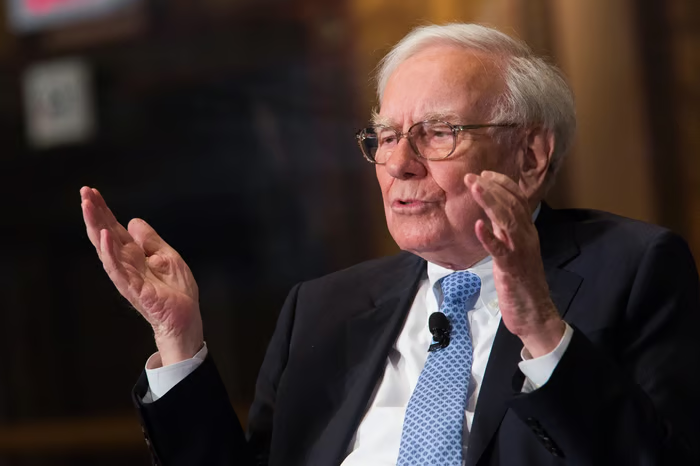
Thankfully, Warren Buffett spent his career explaining how everyday investors can navigate situations exactly like this.
Image source: Getty Images.
AI stocks are pushing valuations to historical levels
The so-called “Ten Titans” — Nvidia, Apple, Alphabet, Microsoft, Amazon, Tesla, Meta Platforms, Broadcom, Oracle, and Netflix — are a group of megacap technology and AI-related companies. Taken together, this cohort is increasingly becoming an influential force in the S&P 500. Although this basket of stocks has driven spectacular returns, it also means weakness among a handful of giant companies could weigh heavily on the broader market during a downturn.
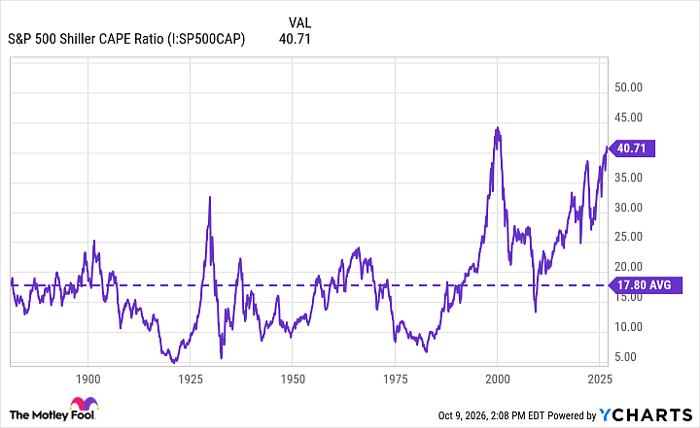
Meanwhile, the Shiller CAPE ratio is flashing a warning investors should not ignore. CAPE, short for cyclically adjusted price-to-earnings, measures the S&P 500’s price relative to its average inflation-adjusted earnings over the last 10 years. Unlike conventional price-to-earnings (P/E) ratios, CAPE readings smooth out short-term fluctuations in profitability.
S&P 500 Shiller CAPE Ratio data by YCharts.
Historically, the CAPE ratio averaged around 17. Today, CAPE readings hover around 41, a level approached or exceeded in only a handful of periods, most notably during the dot-com bubble. Elevated CAPE readings do not guarantee a stock market crash is imminent. However, they do suggest investors are paying historically higher prices for earnings, potentially limiting future returns.
What would Warren Buffett say about the stock market right now?
During his tenure as CEO of Berkshire Hathaway, Buffett spent countless hours warning investors against confusing rising stock prices with attractive valuations. The Oracle of Omaha, as he is also known, famously observed, “Price is what you pay; value is what you get.”
Buffett also recognized that most investors shouldn’t spend too much time trying to determine which specific stocks are overpriced or when the next correction will arrive. Instead, he favors a much simpler solution: owning a low-cost S&P 500 index fund. In Berkshire Hathaway’s 2013 shareholder letter, Buffett detailed that his instructions for his wife’s trust called for 90% of the money to be invested in a low-cost S&P 500 index fund, specifically suggesting Vanguard.
Buffett actually put that philosophy into practice. In late 2019, Berkshire purchased 43,000 shares of the Vanguard S&P 500 ETF (NYSEMKT: VOO). The investment conglomerate maintained that position for roughly five years — through the pandemic, the 2022 bear market, and the beginning of the AI boom. With an annual expense ratio of just 0.03%, investors pay just $3 for every $10,000 invested.
Why VOO wins even if AI crashes
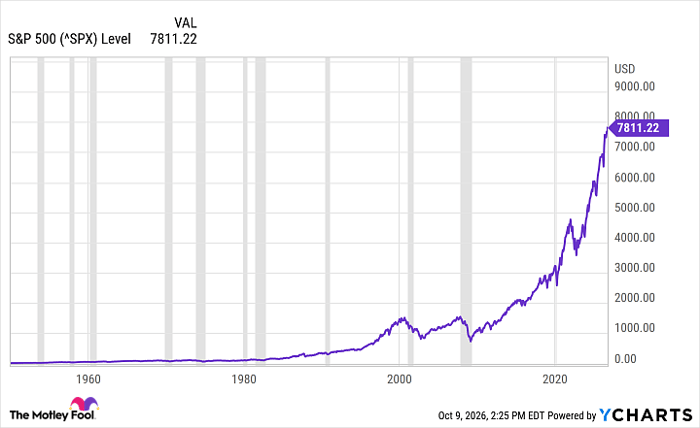
What makes Buffett’s philosophy so valuable is understanding the S&P 500 has survived the dot-com collapse, the 2008 financial crisis, the COVID-19 crash, and countless recessions — all of which are illustrated below by the grey-shaded columns. Despite these setbacks, the S&P 500 has generated a 10% annualized return between 1928 and 2025.
This doesn’t mean the VOO ETF is immune to an AI bubble bursting event. But unlike investing in one specific AI stock, owning the Vanguard S&P 500 ETF diversifies your capital across hundreds of businesses with different products, customer demographics, and growth drivers. It also provides exposure to established companies with experienced management teams, strong balance sheets, and the ability to adapt to changing economic conditions.
AI enthusiasm is pushing valuations into historically expensive territory, making a correction entirely possible. Even so, Buffett makes it clear that timing the next bubble matters far less than owning diversified, high-quality businesses for decades. For investors with a long-term time horizon, the Vanguard S&P 500 ETF remains a compelling investment regardless of what happens next with AI.
Should you buy stock in Vanguard S&P 500 ETF right now?
Before you buy stock in Vanguard S&P 500 ETF, consider this:
The Motley Fool Stock Advisor analyst team just identified what they believe are the 10 best stocks for investors to buy now… and Vanguard S&P 500 ETF wasn’t one of them. The 10 stocks that made the cut could produce monster returns in the coming years.
Consider when Netflix made this list on December 17, 2004… if you invested $1,000 at the time of our recommendation, you’d have $379,123!* Or when Nvidia made this list on April 15, 2005… if you invested $1,000 at the time of our recommendation, you’d have $1,408,822!*
Now, it’s worth noting Stock Advisor’s total average return is 950% — a market-crushing outperformance compared to 215% for the S&P 500. Don’t miss the latest top 10 list, available with Stock Advisor, and join an investing community built by individual investors for individual investors.
*Stock Advisor returns as of October 12, 2026.
Adam Spatacco has positions in Alphabet, Amazon, Microsoft, Nvidia, and Tesla. The Motley Fool has positions in and recommends Alphabet, Amazon, Apple, Berkshire Hathaway, Broadcom, Meta Platforms, Microsoft, Netflix, Nvidia, Oracle, Tesla, and Vanguard S&P 500 ETF. The Motley Fool has a disclosure policy.