Key Points
-
Cathie Wood of Ark Invest has been a longtime supporter of Elon Musk and Tesla.
-
Ark forecasts Tesla stock to reach $5,000 by 2031, implying more than 1,200% upside.
-
Ark’s model relies heavily on Tesla’s artificial intelligence (AI) businesses, Robotaxi and Optimus.
- These 10 stocks could mint the next wave of millionaires ›
Tesla (NASDAQ: TSLA) has always been a polarizing stock. Supporters buy into Elon Musk’s vision of building an autonomous future, while skeptics question whether the company’s ambitions are too lofty and merely supported by a hype narrative.
For years, one of the most staunch Tesla optimists has been Cathie Wood, CEO of Ark Invest. Ark just released an updated valuation model projecting Tesla shares could reach $5,000 by 2031 in its upside scenario. With Tesla stock currently trading around $375, that implies roughly 1,233% upside. Such gains could turn even a relatively modest investment into generational wealth.
Missed Nvidia in 2009? This Rare Signal Is Flashing Again. In 2009, a “Double Down” signal flashed for a little-known chipmaker called Nvidia. For the first time in years, that same “Total Conviction” signal is flashing for a company 1/100th the size of Nvidia. Continue »
Let’s explore what needs to happen for Tesla to deliver those returns. From there, I’ll make a call on whether Tesla stock is a multibagger in the making or a risk opportunity.
Image source: Getty Images.
Tesla could become a $20 trillion company
Right off the bat, investors should understand that Ark’s forecast is not aligned with traditional Wall Street price targets. Even in the downside scenario, Wood projects Tesla stock to reach $3,300 per share, underscoring how optimistic the firm’s underlying expectations are.
In the bull case, Ark estimates Tesla could reach a $20.4 trillion market capitalization. The financial assumptions behind this include the company generating $1.62 trillion in annual revenue and operating at a 65% earnings before interest, taxes, depreciation, and amortization (EBITDA) margin.
For perspective, Tesla generated $95 billion in revenue during 2025 with a 15.4% adjusted EBITDA margin. Reaching Ark’s projection would require the company’s annual sales to increase roughly 17x in five years.
Interestingly, sales of electric vehicles (EVs) are not the biggest tailwind for Tesla’s growth heading into the next decade. Instead, Wood’s forecast depends heavily on Tesla successfully commercializing autonomous transportation (Robotaxi) and humanoid robotics (Optimus).
How big can Robotaxi and Optimus become?
Ark estimates that Tesla’s Robotaxi business will account for 80% of its enterprise value by 2031. For reference, Tesla launched the Robotaxi service in Austin, Texas, in June 2025 and has since expanded into additional cities. Ark’s bigger thesis is that the company can leverage its autonomous driving technology, Cybercab vehicles, and manufacturing expertise to operate a global transportation network.
In the upside case, Ark’s model assumes there will be 10 million Robotaxis operating by 2031, collectively generating $900 billion in annual ride-hailing revenue. The firm also includes 1.2 million external Optimus robots generating $254 billion in revenue.
The idea here is that Tesla can create a robot-as-a-service model, allowing businesses to pay for robotic labor rather than simply purchasing the machines outright. This could create a high-margin, recurring-revenue stream as businesses deploy humanoid robots in factories, warehouses, retail operations, and more.
Additionally, Ark forecasts $193 billion in energy storage sales, while traditional automotive sales remain a fixture. The upside case assumes 11.7 million vehicles sold annually.
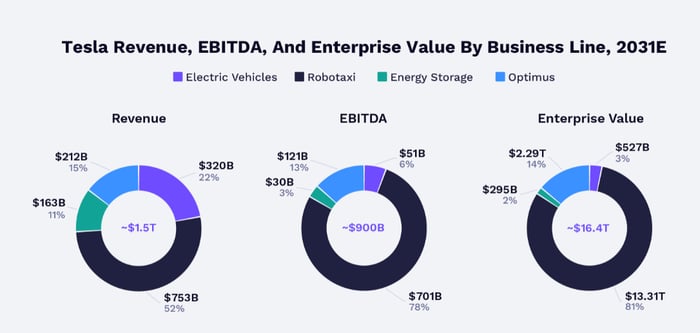
Image source: Ark Invest. Base case scenario.
Reaching these figures requires enormous investments in infrastructure. Ark estimates Tesla’s cumulative AI capital expenditure (capex) budget could reach $225 billion by 2031, supporting the compute resources needed to develop autonomous vehicles and robotics.
Interestingly, Ark’s analysis doesn’t include potential contributions from Tesla Semi, additional Full Self-Driving (FSD) licensing opportunities, and a hypothetical Tesla-Space Exploration Technologies merger. By no means, however, does their exclusion make Ark’s forecast conservative.
Should you buy Tesla stock now?
In reality, Tesla’s Robotaxi operation is small compared with Ark’s envisioned fleet. Meanwhile, Optimus remains a speculative technology, with commercial adoption heavily dependent on breakthroughs in reliability, safety, and unit economics.
Of course, Tesla stock already commands a substantial valuation on both a price-to-earnings (P/E) and price-to-sales (P/S) basis relative to its competitors and the existing business today. In other words, investors are already paying a premium for opportunities that might take years to mature or never pan out at all.
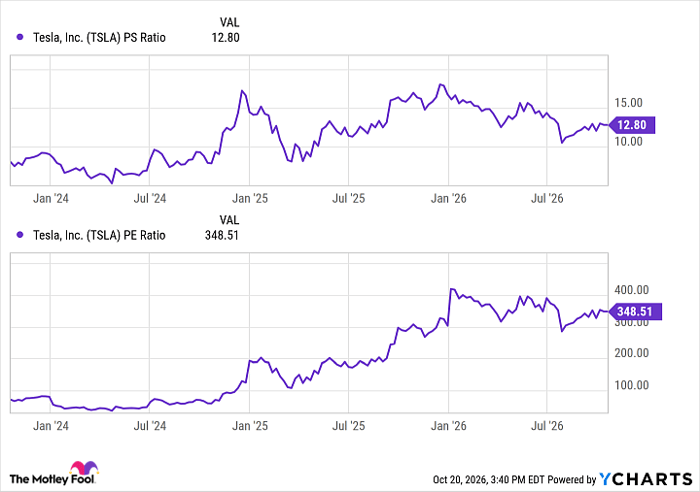
TSLA PS Ratio data by YCharts
While Cathie Wood’s new Tesla price target illustrates an enormous opportunity, it also depends on aggressive assumptions about adoption rates, future profitability, and management’s execution. Against this backdrop, I see Tesla stock as a speculative long-term investment for investors who share Wood’s confidence in autonomous technology and Elon Musk’s vision of creating an AI-enabled platform centered on cars, robots, and energy.
I would not buy Tesla stock simply because one analyst is calling for more than 1,200% upside. For most investors, it may be best to sit on the sidelines until stronger evidence around the scalability of Robotaxis and Optimus becomes clear.
We just issued ‘double down’ alerts on 3 stocks — find out if Tesla made our list
Ever feel like you missed the boat in buying the most successful stocks? Then you’ll want to hear this.
On rare occasions, our expert team of analysts issues a “Double Down” stock recommendation for companies that they think are about to pop. If you’re worried you’ve already missed your chance to invest, now is the best time to buy before it’s too late. And the numbers speak for themselves:
- Nvidia: if you invested $1,000 when we doubled down in 2009, you’d have $562,777!*
- Apple: if you invested $1,000 when we doubled down in 2008, you’d have $64,762!*
- Netflix: if you invested $1,000 when we doubled down in 2004, you’d have $370,440!*
Right now, we’re issuing “Double Down” alerts for three incredible companies, available when you join Stock Advisor, and there may not be another chance like this anytime soon.
*Stock Advisor returns as of October 21, 2026.
Adam Spatacco has positions in Tesla. The Motley Fool has positions in and recommends Tesla. The Motley Fool has a disclosure policy.