National and Labour’s leaders say they’re “open” to looking at installing safety cameras at intersections, as the AA calls for enhanced measures to detect drivers using their mobile phones while behind the wheel.
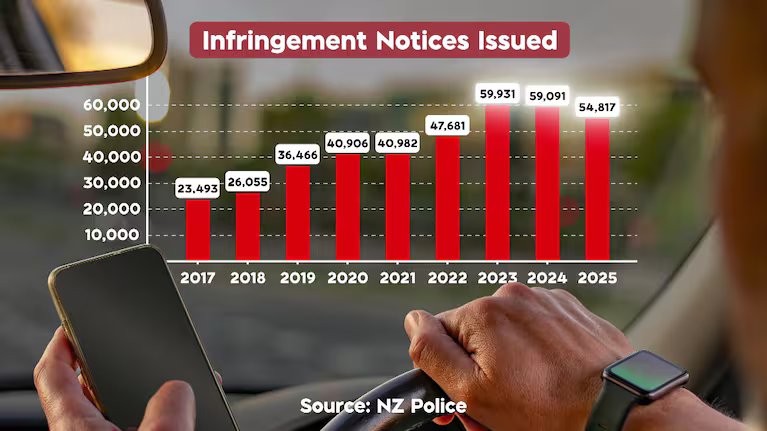
Police figures show offences for hand-held phone use while driving is stubbornly high, despite the fine increasing from $80 to $150 in 2021. Since 2023 police have issued infringement notices for more than 50,000 people each year.

AA’s Dylan Thomsen said the use of camera technology is widespread in Australia and has already been trialled successfully in New Zealand too.
“Anyone who drives around and looks can see; we have a major issue in New Zealand with people not being able to leave their phones alone. Texting while driving is the worst, it is the most common thing people are doing,” he said.
He said it’s time people had a “bit of a nudge” to the leave the phone alone.
“We want them to bring in some portable cameras that can detect when people are on their phone. We think that’s a simple thing that most New Zealanders would welcome being on our roads.”

Thomsen said the current approach is simply not working.
“You can have really heavy penalties but if hardly anybody gets caught, it doesn’t really have much effect.”
A recent AA survey of 1000 people revealed one in five admitted to texting while driving in the previous four weeks, while one in 10 said they’d scrolled social media while behind the wheel.
Caroline Perry of advocacy group Brake agreed it was time cameras were used at intersections to crack down on offenders, and added fines needed to be increased too to line up with other countries.
“The (2021) increase in fines here was a step in the right direction, but it’s nowhere near as high as the penalties in other countries. For example, in Queensland and Western Australia their fines are over AU$1000 (NZ$1232), and in the UK it’s over £200 (NZ$469.40),” she said.

On the campaign trail on Monday, both major party leaders said they were “open” to exploring camera options.
Labour’s Chris Hipkins said roadside technology for detecting phone-use was “pretty common” in other countries, and he was open to doing more of that in New Zealand.
National’s Christopher Luxon said it was a “not an unreasonable idea”, and he’d be happy to look at options after the election.
The current advice from both the AA and police is to put phones on ‘do not disturb’ while driving.