The Dollar Extended Its Broad-Based Decline After Fed Chairman Warsh Disappointed Traders Hoping for a Hawkish Response to This Week’s Inflation Surprises
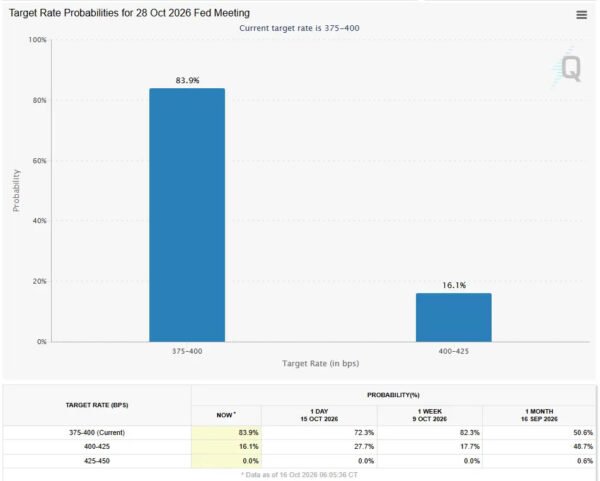
What’s happening: The Dollar extended its broad-based decline on Friday as Federal Reserve Chairman Kevin Warsh offered no indication that another rate hike was becoming more urgent at the October 27–28 FOMC meeting, despite hotter-than-expected CPI and PPI reports. According to CME FedWatch, the probability of an October hike dropped from 27.7% to 16.1%, while the Dollar Index fell toward 101.69.
Why it matters: The Dollar has surrendered its entire CPI-driven surge and fallen below its pre-release level. Yet US equity futures stabilized and longer-term Treasury yields edged higher on Friday, so the selling looks tied to the disappearance of hopes for an October hawkish surprise rather than to the AI-related risk aversion of earlier sessions. The Dollar Index is now approaching 101.285 support.
Dollar extended its broad-based decline on Friday as Federal Reserve Chairman Kevin Warsh disappointed traders hoping for a stronger hawkish response to this week’s inflation surprises. Despite hotter-than-expected CPI and PPI reports, Warsh offered no indication that another rate hike was becoming more urgent at the October 27–28 FOMC meeting. October hike odds subsequently dropped from 27.7% to just 16.1%, while Dollar Index fell toward 101.69. The decline came even as US equity futures stabilized and longer-term Treasury yields edged higher, suggesting that Friday’s selling was no longer primarily driven by the AI-related risk aversion that dominated earlier sessions.
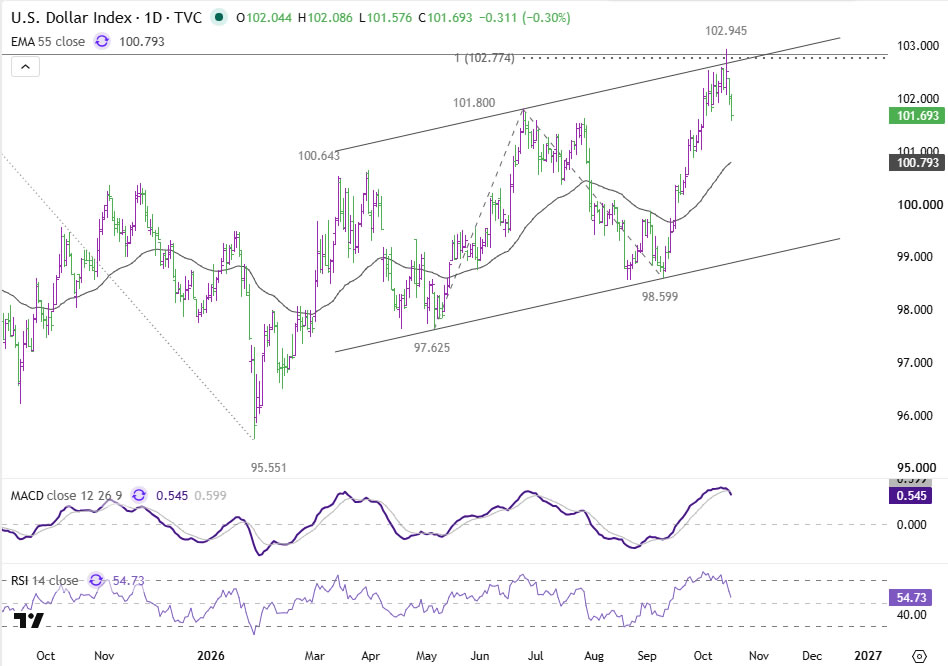
The latest weakness completes a remarkable reversal of Dollar’s initial response to inflation. Wednesday’s CPI surprise briefly pushed October hike expectations toward 44%, sending Dollar Index to 102.945. Thursday’s stronger-than-expected PPI failed to sustain that repricing, but traders anticipating an October increase still had Warsh’s Friday appearance as a potential source of hawkish confirmation. When that signal failed to materialize, the remaining hopes for immediate tightening appeared to fade further. Dollar has now surrendered its entire CPI-driven surge and fallen below its pre-release level, while October hike expectations have retreated to even lower levels than before the inflation report.
Warsh Fails to Revive October Hike Expectations
Warsh’s remarks were significant less for what he said than for the hawkish signal he did not deliver. Speaking alongside IMF Managing Director Kristalina Georgieva at the IMF–World Bank Annual Meetings in Bangkok on Friday, Warsh declined to prejudge the October 27–28 FOMC decision or indicate how he might vote at the remaining meetings this year. He reiterated that the Fed was moving away from routinely previewing upcoming policy decisions.
Warsh also referred to September’s 25bps rate increase, which lifted the federal funds target range to 3.75–4.00%, saying the central bank had “removed a dose of accommodation.” However, he offered no fresh indication that this week’s inflation surprises required another immediate adjustment.
The context matters. Wednesday’s hotter-than-expected CPI had briefly pushed October hike expectations toward 44%, helping Dollar Index surge toward 103.00. Thursday’s PPI then delivered another substantial surprise, with headline producer prices rising 1.3% mom and core PPI increasing 0.7%, both considerably above forecasts. Yet those releases failed to sustain the initial hawkish repricing. By Thursday, the implied probability of an October hike had already retreated to 27.7%. Warsh’s appearance therefore represented another opportunity for traders expecting imminent tightening to receive confirmation from the Fed chairman. Instead, he declined to provide it.
CME FedWatch: October FOMC Probabilities
| Timing | A 25bps hike | No change |
|---|---|---|
| A week earlier | 17.7% | 82.3% |
| Wednesday (after CPI) | Toward 44% | Below 55% |
| Thursday | 27.7% | 72.3% |
| Friday | 16.1% | 83.9% |
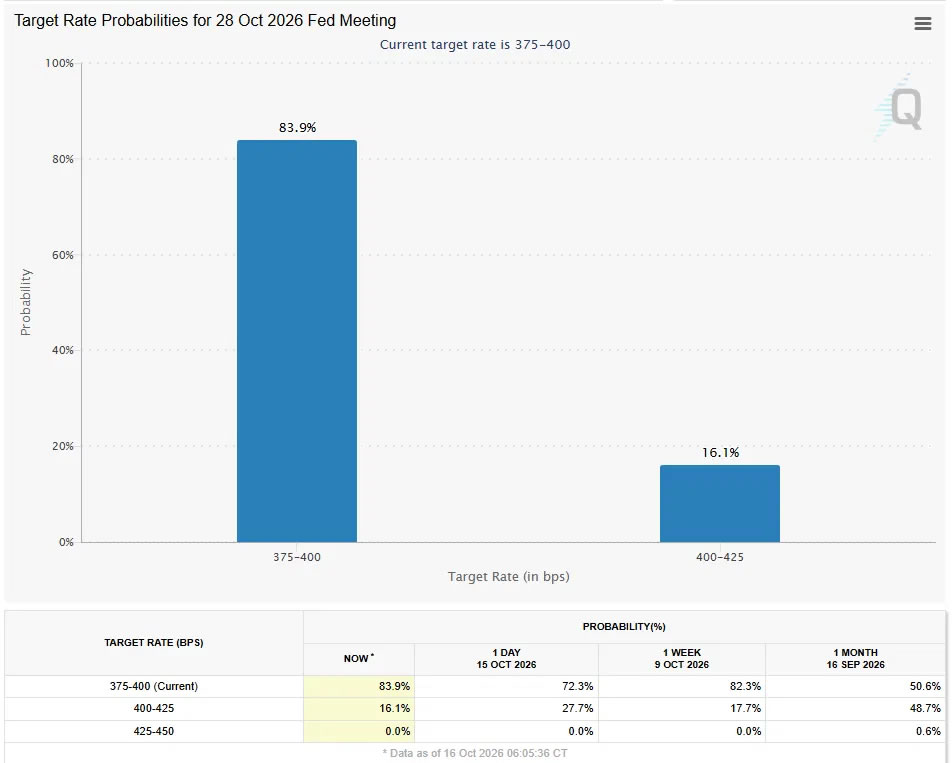
CME FedWatch now assigns an 83.9% probability to rates remaining at 3.75–4.00% in October, compared with 72.3% a day earlier. The probability of a 25bps hike has fallen from 27.7% to 16.1%, below the 17.7% recorded a week earlier. The inflation-driven October hike premium has therefore been completely reversed, and more.
That does not mean Warsh sounded dovish. He reiterated his commitment to price stability, described a synchronized global tightening environment and expressed confidence in US economic resilience. He also highlighted AI-related investment as a near-term source of demand and potential inflation pressure. Nevertheless, he did not escalate his inflation warning or suggest that October tightening had become more urgent. The subsequent decline in hike probabilities is consistent with disappointment among traders who had been looking for such a signal, although the pricing alone cannot establish their individual expectations or positioning.
Treasury Yields No Longer Explain the Dollar’s Decline
The retreat in October hike expectations explains why Dollar’s CPI-driven surge disappeared, but the broader Treasury market offers less support for attributing Friday’s additional weakness entirely to interest-rate repricing.
Friday’s Treasury Yields
- US 2-year yield: around 4.76%, broadly within the range established since late September
- US 10-year yield: around 5.11%
- US 30-year yield: near 5.45%
Wednesday’s inflation surprise produced a temporary spike in the two-year yield, but that move has largely reversed. The short end has not experienced a sustained decline comparable to Dollar Index’s retreat from 102.945, while longer-term Treasury yields have edged higher on Friday. With the two-year yield relatively steady, the latest movements indicate modest steepening of the Treasury curve. This contrasts with the earlier part of the week, when falling Treasury yields accompanied Dollar weakness.
The key distinction is between the timing of additional Fed tightening and the broader expectation that rates could still rise further. Markets have substantially reduced expectations for an October increase, but further tightening later in the year remains a possibility, with December still an important focus. Warsh’s remarks did little to resolve that broader outlook.
The latest Dollar decline therefore appears more pronounced than changes in Treasury yields alone would suggest. That is consistent with a wider reversal of the earlier bullish Dollar response, although direct evidence of currency positioning would be needed to establish how much of the selling reflects investors unwinding existing long positions.
Friday’s Selling Is Different From the AI Credit Scare
Another important distinction is that Friday’s Dollar weakness is not accompanied by the same risk-aversion pattern that dominated Wednesday and Thursday. Earlier in the week, concerns about financing the AI infrastructure investment boom triggered sharp declines in technology stocks. The selling spread across Asian markets, while defensive demand for Treasuries pushed yields lower. Dollar weakened alongside falling yields, suggesting that pressure on US financial assets was outweighing its traditional defensive appeal.
AI Credit Scare Days vs Friday
| Market | Wednesday and Thursday | Friday |
|---|---|---|
| US equities | Sharp declines in technology stocks, with selling spreading across Asian markets | Nasdaq futures down just 0.08%, S&P 500 futures up 0.15%, Dow futures up 0.09% |
| Treasury yields | Defensive demand pushed yields lower | Longer-term yields higher |
| Dollar | Weakened alongside falling yields | Weaker despite steadier equities and firmer long-term yields |
At the time of writing, Nasdaq futures are down just 0.08%, while S&P 500 futures are up 0.15% and Dow futures have gained 0.09%. These relatively small movements contrast with the sharp equity declines of the preceding sessions, and longer-term Treasury yields are also higher rather than lower. The combination of steadier equities and firmer long-term yields weakens the argument that another escalation in AI-related risk aversion is driving Friday’s additional Dollar losses.
The AI financing scare remains important to understanding the week’s broader market reversal. However, Friday’s immediate selling appears more closely associated with the disappearance of hopes for an October hawkish surprise, rather than a fresh deterioration in credit-market sentiment.
Dollar Index Approaches Critical 101.285 Support
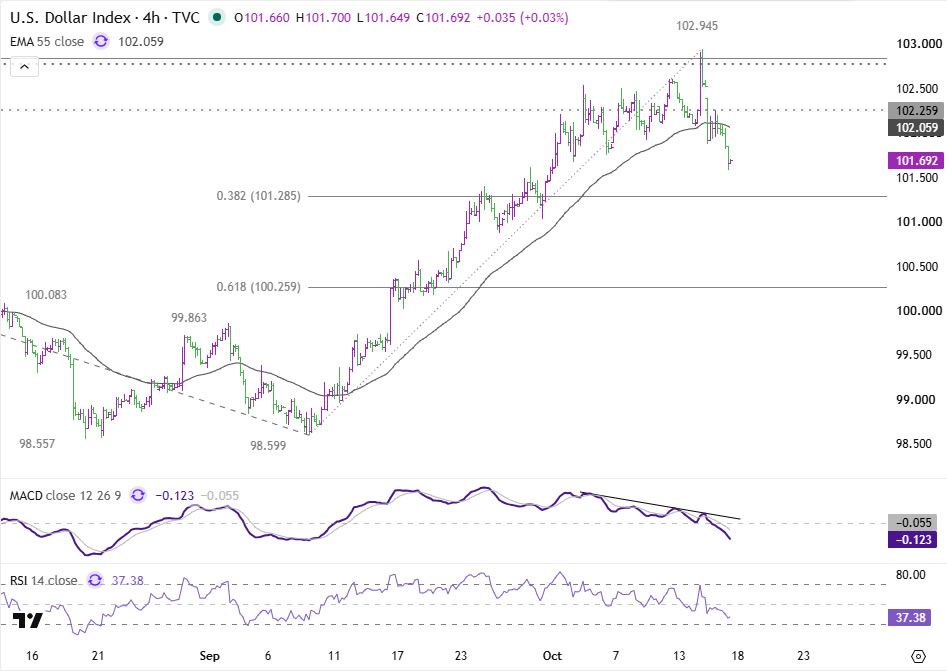
Dollar Index’s decline from 102.945 has established a short-term top, with further downside favored toward 101.285. That level represents the 38.2% retracement of the advance from 98.599 to 102.945. The four-hour chart shows Dollar Index trading below its 55-period EMA, currently around 102.059, while weakening MACD momentum supports the near-term bearish outlook. However, the decline has not yet decisively damaged the broader daily uptrend.
Dollar Index: Hold vs Break at 101.285
| Scenario | What it would suggest | Next reference levels |
|---|---|---|
| Strong support at 101.285 and a rebound | The current move is primarily a correction of the September–October advance | A break above 102.259 minor resistance would indicate the pullback from 102.945 has likely completed, reopening the way toward the 102.774–102.945 resistance region |
| Sustained break below 101.285 | The retreat is extending beyond a relatively shallow correction, raising the possibility of a larger reversal | Daily 55-day EMA around 100.793 |
A sustained break would increase the importance of subsequent Fed communication and Treasury yield developments in determining whether the earlier uptrend can resume.
October Hike Hopes Fade, but Dollar’s Larger Trend Faces a Separate Test
The immediate catalyst behind Friday’s Dollar weakness appears to be the failure of the final anticipated hawkish signal to materialize. Hot CPI initially revived October tightening expectations. Hot PPI kept inflation concerns elevated but failed to sustain the repricing. Warsh then declined to provide the additional urgency that traders anticipating an October hike might have hoped to hear. With October hike odds falling to 16.1%, Dollar has surrendered its inflation-driven gains and continued lower.
Yet the broader market picture is more complicated. Treasury yields have not fallen proportionately, longer-term yields are higher on Friday, and equities are no longer showing the same acute risk aversion seen earlier in the week.
The next important question is whether Dollar Index can find support at 101.285. A rebound from that level would keep the broader bullish structure intact, while a sustained breakdown would put the daily 55-day EMA near 100.79 in focus.
For now, the October Fed hike premium has disappeared. Whether that becomes a larger Dollar reversal will depend on what happens after the market finishes unwinding expectations of immediate tightening.
Related Coverage
The Fed and the Dollar
Sterling and the BoE
Eurozone and New Zealand Data
FAQ
Why did the Dollar fall on Friday after hot CPI and PPI reports?
Fed Chairman Kevin Warsh offered no indication that another rate hike was becoming more urgent at the October 27–28 FOMC meeting, disappointing traders hoping for a hawkish signal. CME FedWatch hike odds fell from 27.7% to 16.1%, and the Dollar Index fell toward 101.69, having surrendered its entire CPI-driven surge and fallen below its pre-release level.
Is the Dollar’s decline linked to the AI credit scare?
Not primarily. Earlier in the week, AI financing concerns drove sharp tech declines and defensive Treasury demand. On Friday, Nasdaq futures were down just 0.08%, S&P 500 futures up 0.15% and longer-term Treasury yields higher. That weakens the argument that renewed AI-related risk aversion is behind Friday’s losses, which look closer to the fading of hopes for an October hawkish surprise.
What Dollar Index levels matter next?
The Dollar Index is approaching 101.285, the 38.2% retracement of the advance from 98.599 to 102.945. A rebound from there would suggest a correction within the broader uptrend, and a break above 102.259 would indicate the pullback has likely completed. A sustained break below 101.285 would put the daily 55-day EMA around 100.793 in focus.
Key Takeaways
- The Dollar extended its broad-based decline on Friday after Fed Chairman Warsh gave no sign that an October hike was becoming more urgent.
- CME FedWatch now shows a 16.1% chance of an October hike, down from 27.7% a day earlier, and an 83.9% chance rates stay at 3.75–4.00%.
- The Dollar Index has surrendered its entire CPI-driven surge from 102.945 and fallen below its pre-release level, toward 101.69.
- Warsh declined to prejudge the October 27–28 FOMC decision and said the Fed is moving away from routinely previewing policy decisions, though he did not sound dovish.
- The 2-year yield is steady near 4.76% while the 10-year (about 5.11%) and 30-year (about 5.45%) edged higher, pointing to modest curve steepening.
- Steadier equities (Nasdaq futures down 0.08%) and firmer long-term yields suggest Friday’s selling is not another leg of the AI credit scare.
- The Dollar Index is approaching 101.285 support: a rebound would keep the broader bullish structure intact, while a sustained break would shift focus to the daily 55-day EMA near 100.793.
What to Watch Next
The October 27–28 FOMC meeting is the next decision point, with hike odds now at 16.1%. Because Warsh said the Fed is moving away from previewing its decisions, markets may get fewer advance signals, and December remains an important focus for any further tightening.
Watch whether longer-term Treasury yields keep edging higher while the two-year yield holds near 4.76%, and whether equities stay steady, since either would help show if the Dollar’s weakness is a reversal of the CPI response or the start of a larger trend change.