On my first trip to France in the mid-2000s, the Musée des Arts Décoratifs (MAD) became my go-to destination in Paris for a fashion-museum fix. With each subsequent visit, the intellectualized fashion scene became more saturated, as maisons increasingly invested in their heritage with public-facing venues (Fondation Azzedine Alaïa, Musée Yves Saint Laurent Paris, and Galerie Dior), plus the opening of Palais Galliera’s permanent galleries. As far as I’m concerned, when it comes to fashion exhibitions, the more the merrier. But I remain loyal to my first love. For art and design lovers like myself, it’s hard to top MAD’s interdisciplinary approach—and, of course, that prime Rue de Rivoli address.
This fall, the museum’s self-contained fashion collection—the Musée de la Mode et du Textile (originally Musée des Arts de la Mode)—celebrates its 40th anniversary with an exhibition titled “Look: 40 Years of Fashion at the Museum,” open through April 4, 2027. While the museum’s central hall, the Nef (“nave”), pays homage to 40 of its 70-plus shows by spotlighting a look to represent each, the surrounding galleries invite visitors behind the scenes of an atelier and the museum itself.
“As the custodian of France’s National Fashion Collection, it was really important for us to show people their heritage, as well as the diversity of the collection,” Sophie Lemahieu, the museum’s curator of fashion and textile collections after 1947, told Harper’s Bazaar. Co-curating the exhibition with MAD director Bénédicte Gady, Lemahieu sought to convey the skills of the many professionals who made each garment a reality, as well as the museum workers who care for and prepare them for display.

The multilayered approach represents a consecration of fashion as art—a concept MAD’s Musée de la Mode et du Textile has been instrumental in transmitting since its inception, when such a notion was far from the prevailing opinion. “40 years ago, it was not obvious to have fashion in the museum, even in Paris. There were many curators and art historians who were extremely mad because all these floors could have been used to show Islamic art or other decorative art collections,” said Lemahieu. “It took time to legitimize fashion history as an art history field, but now every museum wants to have fashion exhibitions because they’ve seen how meaningful they can be. People identify with fashion because it’s part of our lives. We all wear clothes.”
For context, MAD was founded in 1864 and contained textiles and fashion prior to the official establishment of the Musée des Arts de la Mode. The decision to formalize its fashion collection was twofold: first, it marked the union of two monumental collections, the Union Centrale des Arts Décoratifs and the Union Française des Arts de la Costume. More broadly, during the 1980s, under President François Mitterrand, the French government began advocating for fashion as national cultural prestige, rather than a purely commercial entity (though it was undeniably one of the country’s leading exports). In 1982, the Louvre’s Cour Carrée courtyard became a designated venue for French ready-to-wear shows, making a powerful global statement. To quote Lemahieu, “Fashion became political.”

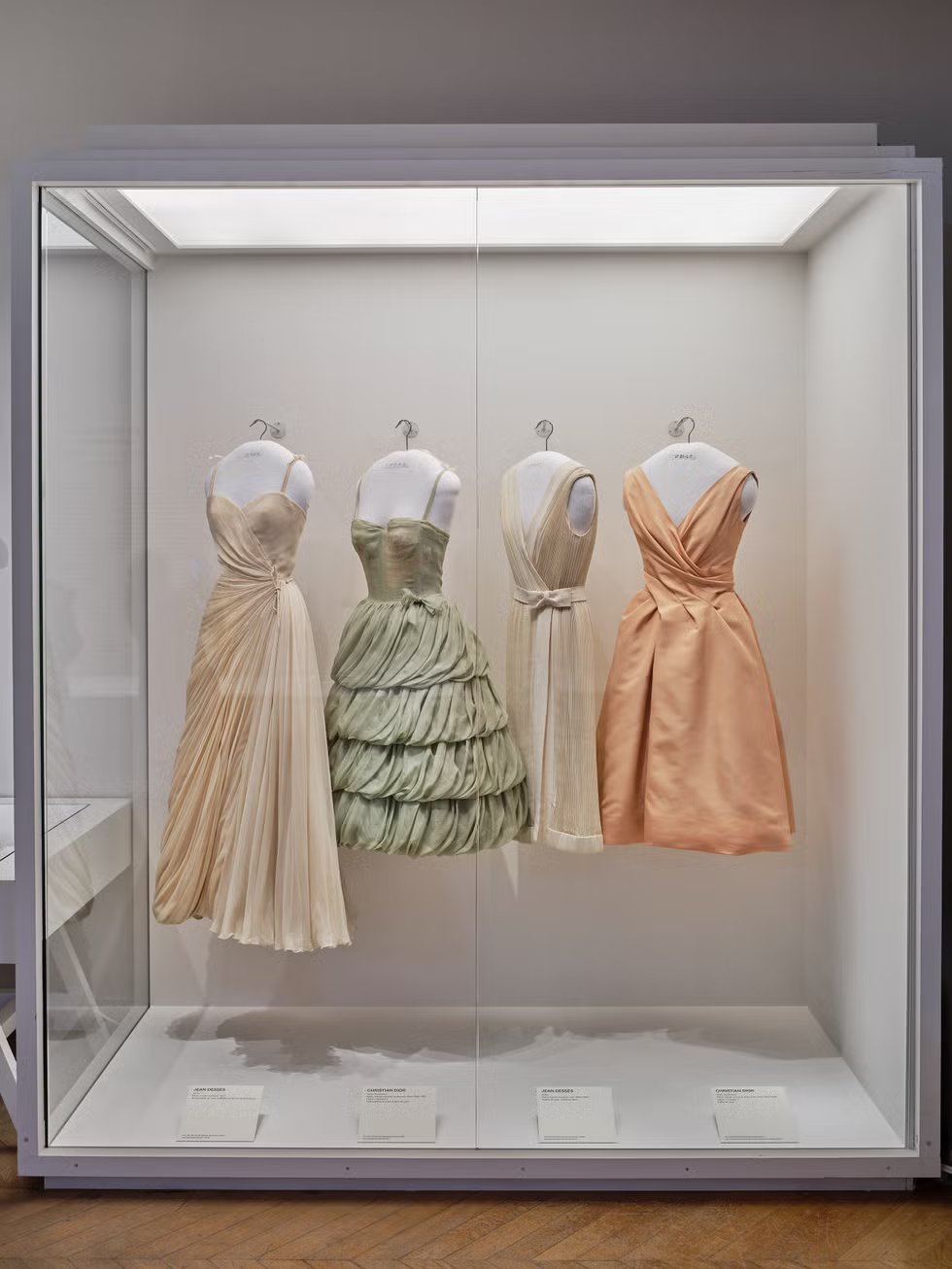
For the Musée des Arts de la Mode’s inaugural exhibition, “Moments de Mode” (1986)—which in “Look” is illustrated by a pristine 1760 robe à la française, the oldest garment in the show—MAD pulled out all the scenography stops. Working with theater professionals, curators presented an immersive history of fashion, including a mannequin, clad in a 19th-century cycling suit, in continuous movement on a mechanical bicycle. While today, such a display would never happen due to conservation requirements, it set the tone for MAD’s myriad innovations showcasing garments at their finest.
Another fascinating example from Moments de Mode is MAD’s usage of invisible mounts, which make garments appear as if they are floating. Visitors to Fondation Azzedine Alaïa may recall that these spectral mannequins have become somewhat of a signature for the institution. Lemahieu said this is not a coincidence: “Mr. Alaïa actually came to the exhibition in 1986 and thought this was an absolutely wonderful way to show a dress, so he asked the same person to do the mannequins for his foundation.”
Elsewhere are odes to MAD’s many monographic shows, from its first, Yves Saint Laurent in 1986, to its traveling blockbuster “Christian Dior, Couturier of Dreams” in 2017. Dior is one of the few designers to have multiple MAD exhibitions—another is Schiaparelli, who was the subject of shows in 2004 and 2022. Similarly, MAD staged two exhibitions about the 1980s—in 1989 and 2022. Lemahieu noted in all cases, however, MAD never repeats its approach to the same subject.
She also pointed to several exhibitions conceived by her colleague, Denis Bruna, curator in chief of the Fashion and Textile Department, who favors a more sociological approach. “The Mechanics of Undergarments: An Indiscreet History of the Silhouette” (2013), for example, explored techniques used by women and men to shape their bodies, while “Proper Attire Required: When Clothing Causes a Scandal” (2016), focused on controversies that marked turning points in fashion history.

Nearly all the garments in “Look” were previously featured in their corresponding exhibitions. The one exception is a tricolor bodysuit that Gilles Asquin created for the 2024 Paris Olympics Opening Ceremony (several young designers contributed looks for the momentous event). The garment, which the French National Olympic and Sports Committee entrusted to MAD, is displayed to represent the exhibition “Fashion and Sport, From One Podium to Another,” 2023. Lemahieu said the bodysuit’s inclusion demonstrates how museum exhibitions can open pathways for future donations.
Acquisition, documentation, storage, conservation, and mannequinage (the art of mounting a garment) are some of the internal museum processes discussed in the “How Clothing Becomes a Work of Art: Backstage at the Museum” galleries. Meanwhile, “Backstage: Creating Couture” focuses on inspiration, fabrication, ornamentation, and photography. It’s here where MAD can proudly show the range of its holdings (more than 150,000 pieces from the third century to the present day), which include preparatory sketches, fashion illustrations, embroidery samples, and more. Rarities include a mannequin upon which Madeleine Vionnet draped her fabrics, as well as pleating boards used by Maison Lognon, a historic Parisian pleating atelier founded in 1853.

Running concurrently this fall at MAD are exhibitions dedicated to the Thai court’s fashion evolution, Brazilian photographer Rafael Pavarotti’s cutting-edge imagery, and Marion Delarue’s wearable art created during her residency at the museum. Forty years on, this mix of shows, in scale and subject, has become MAD’s unique strength, as Lemahieu described: “It’s important for us to not just make bigger and bigger exhibitions. We need to be involved in what happens in haute couture, but we also need to be here for young designers and to be aware of what’s happening in fashion socially.” It’s that distinctive cocktail of programming—not to mention all the period-room interiors, jewels, and posters—that still keeps MAD at the top of my Paris museum list after all these years.