Ian Griffiths thinks nothing shows off the softness of his Max Mara designs more than stark Brutalist architecture. The Italianissimo brand held its 2027 resort collection show, which marked its 75th anniversary, at Shanghai’s Long Museum West Bund. The Max Mara creative director was drawn to the reclaimed industrial space and stark architecture of the campus. “Cashmere and concrete go together very well,” he says.
“Max Mara is conceived for a woman who lives in the city, works in the city, and wants to engage with the city completely. It had to be one of the most extreme cities that I could think of,” Griffiths says of the choice of where to stage the show. Max Mara has long had a deep connection with China—the house has been present in the country for 31 years, earlier than most other Western brands, and currently has 244 stores in mainland China, seven of them in Shanghai. Griffiths is drawn to the intense pace of this densely populated city, where buildings are constructed with remarkable speed and trains are some of the fastest in the world.

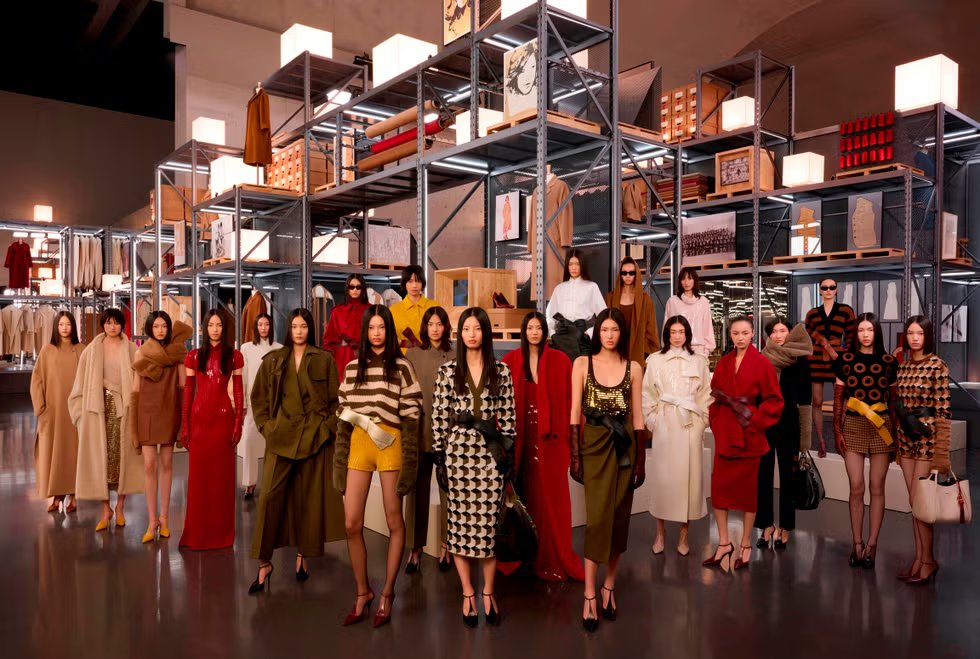
Models in front of the exhibit.
In 2016, Griffiths showed his pre-fall and capsule collections at the Shanghai Exhibition Center, an ornate, monumental space influenced by classical Russian architecture. This time, though, his vision called for a different type of venue. That search took Griffiths and Giorgio Guidotti, the company’s vice president of global communications and publicity, to the museum, where they were struck by an exhibition of mid-century Chinese art. The designer saw surprising commonalities between the minimal designs in the exhibit and Max Mara’s approach to sleek elegance. “One of the most important aspects of my research was [seeing] this sense of pride in local costume and local culture,” says Griffiths, who has worked for the house for nearly 40 years.
To mark its anniversary, Max Mara presented a concurrent exhibition at the museum, curated by noted fashion historian Olivier Saillard and Gaël Mamine. Titled “The Max!”, it presented a re-creation of the brand’s archives, shown in nine chapters, and the items that make up its history, from bolts of fabric to sketches and showroom furniture. “We wanted to create the feeling that you get when you walk into the archive, which initially is a random collection of objects. You have to work out why a Gae Aulenti lamp is next to a Max Mara coat from the early 2000s, or why pattern-cutting equipment is stored within a cabinet that came from a drugstore. There’s a reason for all those objects being in our archive, so we wanted to invite the visitor to inquire and work it out,” Griffiths says.

The house’s signature coats were a through line of the collection.
The exhibition has the same energetic spirit as the resort collection, which was titled “Kinetic Chic” and featured bold patterns and colors. “Pattern is, for me, the outstanding feature of this collection,” says Griffiths, who looked to the work of German fabric artist Anni Albers. Intarsia knitwear prints showed tumbling cubes and squares, while the transparent sequins seen throughout offered “a sense of light flashing and movement.” There were also Asian influences, including dresses, jackets, and shirts with cheongsam-inspired closures and pankou buttons. Obi-style belts cinched everything from trench coats to a high-waisted skirt. The palette tended toward rich jewel tones, reds, blues, and creams. And, of course, Max Mara’s signature coats were also in the mix.
Three coats were shown on male models, in a nod to “what’s happening on the street now, especially in Asia, where you see so many men wearing Max Mara coats and jackets,” Griffiths explains. “The history of fashion has never witnessed a phenomenon quite like this, because unisex always goes the other way. It’s always about women borrowing from the masculine wardrobe.”
In fact, Griffiths is looking much harder at the streets than at the archives. Max Mara, he says, is about what comes next. “There’s no sense of nostalgia about this collection at all,” he says. “It’s a collection that’s looking forward to 75 years of the future, as opposed to 75 years of the past.”
This story appears in the November 2026 issue of ELLE.