Highlights
- In terms of building trade and financial ties with the EU, Canada starts from a modest position. Despite a stronger investment relationship, Canada currently supplies only around 1% of EU goods and services imports. Although the benefits of the CETA free trade agreement between Canada and the EU have (gradually) emerged, regulatory barriers, geography and established commercial relationships with other trading partners continue to limit progress.
- These barriers notwithstanding, Canada is well positioned to increase its market share in the EU. The October 29–30 Canada–EU summit in Montreal is an opportunity to build momentum and advance cooperation in priority sectors. European demand increasingly overlaps with Canadian capabilities and the two sides’ strategic interest in diversifying economic ties.
- The upside for Canadian exports is meaningful. Product-level analysis suggests demand for nearly C$60 billion in additional goods exports could exist, under certain conditions, including roughly C$50 billion in energy. The strong gains in services exports since CETA provide a precedent for renewed growth as both economies work towards closer integration. Notably, certain services (like financial services) don’t have the same scale of geographic barriers faced by goods industries.
- The largest long-term opportunities span defence, energy, critical minerals, digital markets, as well as financial and other professional services. The biggest gains will need to be unlocked through expanded infrastructure and deeper cooperation to expand investment, improve market access, and build new supply chains in critical areas.
Canada’s push to diversify trade away from the U.S. has put renewed focus on its economic relationship with Europe. But how important is the EU to Canadian exporters today, what is holding trade back, and where are the biggest opportunities for growth? In this Q&A, we take stock of Canada-EU trade, examine the barriers that remain nearly a decade after CETA took effect, and assess how much potential upside there could be.
What’s the State of Play?
Goods
Currently, the EU accounts for only 5-6% of Canadian international merchandise exports – about the same share as the U.K. and China. In 2025, some $43 billion worth of goods were shipped from Canada to the EU. This is a fairly small share of the EU’s imports, around 1%.
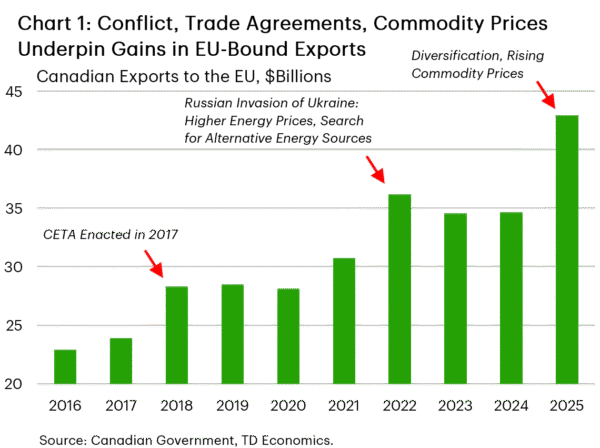
Canadian exports to the EU have posted several notable gains in recent years (Chart 1). Shipments rose 20% in 2018 after CETA took effect, then jumped in 2022 as Russia’s invasion of Ukraine lifted energy prices and Europe’s demand for alternative suppliers. Exports rose again in 2025 and early 2026, supported by higher oil and aluminum prices and diversification away from the U.S.
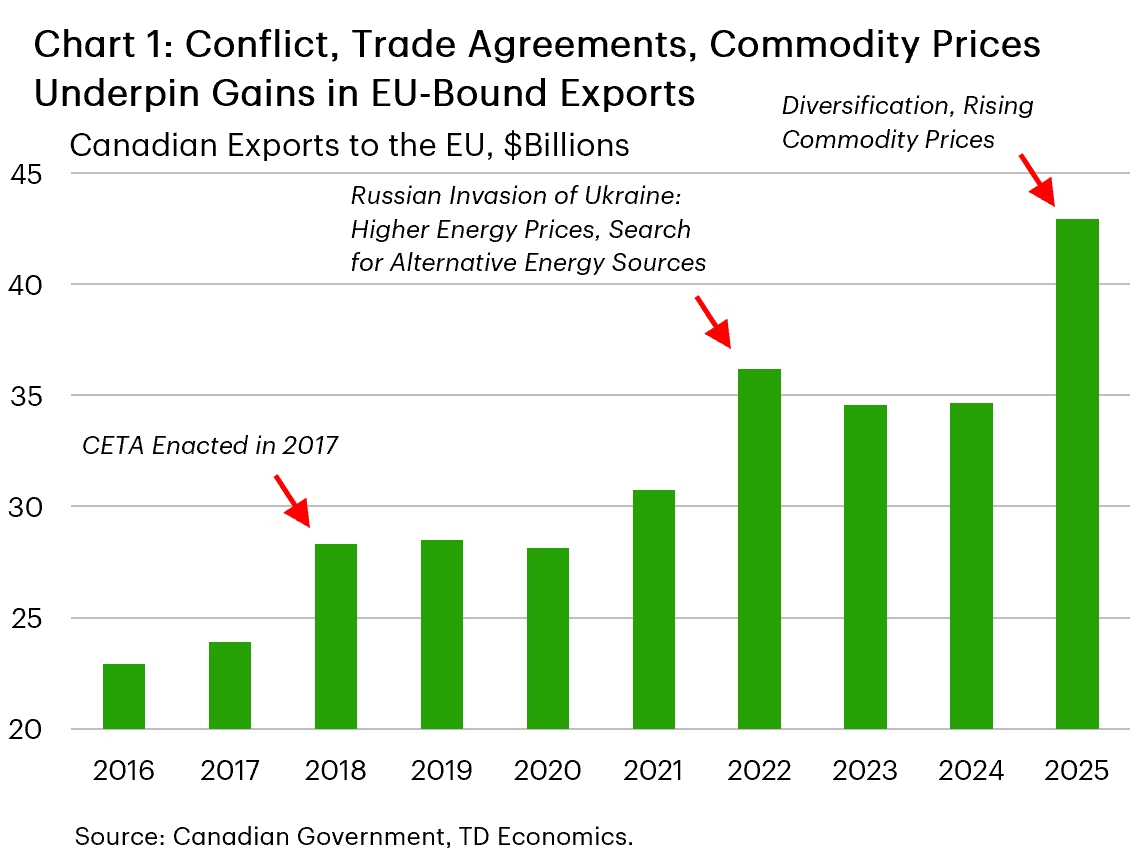
Canada’s main exports to the EU include crude oil, aircraft, aluminum, uranium, iron, canola, nickel and diamonds (Chart 2). This mix makes the EU especially important to Newfoundland and Labrador and Quebec (Chart 3). Aluminum and aircraft lift the EU’s share of Quebec exports to 11%, while crude oil, iron and nickel send more than 40% of Newfoundland and Labrador’s exports to the EU. Seafood supports PEI and Nova Scotia, while Saskatchewan supplies uranium and canola.
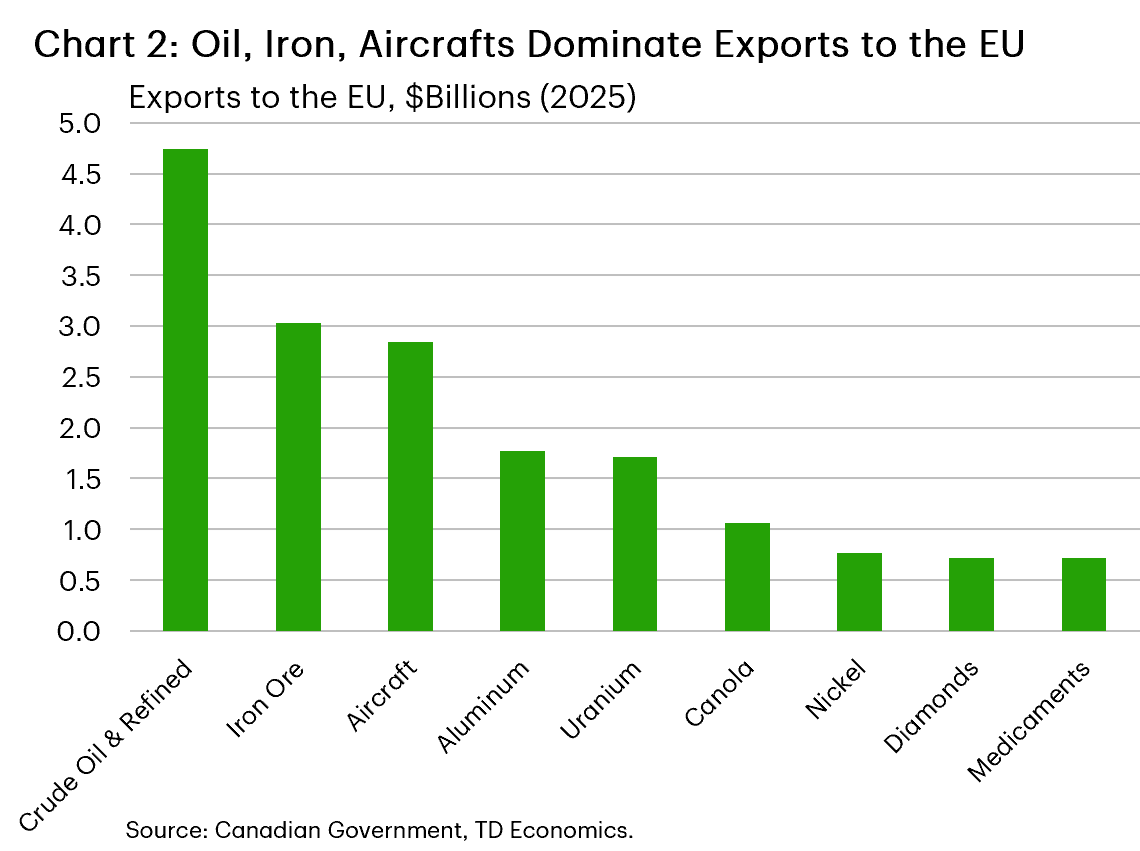
In contrast, the EU accounts for only about 3% of exports (on average) in Ontario, Manitoba, B.C., Alberta and New Brunswick.
Even with this hefty product mix, Canada typically runs a goods trade deficit with the EU. In 2025, it amounted to $50 billion, with Canada importing high-value manufactured products like pharmaceutical products, automobiles and medical instruments.
Services
Canada exported $22 billion in services to the EU in 2024, the latest available year. Commercial services, including consulting, finance, insurance and construction, accounted for about 60%. Travel services (e.g., tourism, EU students spending in Canada) contributed $6 billion, with transportation and government services (e.g., airline fares paid to Canadian carriers, costs associated with foreign embassies) making up the balance.
Services exports rose more than 80% between CETA’s introduction in 2017 and 2024. Yet Canada’s $22 billion was barely a blip considering the EU’s more than $2 trillion in services imports from non-EU countries. Canada still ran a $5 billion services deficit with the EU in 2024, driven by travel, transportation and government services. Interestingly, trade in commercial services was much more balanced.
Investment
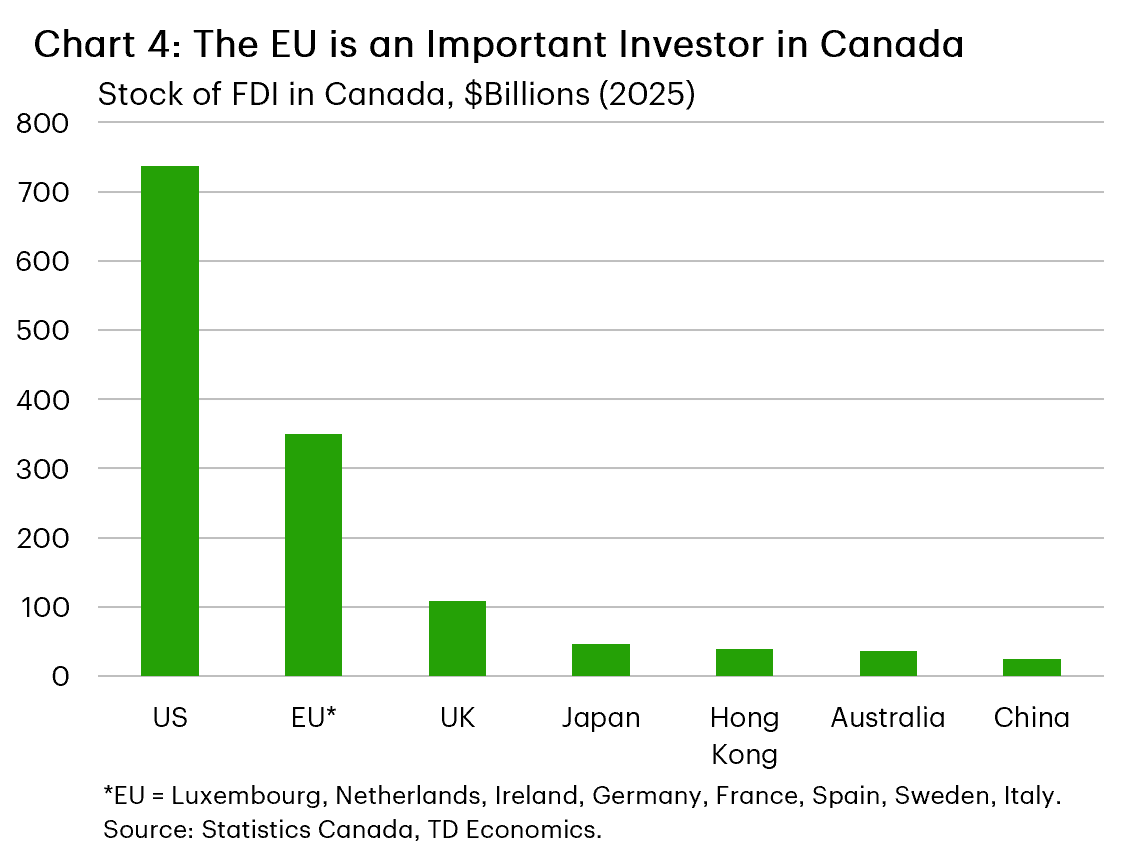
The stock of EU foreign direct investment (FDI) in Canada reached about $350 billion in 20251, up roughly 70% from 2017. U.S. holdings were still more than twice as large (Chart 4). Total FDI in Canada reached $1.6 trillion, up 90%, led by gains from the U.S., EU, U.K. and Australia.
On the other side of the ledger, the stock of Canadian investment in the EU totaled $286 billion in 2025, up 90% from 2017.
What are the Barriers to Trade?
CETA has been successful in lowering tariff barriers, with tariffs eliminated on 98% of goods products2. However, several obstacles remain:
- Regulatory/legislative barriers: A longstanding example is the EU’s import ban on hormone-treated beef, which Canadian producers must navigate by raising and processing a portion of their stock in a different, more expensive way3. More broadly, regulatory and technical standards remain in force, raising costs for Canadian firms to comply. In another notable example, a Canadian firm will only enjoy preferential access under CETA if it can demonstrate that a product satisfies CETA’s applicable rules of origin. This “rules-of-origin” requirement can complicate situations where a final good sources inputs from several other countries, as it requires a careful and costly paper trail4.
- Canada has its own set of non-tariff barriers that EU importers must navigate. Despite the removal of tariffs on nearly all product categories under CETA, EU exporters continue to face Canadian market-access barriers, including tariff-rate quotas on supply-managed agricultural products5, regulatory and sanitary requirements6, as well as provincial-level barriers in certain regulated markets such as alcoholic beverages and professional services. For example, EU companies have pointed to issues with the accreditation of European engineers.
- Geography and transportation costs: Distance remains an important structural constraint on Canada-EU merchandise trade, particularly for bulky, lower-value or time-sensitive goods where freight costs can materially erode competitiveness. What’s more, air freight has been shown to be an important weight on trade between the two sides7. Canada’s Atlantic provinces are relatively well positioned because of their proximity to Europe and access to major ports, while exporters in inland and western provinces face additional domestic transportation costs before goods even reach an Atlantic gateway. However, geography is a much weaker constraint on services trade. Financial, digital and other knowledge-intensive services can often be delivered electronically, reducing the importance of physical distance and transportation costs.
- The U.S. pull: Most Canadian exports to the U.S. remain tariff-free, while established supply chains and business relationships reinforce the status quo.
- The U.S. also supplies about 35% of the EU’s imported services, making it a formidable competitor in areas such as finance and digital services.
- Incomplete CETA ratification: Ten of 27 EU members, including France and Italy, have not fully ratified CETA. Provisional application has kept nearly all trade tariff-free, so the direct effect is limited. However, the lack of ratification may discourage long-term investment in Canada-EU supply chains8.
What opportunities exist to deepen trade between Canada and the EU?
Trade is the most obvious place to deepen economic ties between Canada and the EU. The EU is the world’s second-largest economic bloc and, by some measures, its largest importer, accounting for roughly 12–13% of global imports. Yet it still buys only a small share of Canada’s merchandise exports.
There are two broad ways to think about the opportunity. The first is to look for products Canada already exports competitively but sells only in small amounts to Europe. The second is to focus on strategic sectors—such as energy and critical minerals—where governments on both sides want to build new supply chains and deepen economic ties, even if trade is limited today.
To assess the first group, we examined detailed trade data across nearly 5,000 product categories. We compared the goods in which Canada has a revealed comparative advantage—a sign that it is already a competitive exporter—with products the EU relies heavily on imports to supply. The results point to some room for growth in areas where Canadian producers already have a strong base9, 10.
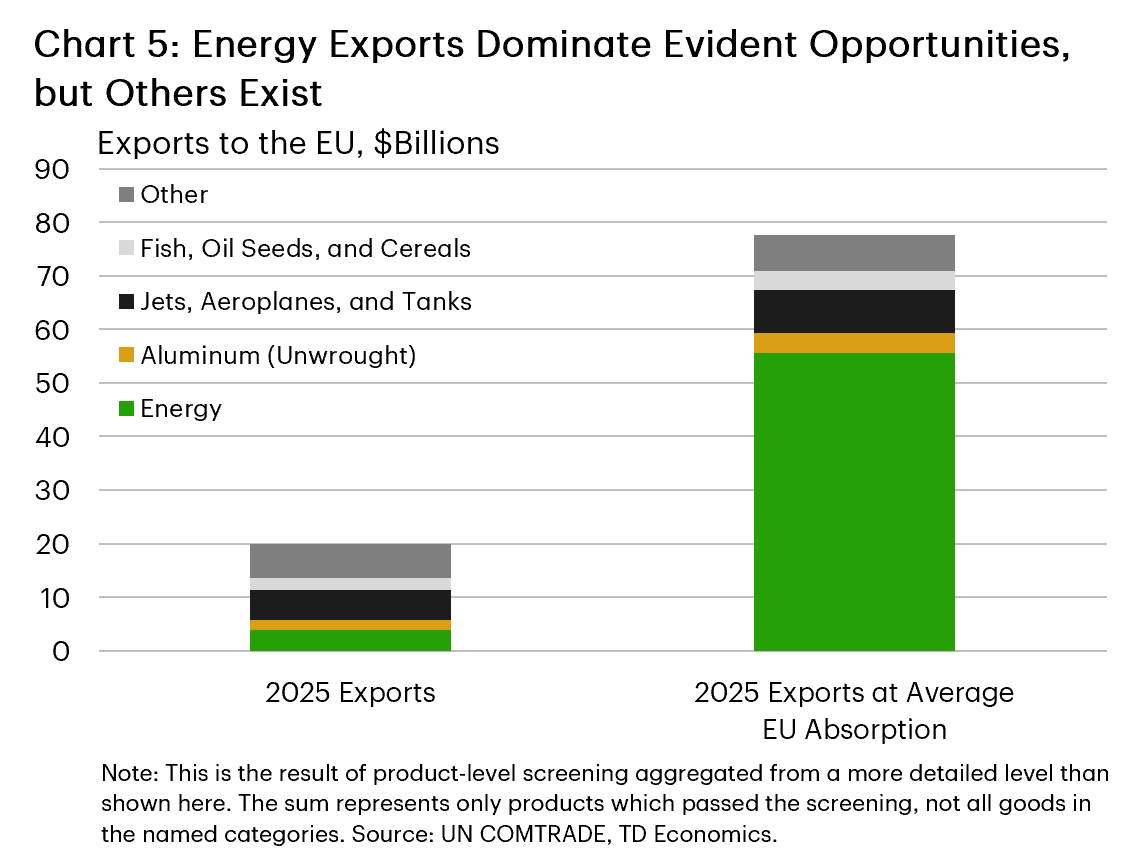
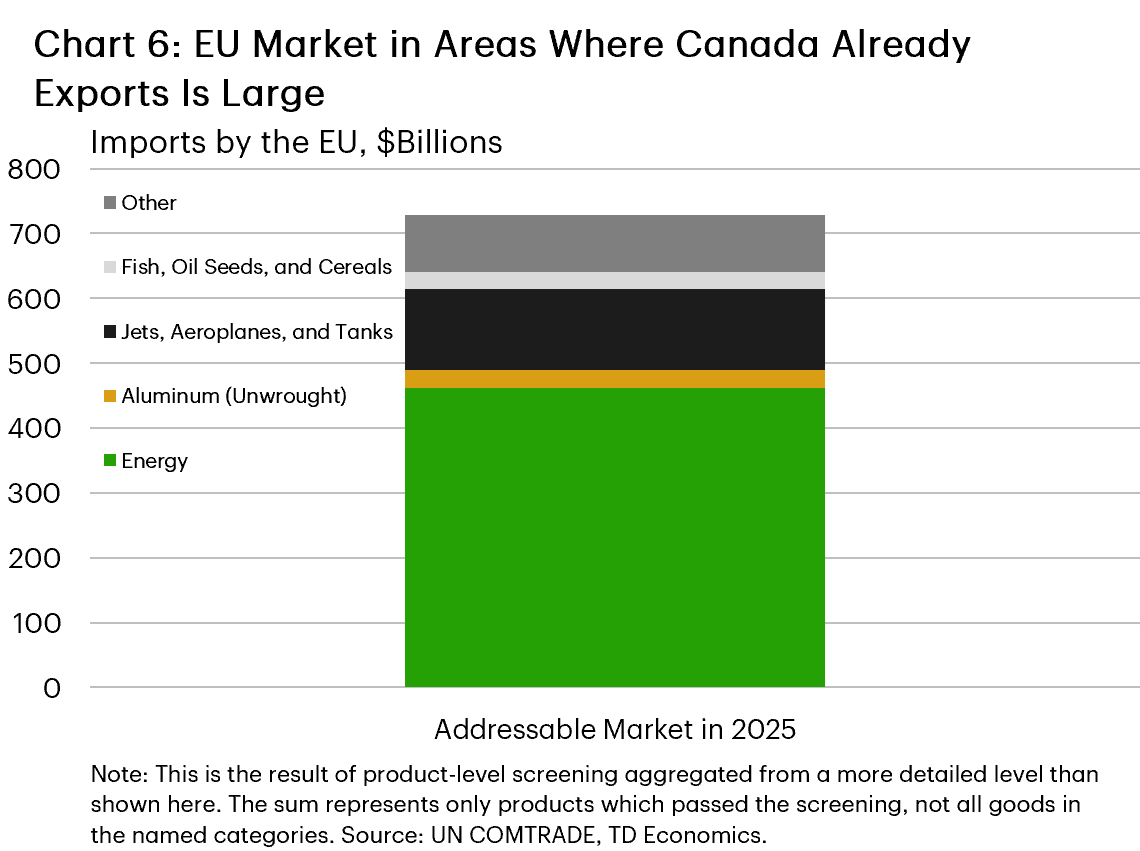
Two observations stand out from this product-level screening, illustrated in Charts 5 and 6. First, even though this analysis was designed to identify products where Canada has a competitive advantage globally, Canada is still punching below its weight in the EU. Average absorption rates would have meant an additional $6 billion in non-energy exports and $51 billion in energy exports in 2025 from Canada to the EU. Second, the overlap between Canadian strengths and EU import needs represents a sizable market. The EU imported more than $700 billion of these goods in 2025, suggesting considerable room for competitive Canadian exporters to expand. Over $266 billion of these were non-energy goods.
The opportunities for Canada’s exporters here are therefore potentially very large, if the right conditions are met. We have already noted that substantial non-tariff barriers to trade exist, and these would need to be addressed for Canadian exporters to expand in these goods. Infrastructure limitations are also binding at present for many of these products, especially energy exports. These gains in energy are not achievable without major new export and energy infrastructure. The proposed Ksi Lisims LNG terminal on the west coast, which has already attracted offtake agreements from European partners, is an example of the sort of infrastructure development that needs to be funded and developed for Canada to expand capacity in these areas.
Where could the next generation of opportunities come from?
The product-level screening above points to a timely alignment of Canadian strengths and European needs. Several opportunities overlap with the priorities in Prime Minister Carney’s September address to the European Parliament and preparations for the Montreal summit. Europe’s push to strengthen security, diversify strategic supplies and build digital capacity is lifting demand in areas where Canada already has a competitive base. With these markets poised to outpace Europe’s broader economy, investment and policy cooperation could help Canada build on existing strengths rather than start from scratch.
Defence and SAFE
Defence is a strong example. Europe’s build-up plays directly to Canadian strengths in aerospace, transportation equipment, communications technology and advanced manufacturing. EU defence spending rose from €218 billion in 2021 to a projected €392 billion in 2025 and could reach roughly €635 billion if members meet NATO’s 3.5%-of-GDP core-defence target. For Canada, the challenge is turning that demand into access to contracts. Security Action for Europe (SAFE), launched in 2025, helps bridge that gap: it offers up to €150 billion in long-term loans to EU member states for joint defence purchases and expanded production capacity. Canada’s participation agreement, signed in February 2026, gives Canadian firms preferential access and allows Canadian content to account for up to 80% of a procurement’s value. The potential scale is meaningful: EU imports of aircraft, spacecraft, tanks and related products totalled about C$125 billion in 2025, making an additional one percentage point of market share worth roughly C$1¼ billion in annual exports. That broad import market is not all defence-related, nor is it all covered by SAFE, but it illustrates how modest share gains could matter.
Critical minerals and AI
The same search for secure supplies creates an opening in critical minerals. Europe needs more inputs for its future industries while reducing dependence on any single foreign supplier; this gives Canadian firms an opportunity to become a larger supplier, not just through extraction but through processing, refining and advanced materials. In 2023, the EU expected lithium demand to be roughly 12 times higher by 2030 and rare-earth demand five to six times higher11. Those growth rates point to substantial potential, which has yet to be fully realized in Canadian export sales. Existing trade offers a more tangible yardstick: EU imports of unwrought aluminum totalled about C$27 billion in 2025, so an additional one percentage point of market share would be worth roughly C$270 million annually. Established products could deliver gains sooner, while the larger battery and strategic-mineral opportunities depend on building new supply chains.
Europe’s digital ambitions could extend that relationship beyond physical goods. Its plans to at least triple data-centre capacity within five to seven years, mobilize €200 billion for AI and direct €20 billion toward up to five AI gigafactories create potential demand for Canadian services, cloud infrastructure and advanced computing. Projected growth in data-centre electricity use—from 68 TWh in 2024 to 114 TWh by 2030—also underscores the scale of the build-out12. Access to selected EU cloud and AI procurement could give Canadian firms a foothold, but the investment totals are not an export market Canada can simply claim a share of: they include European construction and other local spending. Here, the size of the Canadian opportunity will become clearer as projects and contracts take shape.
Financial services
Financial services could help connect these opportunities. Europe’s energy, defence, critical mineral and digital projects will need financing and risk management—areas where Canadian banks, insurers, pension funds, asset managers and fintech firms have expertise. The opportunity is less about displacing European institutions than partnering with them in project finance, asset management, insurance, payments and specialized advisory services. Canada has a base to build on: it exported $22 billion in services to the EU in 2024, including roughly $13 billion in commercial services, while the EU’s financial services import market alone exceeds its total services imports from Canada.
CETA provides a foundation for expanding that foothold through its Financial Services Committee, where regulators can address cross-border issues and the recognition of prudential rules. Closer cooperation on licensing and supervision could reduce duplicate compliance requirements, although formal recognition and market-access decisions remain with the relevant authorities. Progress would make it easier for Canadian institutions to serve European clients and support the projects described above, but will require agreements beyond the cooperation already in place.
Can investment expand the trade relationship?
Investment is the channel that can turn many of these sector opportunities into trade. European investors already hold a substantial stock of direct investment in Canada, while Canadian firms have a large position in the EU. Member states with a larger business presence in Canada also tend to trade more with it, particularly in transportation equipment and chemicals. Causality runs both ways, but the relationship supports the case that European ownership, joint ventures and supplier links can help Canadian firms enter EU value chains.
The September Canada Investment Summit generated nearly $500 billion in announced commitments, but limited evidence of a discrete wave of new European inward investment. Most of the total reflected financing targets from Canadian financial institutions and domestic corporate projects rather than closed foreign transactions. Its more durable contribution may have been to present 167 projects worth about $327 billion to investors from nearly 30 countries. The pipeline—concentrated in minerals and metals, clean energy, digital technology, advanced manufacturing and transportation—closely matches the European demand discussed above.
Can the EU move the needle for Canada?
Europe can move the needle for Canada over time, with effort from both sides. Our product analysis suggests scope for nearly $60 billion in additional goods exports at average EU absorption rates, including roughly $50 billion in energy. Services exports have risen more than 80% since CETA took effect, although most of that growth came before 2020 and momentum has since slowed. Renewed cooperation on services, alongside greater direct investment in defence, critical minerals, and energy, could unlock a new phase of growth. The largest, long-term opportunities lie in the defence, energy, critical mineral and digital markets examined above. Reported Montreal summit proposals on firefighting-aircraft purchases and selected cloud and AI procurement could help translate some of that demand into Canadian business.
Capturing those gains will require new production and export capacity. Reported proposals for European Investment Bank financing of Canadian critical minerals projects and a feasibility study on LNG exports could help advance the investment pipeline described above. Canadian financial institutions could also provide financing and risk management, though that is a broader commercial opportunity rather than a reported summit outcome. Much work will remain after the summit: securing capital and buyers, delivering timely approvals, expanding infrastructure, and easing certification and procurement barriers. Ultimately, stronger demand, greater Canadian capacity and better market access—not a one-off diversion of trade—could make Europe a meaningfully larger export market.
Endnotes
- This $350 billion figure is likely understated given that the StatCan daily only captures Luxembourg, Netherlands, Germany, France, Italy, Ireland, Spain and Sweden.
- Julian Hinz et al., An Analysis of the Implementation of the EU-Canada Comprehensive Economic and Trade Agreement (CETA), European Parliament, Policy Department for External Relations, November 2023.
- Pascal L. Ghazalian, “Enhancing Canada’s Beef Exports and Competitiveness in the Global Market,” The School of Public Policy, University of Calgary, Briefing Paper 17:10, August 2024, https://doi.org/10.55016/ojs/sppp.v17i1.78430.
- Global Affairs Canada, Office of the Chief Economist, “Determinants of CETA Preferential Rate Utilization (2018–2024): A France-Canada Comparative Analysis,” July 2026, https://international.canada.ca/en/global-affairs/corporate/reports/chief-economist/diversification/2026-07-ceta-tariff
- Global Affairs Canada, “Key Dates and Access Quantities 2026–2027: TRQs for Supply-Managed Products,” Government of Canada, October 9, 2026, https://www.international.gc.ca/trade-commerce/controls-controles/trq-dates-ct.aspx?lang=eng.
- Global Affairs Canada, “Joint Report: CETA Sanitary and Phytosanitary (SPS) Measures Joint Management Committee (JMC),” November 12–13, 2025, Government of Canada.
- Global Affairs Canada, Office of the Chief Economist, “Determinants of CETA Preferential Rate Utilization (2018–2024): A France-Canada Comparative Analysis,” July 2026, Government of Canada.
- Achim Hurrelmann, “What Would It Take to Further Intensify Canada-EU Economic Relations?” Centre for European Studies, Carleton University, EU Policy Brief, no. 15, December 2025.
- Canada’s revealed comparative advantage is calculated at the HS6-level of trade. If, for a given good, Canada’s global export market share is above the average, Canada is estimated to have a revealed comparative advantage. These goods are then screened against EU import reliance, a metric we calculate by dividing EU imports by total EU trade, leveraging the tendency of countries to export goods that they also produce domestically. This gives us the intersection of goods for which Canada is ostensibly a competitive exporter and the EU needs imports.
- For the products where Canada had a revealed comparative advantage in 2025, we calculate the EU’s share of global imports and apply that share to Canada’s global exports of the same product. The resulting counterfactual estimates how much Canada would export to the EU if the EU absorbed the same share of Canadian exports as it does of global exports. This implies roughly $57 billion in additional Canadian exports. The estimate should be viewed as an indication of market potential rather than a forecast, particularly because most of the opportunity is concentrated in energy, where production, transportation and export infrastructure substantially limit Canada’s ability to serve the European market.
- European Commission, European Critical Raw Materials Act, factsheet, March 2023, p. 1. Projections refer to EU demand for lithium for electric-vehicle batteries and energy storage, and rare-earth metals used in wind turbines and electric vehicles.
- European Commission, Report on the energy efficiency of data centres in the EU, COM(2026) 500 final, September 21, 2026, Section 1 (Introduction).