- Large volumes of critical minerals are being imported from Myanmar into Thailand and then mostly resold to China.
- At least six Thai rivers have been found to be contaminated with heavy metals linked to mining operations in Myanmar.
- Data suggests companies in Myanmar, Thailand and China are profiting from an industry that has created a public health crisis, impacting food and water security for hundreds of thousands across eastern Myanmar and northern Thailand.
- Civil society and Thai political groups are calling for an end to imports of minerals mined in Myanmar in response to the ongoing river pollution crisis.
UMPHANG, Thailand — At 8 a.m. on June 26, at least 13 double-trailer trucks were lined up at the Pheung Khleung border crossing in northern Thailand — one of the few places where minerals can be legally transported overland from Myanmar into Thailand. Tensions were running high under the sun. The border gate had not yet opened and irate mineral merchants were yelling at reporters, demanding that no photos be taken.
The previous day, the Thai military personnel that oversee the cross-border mineral trade had granted Mongabay permission to document the hundreds of tons of antimony expected to be delivered from Myanmar’s Karen state to Thailand’s Tak province, some 200 kilometers (124 miles) south of the city of Mae Sot. Reporters were forbidden from photographing soldiers’ involvement in the trade or the minerals themselves.
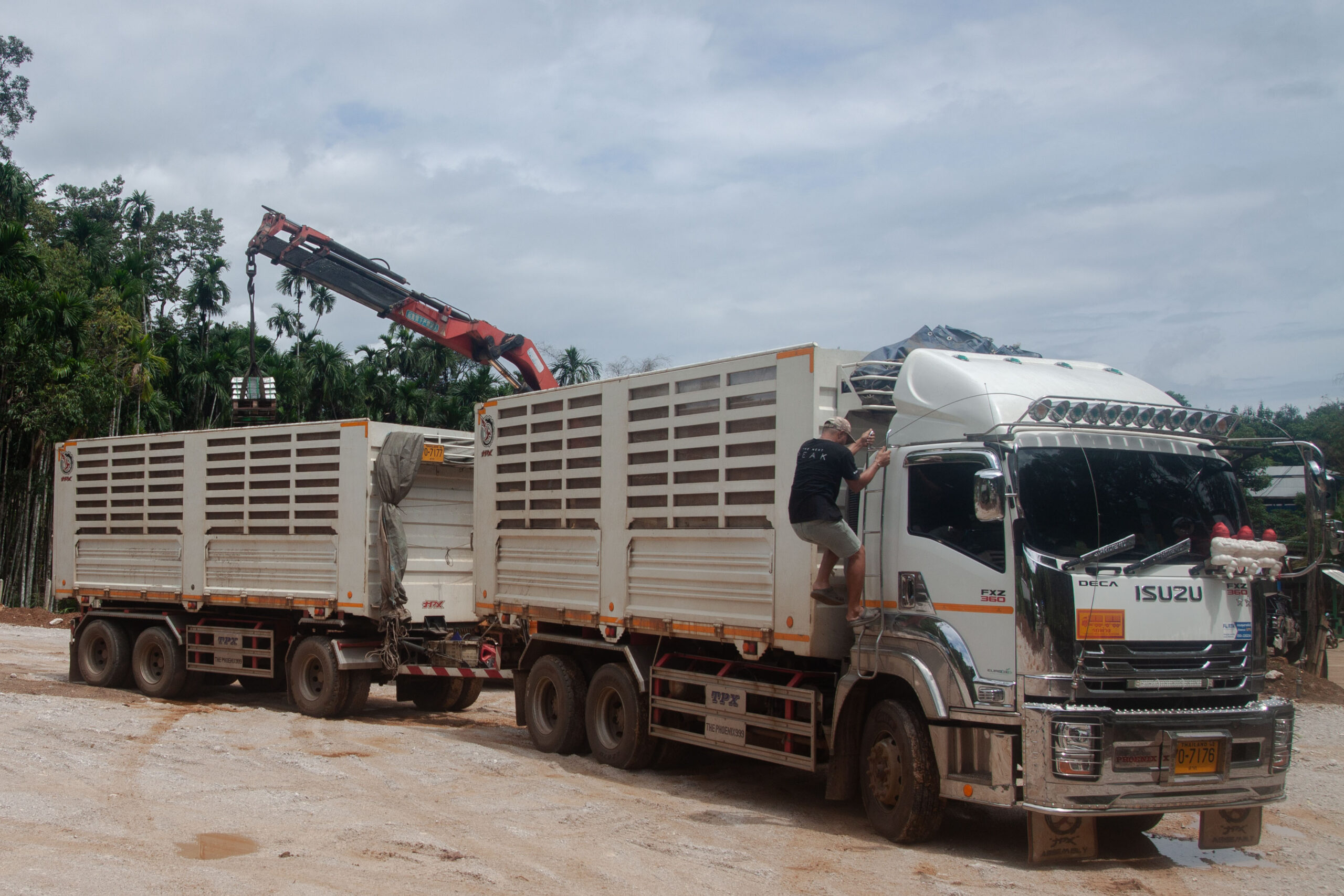
It wasn’t until 10 a.m. that the border gates opened and the first truck from Karen state bearing antimony, a silvery mineral used in bullets, bombs, armor, semi-conductors and other defense, aerospace and tech industries, crossed into Thai territory.

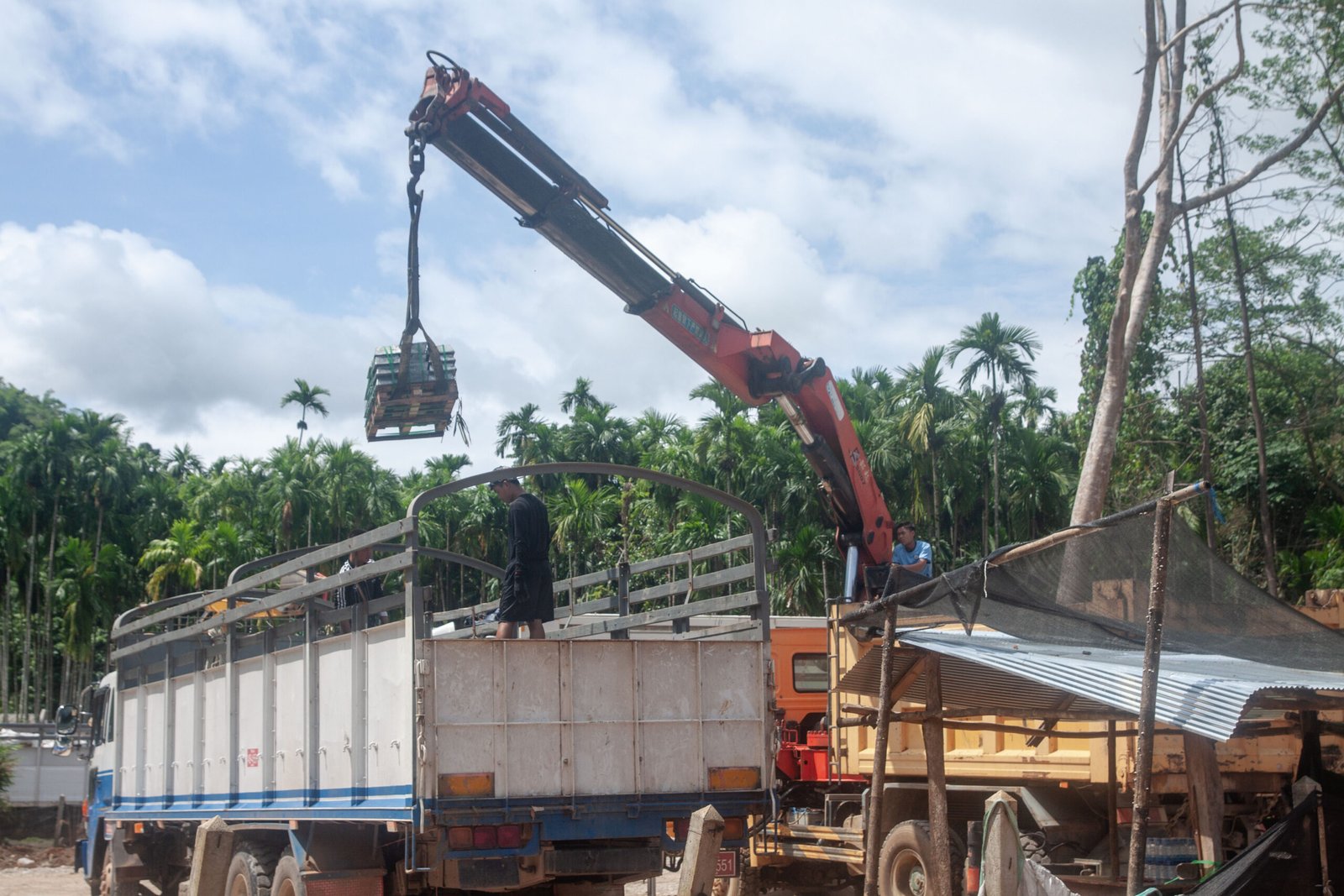
A crane, followed by a parade of battered trucks, rolled over from Myanmar and instantly workers from both sides frantically began attaching hoisting cables to 1-ton bags of what reporters were told was antimony ore and stacked bars of antimony ingot.
Drivers sheltered from the heat as bags and bars of antimony ore and ingot swung wildly through the air, the crane rapidly emptying the Myanmar trucks and filling the Thai ones. Once loaded, the Thai trucks’ loads were covered by tarpaulin and given a cursory check by Thai soldiers before they made for Mae Sot.
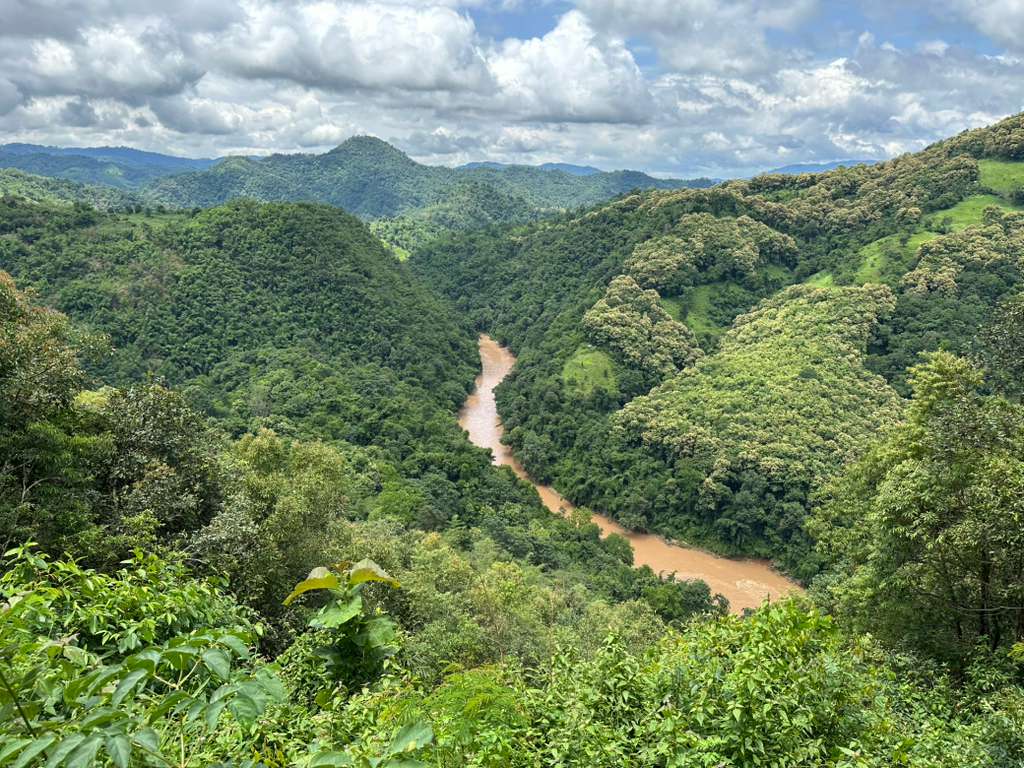
The rapid growth of unregulated mining operations across Myanmar in recent years has also led to a pollution that knows no borders, with heavy metal toxins floating through rivers from mining sites in Myanmar to Thailand. To date, Thai authorities have identified arsenic, cadmium, lead and other contaminants in the Kok, Sai and Ruak rivers, which feed into the Mekong River, as well as in the Mekong itself, the Salween River along the Thai-Myanmar border and the Kraburi River in Ranong province.
Despite widespread public outrage at the unmitigated spread of toxins through Thai rivers, Mongabay has found more than 50 Thai-registered companies importing critical minerals from Myanmar.

‘Very big’ mines, ‘big operations’
“The mines are very big, big operations with a lot of staff,” said one man who had rode in on a truck full of antimony from Myanmar.
Two sources familiar with Myanmar’s extractive industries agreed that antimony mining had become industrialized across Karen state, including in areas under the control of the Karen National Union, an ethnic armed group fighting the military government for independence and supporting the revolution.
Much of the processing capacity, however, remains in the southeastern city of Myawaddy, Karen state, which is currently controlled by forces allied with the military regime. The processing, these sources agreed, is more environmentally harmful than the mining itself in many cases.
The truck in June had come from Karen state in Myanmar’s east, driving two hours from a mining site that, according to the driver, is near the Three Pagodas Pass, which links southern Karen to Thailand’s Kanchanaburi province. His job, he added, was only to deliver the minerals safely. When asked which company he worked for in Karen state, the driver was suddenly sheepish and declined to answer any further questions.

A trilingual trader, who spoke in Burmese and Indigenous Karen to other mineral traders and in Thai to Mongabay, on condition of anonymity owing to their ongoing work in the trade, explained that mines in Myanmar are rarely run by companies. Instead, they said, mines are known by the names of the landowners who lease their land to Chinese investors that bring in the mining equipment and facilitate the sale of minerals from Myanmar to Thailand.
“The way it works is that I get an order from a Thai company, the important detail for them is the purity, so then the bags are stacked up on the Myanmar side, mostly antimony and tin, plus some other minerals, but I don’t know the names of them all,” the trader said. “They’re all mined in Karen state, but some villagers do it themselves, while most work as middlemen for the mines with Chinese investors.
“The mineral trade has really expanded lately. More and more people in Pheung Khleung are involved now, it’s been this way since last year. It increased dramatically in 2025.”

Thailand’s toxic trade
As the trade has rapidly increased, so has water pollution in the region.
For more than 18 months, a waterborne polycrisis has left tens of thousands of people in Thailand without access to clean water, depriving them of livelihoods and food traditionally derived from rivers, as well as poisoning both farmers and farmland. Public discontent has risen with the Thai government’s interventions widely seen as inadequate and the Myanmar government yet to take meaningful action. At the same time, anger has more recently been directed at the Chinese government because of the role played by Chinese investors and companies in fueling the mining boom in Myanmar that has poisoned Thailand’s rivers.
Some 2,214 mining sites have been identified via satellite analysis across Myanmar since 2015, according to data from U.S. think tank the Stimson Center, which notes that more than half opened after the 2021 military coup.
Despite the ongoing contamination crisis gripping Thailand, Thai government import data lists more than 50 companies actively importing a wide range of critical minerals from Myanmar into Thailand, much of which is then re-exported to China, multiple sources told Mongabay.

In the first nine months of 2025 alone, documents seen by Mongabay show that Thailand imported 105,752 tons of antimony, tungsten, copper, lead and manganese, all mostly in ore form, worth more than 13.9 billion baht (roughly $422 million) more than double the value and volume of all minerals imported from Myanmar in 2024. Tin production and imports from Myanmar also appear to have risen in recent years, but while hundreds of millions of bahts’ worth of tin was imported in 2025, the data are unaggregated and incomplete, making total imports difficult to estimate. It’s similarly unclear whether the datasets Mongabay received are complete or up to date.
Multiple requests sent to the Thai Customs Department for updated data and clarification on the risk of mislabeled minerals went unanswered. Thailand’s Pollution Control Department, which has been conducting water testing across the contaminated rivers, did not respond to written questions sent by Mongabay regarding which minerals could be responsible.
All of the minerals imported from Myanmar to Thailand are designated by the U.S. Geological Survey as critical minerals. This is an evolving list, currently including 60 minerals and rare earth elements, deemed vital to U.S. economic development and national security.
Collectively, antimony, tungsten, copper, lead and manganese overlap in uses, with a range of these minerals found in batteries, engines, munitions and alloy manufacturing across the aerospace, energy, defense and industrial sectors. Skyrocketing demand is being driven by the geopolitically charged growth of artificial intelligence infrastructure, militarization and the green transition, all of which have accelerated extraction in mineral-rich Myanmar.

These critical minerals have had disastrous environmental consequences, both in Myanmar and beyond, causing some Thais to say the government is not doing enough to regulate the trade.
“We don’t know which mine [the minerals] actually come from,” said Phattarapong Leelaphat, an opposition People’s Party member of parliament for Chiang Mai, in an interview with Mongabay.
Phattarapong, who is also chairperson of the Parliamentary Sub-Committee on Transboundary Water Pollution, said the government should ensure more complete customs data and enact section 104 of the 2017 Minerals Act, which could prohibit or regulate the flow of minerals into Thailand from Myanmar until it can be proven they’re not harming Thai rivers.
“When everything is based on data from the Customs Department, it’s a problem that we don’t have the technology for customs officials to detect if this is really tin, if it’s really antimony, or if it’s a rare earth element,” he said, noting that miners in Myanmar may be mislabeling goods sent to Thailand.

The government’s monitoring of water pollution through the Pollution Control Department, Phattarapong said, was not enough, nor was the budget for water testing or support for those affected.
“The problem keeps getting bigger and bigger, but the government just keeps staying quiet,” he said, adding that inaction may lead to suspicion that people in the government are profiting from Myanmar’s mining sector.
Over the course of June, Mongabay tracked down 12 companies across Chiang Mai, Chiang Rai and Tak provinces in northern Thailand. Collectively these areas are home to nearly half of all the Thai companies listed in the government data as importing minerals from Myanmar.
The data only covers minerals that reach Thai territory through legal land borders like Pheung Khleung and river ports such as Chiang Rai, where minerals reach Thailand via the Mekong by way of the Golden Triangle, but multiple illicit smuggling routes are believed to operate along the border. Traders told Mongabay that most of these minerals, whether imported legally or smuggled in from Myanmar, are then re-exported to China through Laem Chabang Port in Chonburi province.

Myanmar’s murky minerals
“If they import legally and follow the processes, then they shouldn’t cause any suffering to villagers or any damage to rivers, if you do that in the mining business, you won’t last long,” said Songphon Teampantunan, director of Thepthrni Business Mining Company, which has run two antimony mines in Karen and Mon states since 2010.
Thepthrni is the only company Mongabay spoke to that actually owns mines in Myanmar, but in an interview at his Mae Sot office, Songphon denied that his mines were responsible for river pollution, noting that he has been importing between 1,000 and 3,000 tons of antimony per month for years without issue.
Like other companies, Songphon’s antimony was brought from Myanmar through the Pheung Khleung border crossing then on to the freezones in Mae Sot that store the minerals until cleared by Thai Customs. Once a shipment clears customs, Songphon’s customers, mainland Chinese buyers, send a Thai company to collect it and ship the minerals out to China via the Laem Chabang Port.
Civil war in Myanmar has caused the cost of logistics for Songphon to rise as he navigates a complex network of checkpoints and taxes from the pro-independence Karen National Union, the military-aligned Democratic Karen Benevolent Army, as well as border guard forces comprised of Myanmar military personnel. The fighting has come as antimony prices soar, more than doubling since 2021, leveling out some of Songphon’s rising expenses while enticing more competition.

“There are so many new companies now though, it used to be just me, but there are many Thai and Chinese companies operating in Myanmar,” he said. “I can’t say whether they all operate legally, but it’s probably a mix. But for me, this is my profession, for many of the Chinese companies, they’re just laundering money from phone scams. They’re only in the mining business to clean their criminal money, but for me, this is a professional business.”
The influx of newcomers to Myanmar’s mining sector, he said, has likely accelerated the environmental impacts being felt both there in and in Thailand.
For other Thai companies importing from Myanmar though, there was little to no knowledge as to exactly where the minerals come from. Who is mining them and whether they’ve contributed to the transboundary river pollution ravaging northern and central Thailand appears to be a mystery, even to the Thai companies that import them.
Operating since 2007 and based in Mae Sot district, Tak province, Far Far Shipping Service Limited Partnership is one of 12 mineral importing companies that Mongabay spoke to.
Waraporn Thepsan, general manager, said she imports antimony and tin from Myanmar through Mae Sot. The minerals reach Thailand through a network of brokers and as a result, Warapon said she didn’t deal directly with Myanmar-based mining companies. Like Songphon, Warapon says she re-exports most of the antimony and tin she buys from Myanmar to China, but also sometimes to Japan and Spain.
“I never get information about the companies or the mines that are involved on the Myanmar side,” she said in a phone interview. “Everything happens through the brokers, they don’t tell me where the minerals come from in Myanmar and I don’t ask.”
This sentiment was echoed broadly across representatives of Thai companies interviewed by Mongabay, who said they are concerned about the lack of traceability, as well as working with unknown buyers and sellers alike.
“I don’t know if I import minerals that have contributed to pollution in Thailand, because I’m not involved in the mining side, so it’s up to the government to deal with the water quality issues,” Warapon said. “I don’t know where my minerals come from, I don’t know if I’m bringing those minerals in or not – I don’t think about these things.”
The lack of transparency over where the minerals come from is a feature rather than a bug, according to Amucha Tedchim, who works at Dion Enterprise Company Limited — another Mae Sot-based logistics company bringing Myanmar’s minerals into Thailand.
Declaration documents and certificates of origin detail what’s being brought in and from which country. But the documents do not say where or which company in Myanmar the minerals come from, so Amucha is only able to trace his supply chain back to Pheung Khleung, he said.
“The situation is that people from Myanmar don’t want us to know who they are, where they mine and that’s why we don’t know which companies we buy from,” he said. “The Customs Department will have that data though, it’s not in the documents we receive, but in my experience, Customs will try to keep that information secret.”

Throughout the cross-border mineral trade, secrecy reigns. In some cases, the companies listed in Thai government import data didn’t appear to exist when reporters attempted to visit in June.
The Chiang Mai office address listed for Tri Manna Import Export ,which imported 226.9 tons of antimony worth more than $538,000 in 2025, was simply an abandoned lot next door to a vacant Shan restaurant.
Similarly, NPC Charoeunsap Co. Ltd., which opened in November 2024 and imported copper throughout 2025, was registered at a Chiang Mai address that the local village chief and two other local officials all said simply doesn’t exist.
Mongabay was unable to reach either company for comment.

Mystery minerals reach Thailand
Further obfuscating an already opaque trade, many traders that spoke to Mongabay disputed the official trade data, notably regarding manganese ore imports, which staff from Sila Import and Export Co., Ltd. in Chiang Mai, Duangmadee Import Export Limited Partnership in Chiang Rai, as well as Dion Enterprise and Far Far Shipping Service all denied having imported either at all or at the volume listed in the data.
“It’s very possible that the bags we import contain something other than antimony,” said Amucha of Dion Enterprises. “There’s no check on every bag imported, so it could be anything, and we don’t know where it’s come from or where it goes, so it could be rare earths if nobody checks properly.”
Whether the import data is incorrect or if minerals are being mislabeled is impossible to determine. The Thai Customs Department declined repeated requests for comment
Most of Myanmar’s known manganese mines have operated since the early 2000s in Shan state, largely in parts controlled by the National Democratic Alliance Army (NDAA), which has leveraged its alliance with the United Wa State Party (UWSP) and its connections to China to become a major player in both rare earth and jade mining.
By 2021, the powerful conglomerate Hong Pang, run by Wei Hsueh-Kang, a U.S. sanctioned Chinese warlord with links to the UWSP, had built manganese processing factories with mining operations situated near Tachileik on the border between Shan state in Myanmar and Chiang Rai in Thailand.
Even then, the Ruak River was found to contain dangerous levels of manganese, which can lead to manganism — a neurological disorder akin to Parkinson’s — as a result of water and soil contamination that lingers long after the mines have closed. In 2025, the Shan Human Rights Foundation reported that manganese mining was expanding alongside rare earth projects in NDAA territory, threatening the Lwe River, which feeds the Mekong River.
“I don’t know where in Myanmar the manganese is mined, we just ship it into Thailand for the Myanmar businesspeople,” said Chusin Loungtalok, who works at Compass Magic Limited Partnership, a company that has facilitated the mineral trade since 2024 between Myanmar and Chiang Rai by way of the Golden Triangle.
Chusin explained how Chinese buyers place orders with mineral brokers in Shan state, who then send the manganese ore down Lwe River, into the Mekong and through the Golden Triangle to Compass Magic in Chiang Rai. It then transports it overland to Chinese steel factories in Thailand and to those in Laos. This happens once or twice a month, with each shipment including up to 800 tons of manganese, he told Mongabay.

Chusin said he believes the river pollution was a result of rare earth mining, which are a subsection of critical minerals, rather than mining for manganese and other critical minerals. He said he was confident that no rare earths were being brought into Thailand from Myanmar.
“If it comes into Thailand, it’s not through our hands. Maybe those miners have a different shipping company they go with,” he said. “It’s very competitive though, the rare earths are worth a lot of money, but the processing is very expensive and challenging, which is why the minerals are worth so much.”
For Phattarapong, the opposition MP from Chiang Mai, the issue is urgent and the government needs to do more to ensure that minerals brought in from Myanmar are not the same ones contaminating the country’s water sources.
“If I were the government, I’d see that I have to fix the laws so we can trace all of the supply chain,” he said. “We have to be able to detect or trace the minerals that are imported through our border and actually know where they come from, where they go and what they’re used for. But for now we can’t do that.”
Banner image: Mineral traders watch on as antimony ore is transferred from Myanmar trucks to Thai trucks at the Pheung Khleung border crossing. Image by Gerald Flynn / Mongabay.