When the 2026 Hanbok Fashion Show began at the Wilshire Ebell Theater, audiences were not met with a traditional catwalk. Rather, a ballerina twirled onto the stage, revealing the iridescent layers underneath her traditional hanbok skirt, a traditional Korean attire, before walking down the stage en pointe. Here began a series of collections that challenged the idea of what a hanbok is and could be.
The 2026 Hanbok Fashion Show, presented by the Korean Cultural Center Los Angeles on Oct. 25, celebrates Hanbok Day through a showcase of contemporary hanbok and Korean dance. The show also featured looks by Meehee Hanbok’s director Eunjoo Kim.
“We’re celebrating the beauty and cultural significance of hanbok while showcasing how this traditional Korean attire continues to evolve through contemporary design and modern sensibilities,” said Jiyoung Park, the event’s host.
The show is part of the larger Korea Month program headed by the Korean Consulate and the Korean Cultural Center. It is also part of the Ebell Theater’s L.A. Voices series, a collection of free events hosted at the theater on select Sundays.
“We believe that culture is not simply something to enjoy, but it is something that connects us, expands our understanding, and helps to shape a better world,” said Stacy Brightman, chief executive officer at the Ebell Theater.

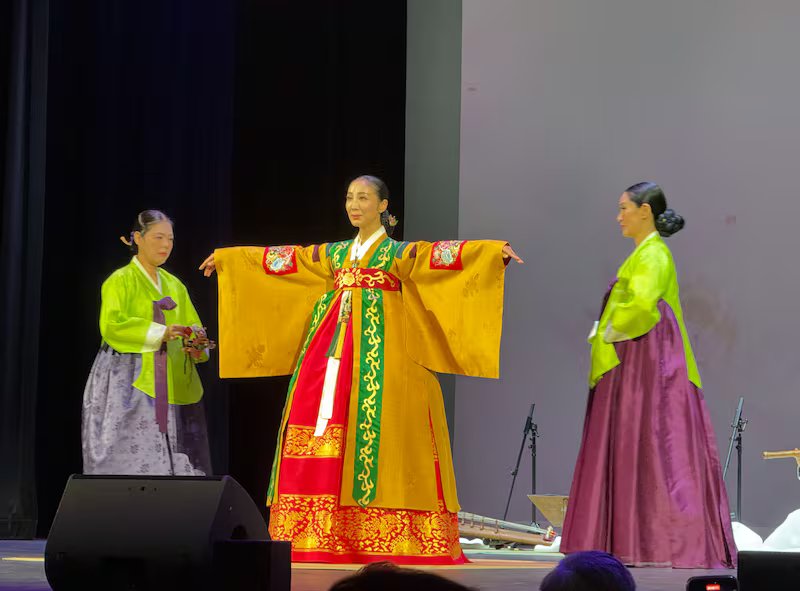
Before the show, a dancer dressed in only a traditional hanbok underskirt and jacket graced the stage. Two women followed and carefully dressed her in layers of gold and red, finishing with two floor-length sleeves of the five Korean cardinal colors – blue, red, yellow, white and black – to reflect prosperity. This style of hanbok was only worn by court dancers performing “Chunaengjeon,” the dance of the Spring Oriole.
The dance was originally performed for royalty during the late Joseon dynasty in 1828. The dancer showed both control and exaggeration, using key moments to flash the cardinal colors before retreating to a gentle stance. She danced to traditional Korean music featuring melodies of wooden flutes.
Another group of dancers, armed with a “kkwaenggwari” gong in one hand and a cardinal-colored, tasseled stick on the other, followed to perform “Jinsoechum,” a small gong dance. Unlike the previous performance, this was more lively, focusing on big, rhythmic movements to the bass of the gong. The hanbok reflected this, using fewer layers and lighter fabric to give the dance a sense of weightlessness.

The show officially opened with the ballet performance, emphasizing the different layers of the hanbok through dance. As the ballerina danced away, an older couple in traditional hanbok wedding attire walked side by side, with the iridescent gold stitching gleaming under the light, introducing the wedding collection.
The collection is marked by desaturated pastels and silver-gold embroidery, with the standout pieces being the silver-trimmed headdress for the show’s husband model and the matching gold and pearl flower hairpins for the wife model.
The next collection focused on bright, feminine hanbok and traditional silhouettes. Each model was given a unique headdress, ranging from simple white flowers to an ornate “hwagwan,” a crown with intricate detailing.

After a moment of silence, the models appeared behind the audience. Models in modern, translucent silhouettes strutted down the seating aisles, with sequined flowers and rolling hills painted behind them. A highlight in this collection was the scholar headpiece accentuated by its spiked edges and the menswear hanbok featuring a painting of a tiger, a prominent symbol of strength throughout Korean history.
The following line continued the modern aesthetic, introducing hanbok jackets in place of suits, mimicking the classic pantsuit-and-shirt menswear silhouette. This collection also featured feminine hanbok in unique cuts, one even foregoing the jacket for an off-shoulder look.

Models then walked the stage in Latin and European-inspired looks, combining the hanbok with boleros and 1950s-style veils for the subsequent collection. What resulted was a line that exhibited traditional expectations of femininity, while breaking fashion norms with cross-cultural elements. In one standout look, the long skirt and the elongated top of a royal dress were stripped of its sleeves, and the headdress was replaced with a black birdcage veil adorned with feathers.
The final collection pushed the definition of a hanbok to the extreme, stripping the looks of the voluminous sleeves and wide skirts with more contemporary elements. One of the womenswear looks replaced the sleeves with lace, while another cut the skirt above the knee.
For menswear, the models were dressed in a matching set, similar to a western suit, but with a Hanbok knot in front to secure everything rather than buttons. In one look, a model was dressed in puff sleeves and a corset, combining popular feminine trends of today with those in Korean history.
The show closed with a look evoking the dramatics of Marie Antoinette. The model’s hair was covered in flowers, resembling the white, pastry-like wig of European royalty. Her jacket was layered tulle, making it appear as if it were fur, punctuated by a train of embroidered pink fabric, tying the look back to the traditional sewing of the original hanbok structure.
To end the event, Korean pop cover group Kidz Never Die performed IVE’s “HEYA,” ONEUS’ “LUNA,” and BTS’ “IDOL” — tracks with concepts focusing on the hanbok. The cover group wore modernized hanbok, performing in the center of the stage as the models circled them, recapping the show.

Attendee Alyssa Huong said that while she initially attended the show to support her friends performing with KND, she admired the intricacy of each design. Even when the models were looking away, their backs were painted.
Cordelia Shih, another attendee, said she also admired the curation of the collections, seeing and ending with the models from the wedding collection.
“The way [the show] was planned … it was majestic in its own way,” Shih said.
Edited by Justin Ha