Back when arcades were on top, fighting games were often the most competitive of the titles available. Not only would players line up to get their chance of beating the CPU, but they’d finally be able to go toe-to-toe with their friends and rivals, in one on one or tournament play.
The fighting genre is probably the one that has changed the least since those early days. The fundamental mechanics are still very much the same. One thing that has changed, however, is the difficulty, with older titles having offered far greater challenges. These titles might be classics in their own right, but they were far from easy to master, with players being foiled by just how overpowered enemies were in single-player.
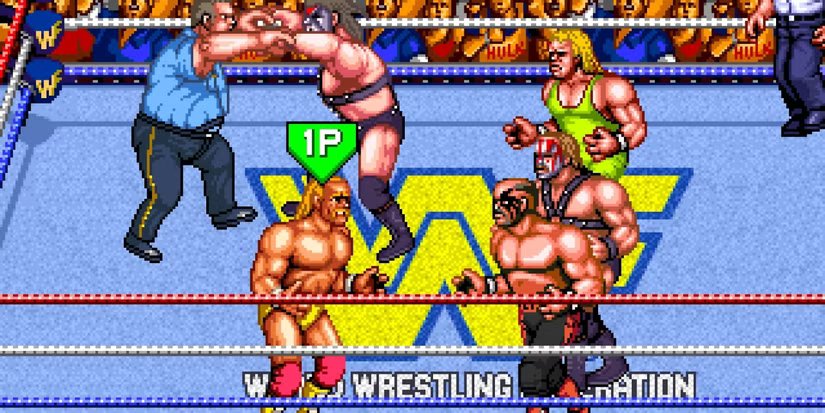
WWF WrestleFest Quickly Scaled

WWF and subsequent WWE games have combined simulation mechanics with classic fighting game systems. The result is a game that can be both rewarding and challenging in equal measure.
While players enjoyed the roster of talent involved and the general mechanics developed by Technōs Japan, it was evident that the tag-team mode had too brutal a boss fight in its culmination, and that the game itself was held back by a hidden stamina system. It was tough to know how to improve and, critically, players found their money was eaten far too quickly.
Primal Rage Was Not Very Intuitive

One would assume that a title like Atari’s Primal Rage wouldn’t have any fundamental flaws, but the thing that made the game so difficult is also what made it so unique. Compared to other fighting titles, Primal Rage had a control system that felt as if it was the reverse of its competitors. The results were unyielding.
This unintuitive method of play meant that fans made mistakes rather easily, because their reactions were flawed. Their instincts got them into trouble, with the 1994 system punishing those that were well-versed in other fighting styles.
WeaponLord Was Ahead Of Its Time

There’s something about weapon-based fighting games that makes them a little more difficult. Perhaps it’s because players fall into a rhythm of traditional games, only to find that new deflection, parrying and catching mechanics take some adjusting to. Regardless, WeaponLord from Visual Concepts brought a new challenge to 1995.
It’s worth noting that WeaponLord was primarily designed for home consoles, but did receive a very small arcade release. On any platform, players got punished for button-mashing and had to deliver more controlled, tactical strikes.

The orginal Marvel vs Capcom came out in 1998 and was a bona fide classic from the get-go. Like most games of the era, it was designed to be a quarter-muncher and took great pride in defeating the player and taking their cash.
But what many remember from the series is the Onslaught boss battle. As one of the most notoriously difficult of the franchise and the genre in general, few were able to make it through this encounter during their first time playing. The game also isn’t balanced in the most traditional sense, which created some unexpected match-ups.
Street Fighter III: 3rd Strike Utilized Parrying Too Much

Street Fighter III: 3rd Strike did do something quite bold, and that was reorganize its combat around a parrying system. Without mastering this precise mechanic, players couldn’t hope to stand a chance.
With players previously holding back to block, leaning into an opponent’s attack felt unnatural. When to use this ability was also a trial-and-error conundrum. It might have been a popular game, but its high-risk strategy and aggressive design required players to push themselves a little too much.
Samurai Showdown Might Be Harder Than Its Successors

Some would say that Samurai Shodown III was the hardest of the arcade fighting series, but those who played the original on arcade or later ported versions might have to disagree. For one thing, anyone who had played the sequels at least had a sense of what to expect and how to protect themselves.
The SNK 1993 title still featured dangerous AI that scaled as the title progressed. It also utilized heavy, slower pacing, which could be difficult to use to one’s advantage. Reacting quickly wasn’t much of an option here. The Rage Meter saw the game pivot suddenly, which brought its own range of issues.
Virtua Fighter Is Iconic For Its Complexity

The Virtua series is iconic at this stage. Everyone has interacted with the franchise at some point. What many forget is that the original incarnation, Virtua Fighter, which debuted in arcades in 1993, was a spectacular achievement in gameplay design, even if its visuals were rather blocky and limited.
Even back then, the Virtua series had begun to build complex systems that felt too challenging to handle. With strict rules in place and a psychological element to combat, there was no style here; it was all substance. That meant it wasn’t nearly as popular as some of its competitors, and without the training wheels connected, newcomers just didn’t know how to begin.
Street Fighter II Is Not Without Its Flaws

Street Fighter II is, without a doubt, a foundational fighting title. Without it, the genre would look completely different. The 1991 Capcom title took a great deal from the original, learning from its errors and adjusting accordingly. The clunkiness was gone, with a new button layout and a combo system that brought a sense of momentum to the screen.
While this flow cannot be trifled with, players felt that the AI systems actively cheated to win. That didn’t make gameplay all that fair, which is why one’s wallet grew lighter with each passing playthrough.
Killer Instinct Drained The Wallet

Players have likely experienced Killer Instinct on consoles. That’s very different from the interactions that players might have had with the game in arcades. Rare’s 1994 release was specifically tailored to be hard enough to be a wallet drainer. Midway Games literally wanted players wasting their cash on these battles.
The auto-adjusting AI system scaled up with every battle, making every moment even more dangerous. Traditional throws were present in the title, but counters to these were challenging, which meant that players had to adjust their strategy accordingly.
Mortal Kombat II Is Still Considered Elite

NeverRealm’s Mortal Kombat series entered new territory with the sequel title, which raised the stakes and introduced players to a faster combat style. It’s true that against one another, this title was lethal. The combos were difficult to counter, and the 1993 video game was elevated compared to the first title, leading to a new learning curve to endure.
The most complained-about aspect of Mortal Kombat II was its AI systems. It was as though the CPU opponent would be able to predict every move. The result was an almost impossible situation, where players could barely land hits, and then had to think quickly to avoid being combo’d to death. It’s still a prominent fighting game, but one that requires patience.