The boom in AI-related spending is already enormous relative to the size of the U.S. economy and is widely expected to grow even bigger. Indeed, a widely cited projection by Stijn Van Nieuwerburgh of the Columbia Business School concludes, based on announced plans by major players in the industry, that this will be the biggest investment boom in U.S. history, measured as a percentage of GDP:
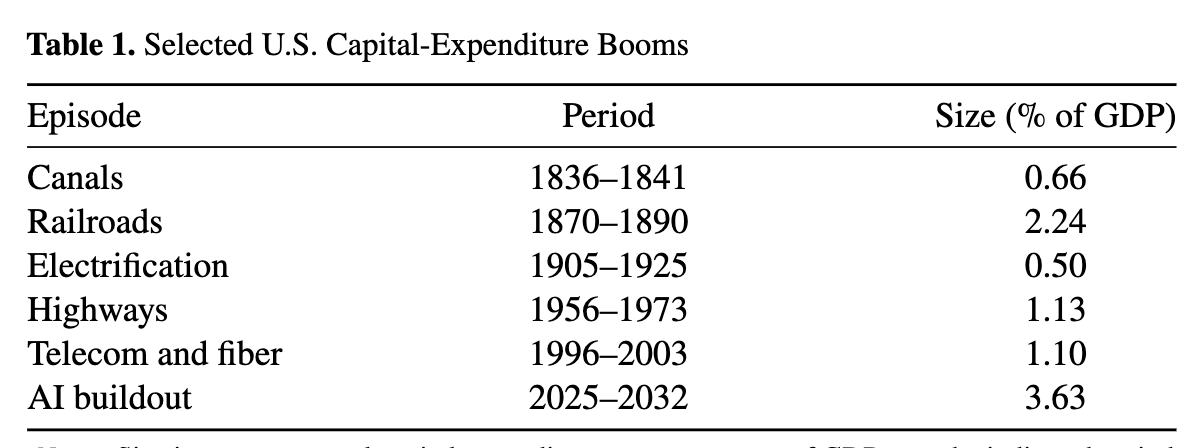
Source: Stijn Van Nieuwerburgh
Well, I’m going to make a prediction: This will not happen. Instead, the splurge on AI will run into two walls that will force either postponement or cancellation of many of those announced projects.
First, the money to fund all this AI investment spending simply won’t be there. Much of the spending so far has come from established industry giants like Google and Microsoft, who in the early phases of the boom could rely on retained earnings from their existing businesses. But the size of the buildout is now so big that it is increasingly dependent upon massive levels of borrowing.
And lenders are getting cold feet. Many observers have long argued that AI is an impressive technology, but profits will be elusive. And it’s now apparent that companies that are spending hundreds of billions on frontier technology are unlikely to generate enough profits to justify their huge outlays. There are a variety of reasons why, with the most obvious being competition from much cheaper and less powerful, yet commercially adequate, models from China.
After all, we’ve seen this movie before. The IT boom of the late 1990s changed the world, but it also ended with many tech leaders going bankrupt because they couldn’t monetize their achievements. During the last few weeks, lenders to AI companies seem to be having a collective Wile E. Coyote moment — the point at which the animated character, having run off a cliff, looks down and only then, obeying the laws of cartoon physics, plunges to the ground.
The financial data now clearly show that fear is spreading in the loan markets. Starting in the summer, CDS spreads — the price of insurance against default — have soared for a number of AI companies:
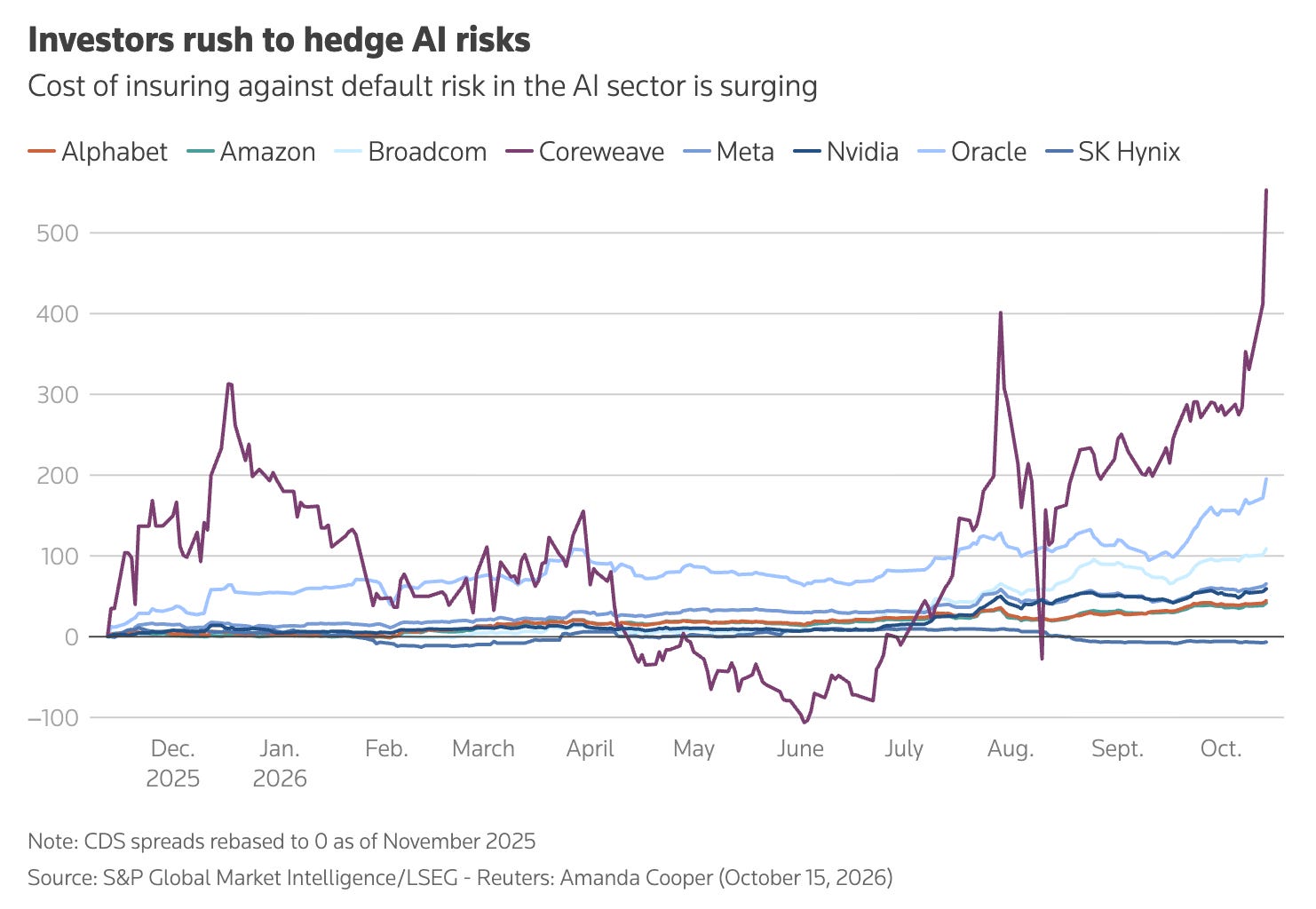
Coreweave, which basically sells compute, is in a league of its own in terms of high default risk. But other companies are also starting to show strain, especially Oracle. As yesterday’s Bloomberg headline put it,

With lenders running scared, and either demanding much higher interest rates or refusing to lend altogether, it’s increasingly difficult to see how the hyperscalers can realize their gargantuan investment plans unless someone is willing to take massive losses.
Furthermore, the AI investment boom is facing another huge obstacle: Most Americans really, really hate data centers and AI in general.
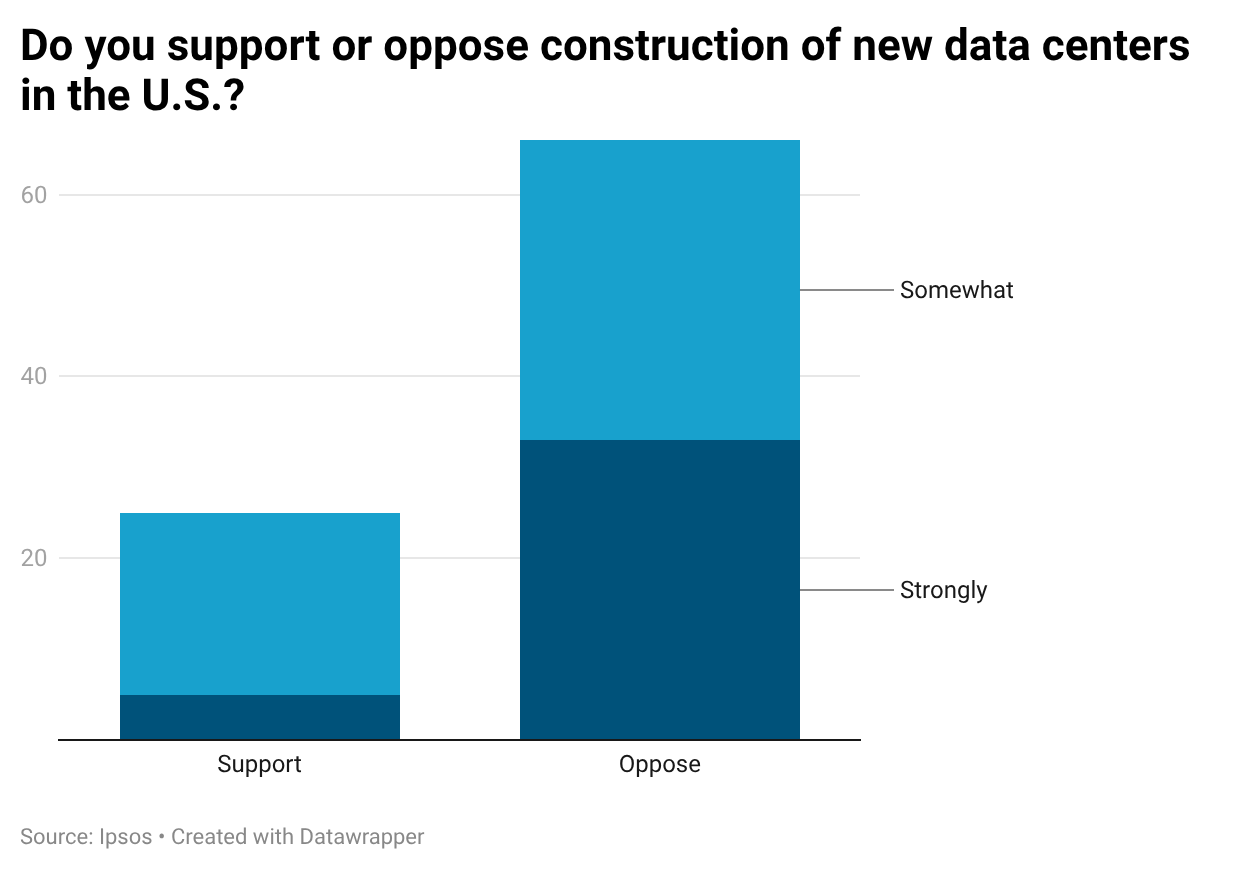
The polling on data centers is astonishingly negative. Not only do most Americans oppose construction of data centers near where they live, an almost equally large majority oppose building them anywhere in the U.S. And the opposition is much more intense than the support:
This hostility no doubt has multiple sources. Data centers impose real costs on communities through their consumption of water and electricity, as well as pollution if they build their own power supplies. At the same time, data centers, once up and running, provide almost no local jobs.
At a more cosmic level, there are widespread fears that AI will lead to mass unemployment and possibly even human extinction — fears that have been spread by the industry itself, in the belief that fear of apocalypse is good for their IPOs.
More generally, the race to build data centers, often accomplished through back-room deals with corrupt local politicians, feeds into the public sense that big-money elites are rigging the system against ordinary Americans.
But the American public is now fighting back, pitchforks in hand. Grassroots opposition is having a big effect because permits are needed to build giants data centers — permits that more and more local governments are refusing to grant in the face of local opposition. One important contributor to Oracle’s problems is the repeated rejection of permits for a natural gas pipeline to provide power to Project Jupiter, Oracle’s massive data center project in New Mexico.
Elsewhere, New York State has introduced a one-year moratorium on all construction of large new data centers, while a number of other states and local governments are considering major restrictions. Furthermore, the political environment is unlikely to become more favorable after the midterms given how well Democrats are polling across state and local races.
Granted, neither financing problems nor political opposition are likely, by themselves, to completely stop AI investment. But I predict they will greatly slow it down. And this would be a very good outcome, perhaps even allowing the AI bubble to deflate rather than bursting and thereby delivering a body-blow to the overall economy.
Yes, some companies – such as Coreweave – may very well go bust and many investors will be hurt. However, under current investment plans, there’s a high probability that a lot of that investment money would have been wasted and total losses would be many times larger. Thus, in the end, angry locals and panicky lenders may well end up saving investors from themselves. And, more importantly, slowing this juggernaut down may save the American economy from the devastation of the bursting of a gigantic AI bubble.
MUSICAL CODA