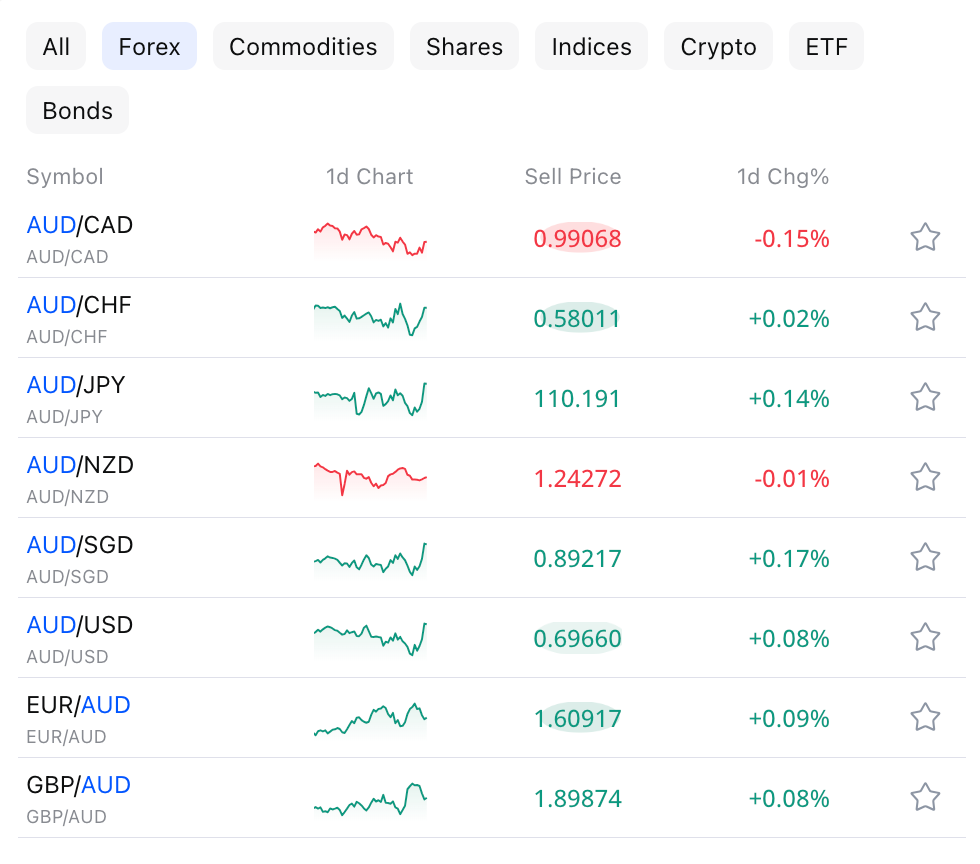
TL;DR: The Australian Dollar remains directionless as RBA hike-timing bets stay split across November, December and February, leaving AUD/NZD, AUD/CAD and GBP/AUD range-bound while AUD/USD tracks the Dollar and EUR/AUD tracks Euro weakness—with October 28’s quarterly CPI, not this week’s minutes or jobs data, likely the real catalyst.
Why This Matters
The Australian Dollar enters a potentially important week without a clear direction of its own, largely because markets remain undecided about the timing of the next RBA rate hike. While another increase is broadly anticipated, expectations are spread across several meetings rather than concentrated on November. Tuesday’s RBA minutes and Thursday’s employment report could challenge that uncertainty, but neither may be enough to settle the debate ahead of October 28’s quarterly inflation data.
That indecision is visible across currency markets. AUD/NZD, AUD/CAD and GBP/AUD have been largely range-bound since late September. Meanwhile, AUD/USD’s decline has been driven predominantly by US Dollar strength, while EUR/AUD has fallen mainly because of Euro weakness associated with French political and fiscal uncertainty. Unless this week’s Australian releases materially shift RBA expectations, the Aussie may continue taking direction from other currencies rather than establishing a broad trend of its own.
RBA Pricing Shows Another Hike, But Little Conviction on Timing
The RBA raised its cash rate by 25bps to 4.60% at September’s meeting, its fourth increase this year. The accompanying statement maintained an explicit willingness to tighten further if needed, but the subsequent press conference struck a more cautious tone, leaving open the possibility that additional increases might not be necessary if inflation moderates.
August’s inflation figures reinforced that ambiguity. Headline CPI accelerated from 3.5% to 4.0% annually, largely reflecting higher energy costs, while trimmed mean inflation remained unchanged at 3.6%. The divergence gave markets little reason to conclude that underlying inflation pressures were accelerating as sharply as the headline suggested.
Current interest-rate pricing reflects that uncertainty. As of October 12, overnight indexed swaps imply approximately 31% probability of a November hike, 25% for December and 28% for February. Cumulative pricing points toward roughly one additional 25bp increase by February or March, but no individual meeting carries more than one-in-three odds.
The market therefore expects further tightening without having a strong conviction about when it will happen. That makes the next two Australian releases important, although the bar for a decisive repricing may be relatively high.
Tuesday’s RBA Minutes: How Seriously Was Holding Considered?
The minutes of September’s meeting may offer limited new information, given the unanimous decision and the guidance already delivered at the subsequent press conference.
Nevertheless, the important question is how seriously the Board considered leaving rates unchanged at 4.35%, rather than whether members were concerned about inflation.
If the minutes suggest holding was a substantial alternative, or reveal greater concern about weakening household demand and the cumulative effects of tightening, markets could conclude that the threshold for another increase in November is relatively high. Such an interpretation would be consistent with the RBA’s efforts to contain inflation without unnecessarily damaging employment. Wage growth has not shown the kind of acceleration normally associated with a wage-price spiral, while real household purchasing power remains under pressure.
Conversely, stronger emphasis on persistent domestic inflation and capacity constraints could maintain support for further tightening.
Still, the minutes would need to reveal something meaningfully different from September’s public communication to substantially alter market expectations. The employment report therefore carries greater potential to reshape the near-term RBA outlook.
Thursday’s Employment Report: Watch the Composition, Not Just Unemployment
Australia’s September employment report is expected to show a 20K increase in employment, following August’s 39.5K gain, while unemployment is forecast to remain at 4.6%.
However, the headline unemployment rate could attract more attention than the underlying labour-market developments justify. Westpac noted that August’s unemployment rate was approximately 4.646% before rounding. Consequently, even a modest increase could push the published figure to 4.7%, without necessarily indicating a sharp deterioration in employment conditions.
That distinction matters because August’s rise in unemployment was largely associated with labour supply expanding faster than employment. Participation reached 67.1%, close to its historical high, while the labour force grew by 67.7K. A further rise in unemployment driven by participation would carry different implications from one caused by falling employment and weaker labour demand.
For example, unemployment rising to 4.7% alongside employment growth near 20K would present a mixed picture, particularly if participation increased further. The RBA could interpret such a result as evidence of gradually increasing labour-market slack rather than a sudden deterioration.
However, unemployment reaching 4.7% alongside employment growth below 10K, falling full-time employment and weaker hours worked would provide more convincing evidence that labour demand is softening. That combination could encourage markets to push expectations for the next hike further into 2027.
Conversely, unemployment holding at 4.6% with employment growth close to expectations would probably offer limited new information. Even a decline to 4.5% would warrant caution if driven by falling participation rather than strong job creation.
There are also reasons not to overinterpret a single monthly figure. The ABS has cautioned about potential residual seasonality associated with survey changes, while broader employment indicators have delivered conflicting signals. The composition of Thursday’s report, particularly full-time employment, participation and hours worked, will therefore matter more than the unemployment headline alone.
October 28 May Be the More Decisive Test
Neither this week’s minutes nor employment data necessarily resolves the RBA’s next decision.
The more important domestic catalyst is likely to be October 28’s CPI release, which will provide September inflation figures and the quarterly trimmed mean measure ahead of the November 3 RBA meeting. That release should offer a clearer assessment of whether underlying inflation pressures are becoming more persistent, or whether recent headline acceleration remains concentrated in energy-related components.
For this week, the practical test is whether the minutes or employment figures move November and December hike probabilities materially from current levels. A change of around 10 percentage points or more would be a useful indication that markets are reassessing the near-term policy outlook.
Without such repricing, AUD/NZD, AUD/CAD and GBP/AUD could remain confined to their recent ranges. However, a lack of Australian-specific direction does not mean AUD/USD or EUR/AUD must remain quiet. Both face substantial external catalysts that could dominate domestic developments.
ActionForex’s Technical View
AUD/USD Still Dominated by Dollar Direction
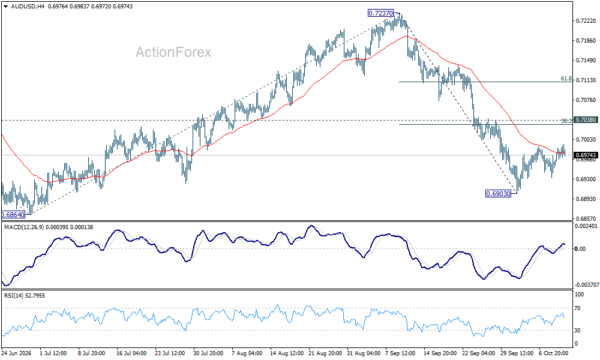
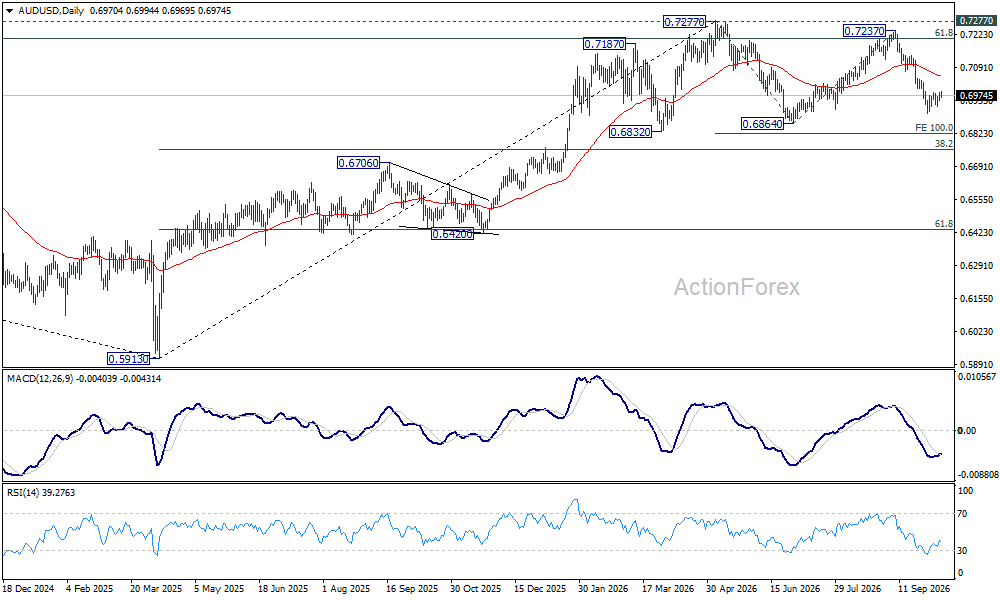
AUD/USD’s decline from 0.7237 to 0.6903 has coincided with a substantial broad-based US Dollar rally. Its next move may therefore depend more on Wednesday’s US CPI report and Treasury yield reaction than on Australia’s domestic releases.
The US 10-year yield retreated from 5.365% to around 5.242% last week as expectations for immediate Fed tightening faded. However, further rate increases remain possible, leaving Wednesday’s inflation data capable of either extending the yield correction or reviving Dollar strength.
Technically, AUD/USD’s fall from 0.7237 is viewed as the third leg of the consolidation pattern originating from 0.7277. The recovery from 0.6903 has improved short-term momentum, but the near-term outlook remains bearish as long as 0.7038 resistance holds.
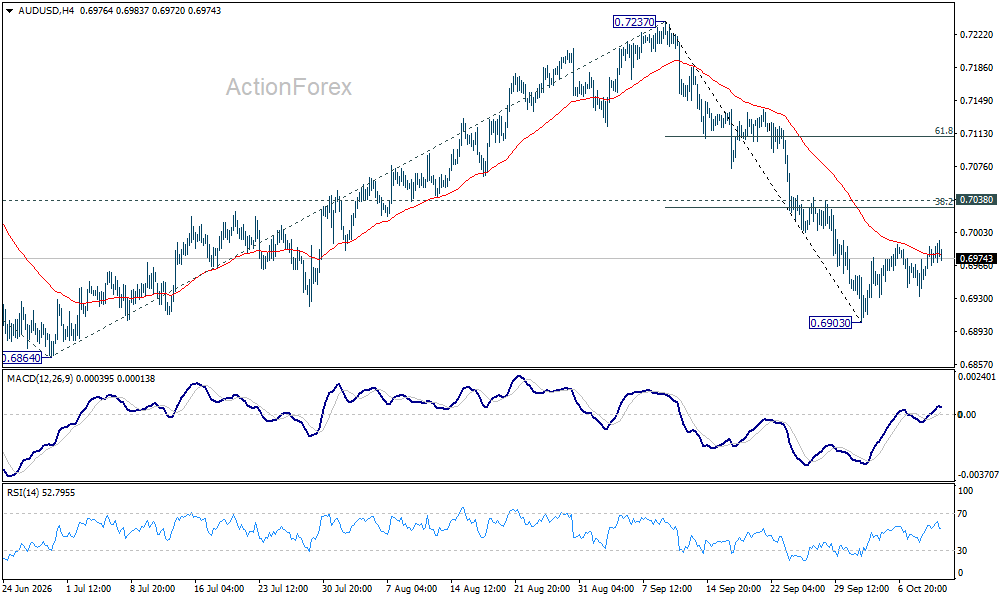
A break below 0.6903 would extend the decline toward 0.6864 support, followed by the 100% projection of 0.7277 to 0.6864 from 0.7237 at 0.6824. Nevertheless, strong support is expected around the 38.2% retracement of the larger advance from 0.5913 to 0.7277, at 0.6756. That area could provide the foundation for completing the consolidation pattern and starting another recovery.
Conversely, a firm break above 0.7038 would suggest that the decline from 0.7237, and potentially the entire consolidation from 0.7277, has already completed.
The timing of the economic releases is particularly important. US CPI arrives Wednesday evening in Australia, ahead of Thursday’s Australian employment figures. AUD/USD could therefore experience substantial repricing on the US side before domestic labour-market data are published.
EUR/AUD: Euro Weakness Keeps the Downtrend Intact
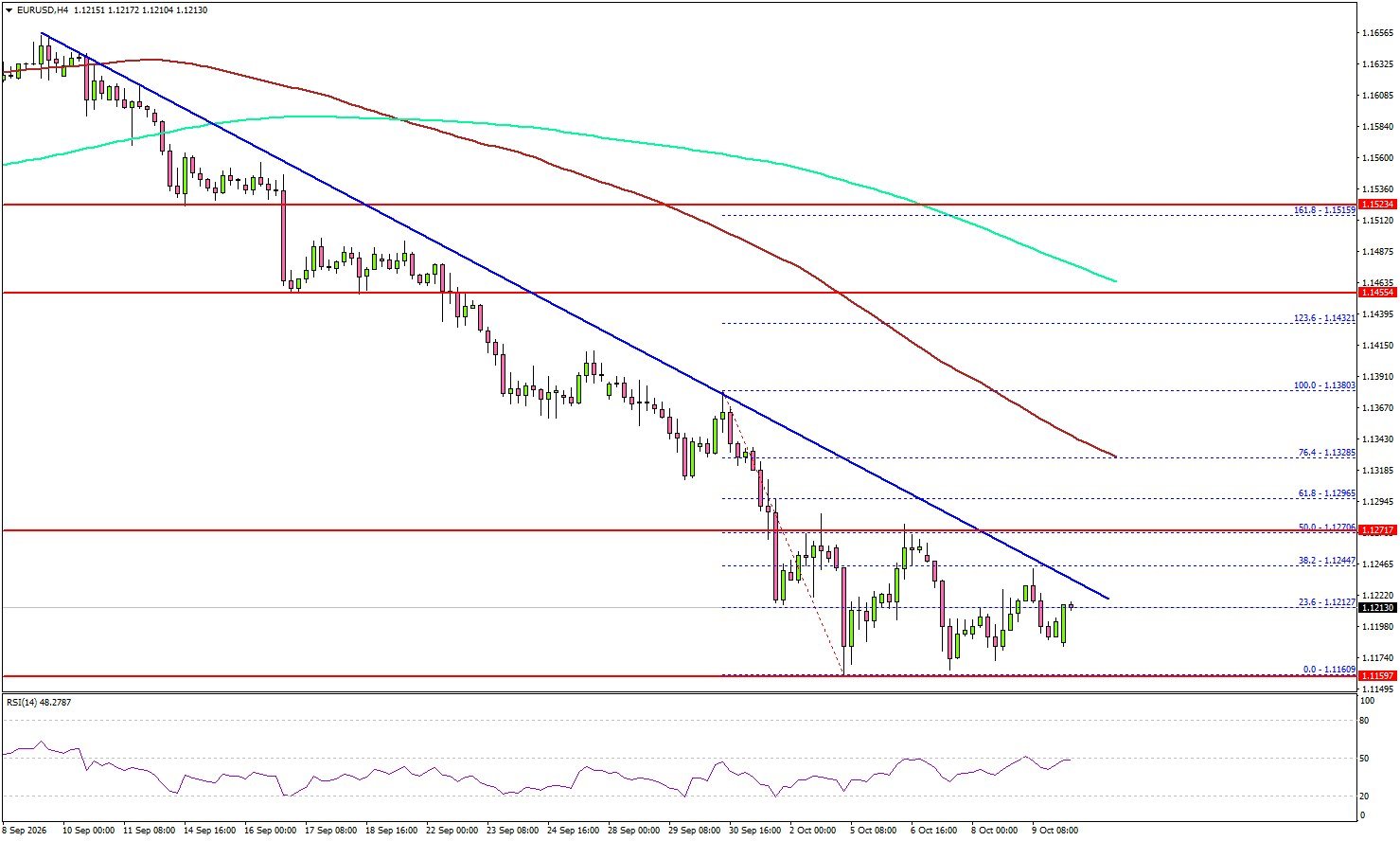
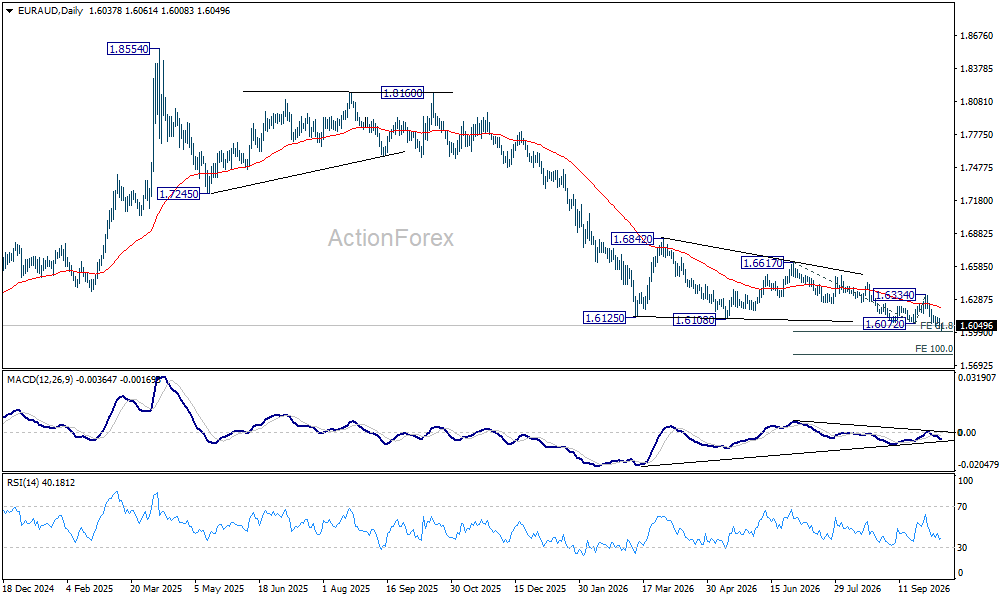
EUR/AUD presents a different story. Its continued decline reflects persistent Euro weakness, with French sovereign and fiscal uncertainty weighing on the common currency even as the Australian Dollar lacks a convincing independent trend.
French political uncertainty and elevated sovereign yield spreads remain important sources of pressure. Renewed widening in the French OAT–Bund spread could reinforce Euro weakness, while stabilization would remove some of that pressure.
Technically, EUR/AUD’s downtrend from 1.8554 has resumed following the break below 1.6072 support. Immediate focus is now on the 61.8% projection of 1.6617 to 1.6072 from 1.6334, at 1.5997. A firm break there would target the 100% projection at 1.5789.
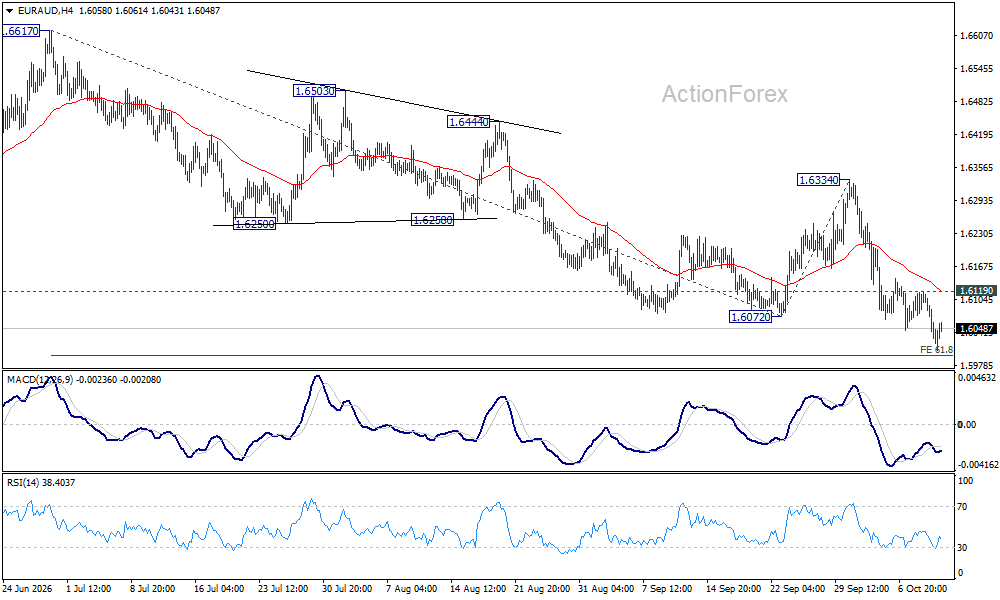
On the upside, a break above 1.6119 minor resistance would turn intraday bias neutral and bring consolidation. Nevertheless, the broader outlook would remain bearish as long as 1.6334 resistance holds.
That leaves EUR/AUD vulnerable to further declines even without a meaningful shift in Australian rate expectations. However, unexpectedly weak Australian employment data could still interrupt the downtrend by reducing expectations for further RBA tightening.
Aussie Needs a Domestic Catalyst to Break Its Indecision
This week’s Australian calendar offers two opportunities for markets to reassess the timing of the next RBA hike, with Thursday’s employment report likely carrying more new information than Tuesday’s minutes.
Yet neither release is guaranteed to settle the debate. With another hike already broadly anticipated but its timing uncertain, a decisive Australian Dollar move would probably require a meaningful change in near-term RBA pricing.
Until then, AUD/NZD, AUD/CAD and GBP/AUD could remain range-bound, while AUD/USD follows US inflation and Treasury yields, and EUR/AUD responds to developments in France and the Eurozone.
The real test of whether the Aussie can establish a direction of its own may ultimately come on October 28, when quarterly underlying inflation data arrive just ahead of the next RBA decision.
Key Takeaways
- RBA rate-hike pricing is split almost evenly across November (31%), December (25%) and February (28%), leaving the Aussie without a clear near-term rate catalyst.
- Tuesday’s RBA minutes are likely to offer limited new information; Thursday’s employment report, especially its composition (full-time jobs, participation, hours worked), carries more potential to shift pricing.
- AUD/NZD, AUD/CAD and GBP/AUD remain range-bound, while AUD/USD is driven by US CPI and Treasury yields, and EUR/AUD by French fiscal stress and Euro weakness.
- AUD/USD’s near-term bias stays bearish below 0.7038, with a break under 0.6903 opening 0.6864 and 0.6824; EUR/AUD’s downtrend stays intact below 1.6334, targeting 1.5997 and 1.5789.
- October 28’s quarterly CPI, not this week’s releases, is likely the real test of whether the RBA’s hike timing—and the Aussie’s direction—becomes clearer ahead of the November 3 meeting.