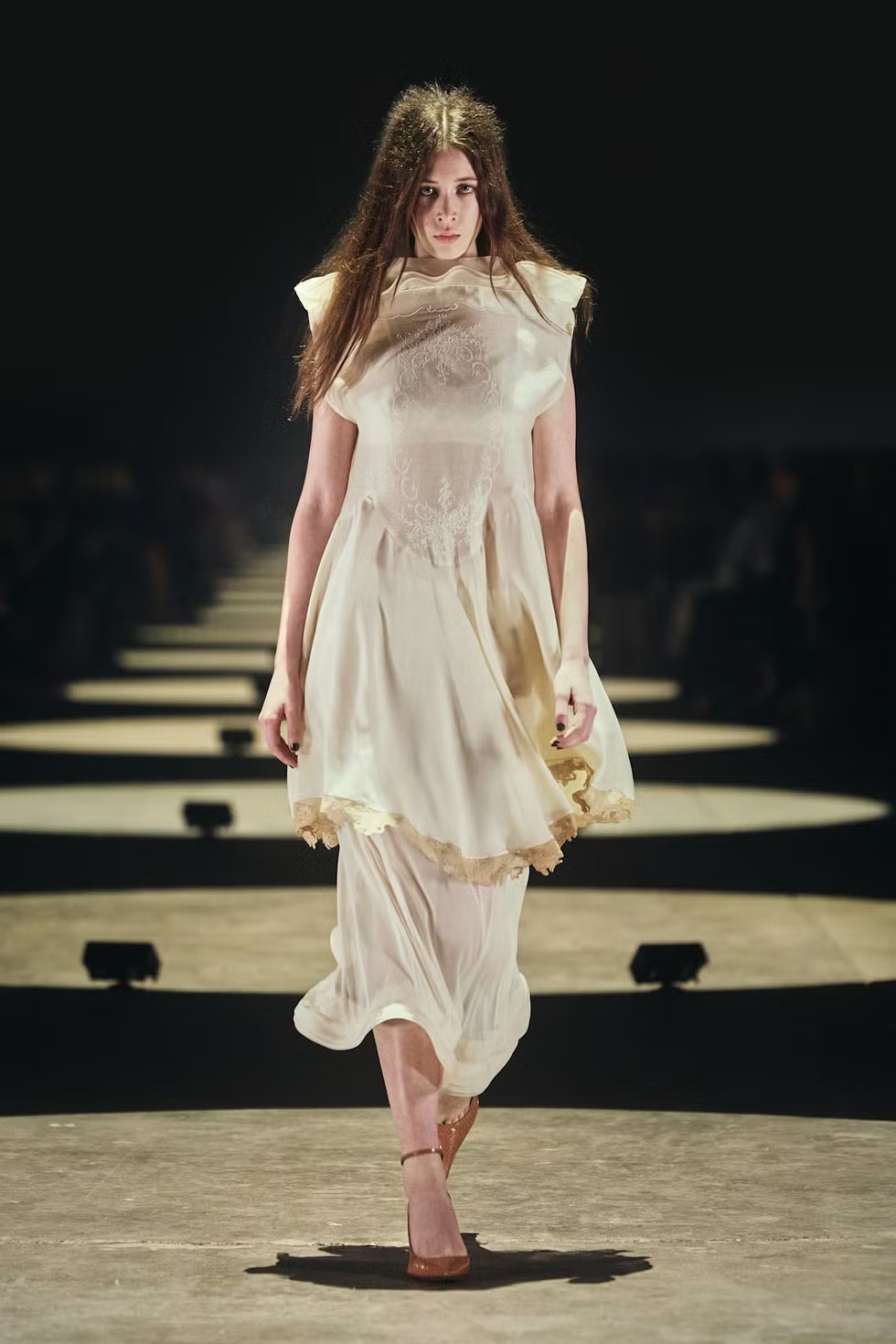
Tight corsets, ruffled bustles, and witchy boots: Victorian style has seamlessly taken over our screens in recent weeks. First came the recent releases of Netflix’s East of Eden and Monster: The Lizzie Borden Story and, next, comes Victorian Psycho, the gothic horror-thriller film based on the book by Virginia Feito, out in theaters beginning Nov. 13, 2026. In these series and films that take place in Victorian times, women wear their high collars and statement lockets with a side of female rage rather than docile oppression. The runways are aligned. Given fashion’s predilection for antiques, Victorian style has been mulling around designers’ mood boards for several seasons now, with labels like Khaite, Erdem, Meruert Tolegan, McQueen, and Banshee of Savile Row visually referencing the era, which ranges from 1837 to 1901.

Khaite spring/summer 2027.

Meruert Tolegan spring/summer 2027.
The wickedly dark, highly detailed, handcrafted aesthetic feels groundbreaking in an era of lightning-speed, always-at-your-fingertips fashion. The silhouettes were dramatic and the jewelry told stories, whether it was of mourning or adoration. Today, the Victorian trend is not merely limited to the fantasy of our screens or the catwalk. Take Christina Grasso, for instance, who wears her ghostly capes and long white era-specific dresses with a modern Victorian attitude. The time period has long been a point of reference for the fashion content creator.
“I think what draws me to the Victorian era is the tension between restraint and excess, propriety and rebellion, romance and morbidity,” Grasso tells ELLE. “It was really the only period in which melancholy was treated as something beautiful, and to be embraced. It’s an aesthetic that sees getting dressed as an elaborate form of self-expression, where even the smallest details are imbued with meaning. And that’s something I’ve always subscribed to: the beauty of a gesture, an appreciation for the absurd, and small, sentimental details that may only be noticed by the person wearing them. Overall, it was an era in which the macabre and the eccentric intersected, and I tend to exist comfortably on that corner.”
Grasso is drawn to many of the detailed, handmade chatelaines, mourning jewelry, high collars, lace, boots, and hairwork. She is not unlike Cathy Ames (Florence Pugh) in East of Eden, who sports stacks of real antique gold lockets, veiled hats, Archaeological Revival earrings, guard chains, and chatelaines.

In Victorian Psycho, we see main character Winifred Notty (Maika Monroe) in high collars, peculiar bonnets, and stately dresses. Costume designer Allison Byrne meticulously researched the era for the film, studying everything from the real-life Victorian “lunatic asylums” to the distinct colors of clothing in antique paintings. She worked with old linen mills in Ireland to get the textures of the clothing just right. “The color for me is a really strong part of what we were doing,” she tells ELLE. “The fabrics we used were really instrumental in making that kind of detail work. They were very bright green or red in one way and then they were quite dull and textured in another way. I think that added to the kind of overall mayhem and kind of unnervingness of the whole thing.” She credits today’s fascination with Victorian fashion to the quality. “We’re kind of moving more and more away from the disposable quick-fix fashion.”

Victorian Psycho.
Like Cathy Ames and Lizzie Borden, however, Winifred Notty can swing an ax or shoot a gun; the corset, hoop skirts, and bustles no longer limit women. Victorian fashion is drama, darkness, and whole devotion; today’s version of it also represents rebellion, stitched in lace, linen, and gold.