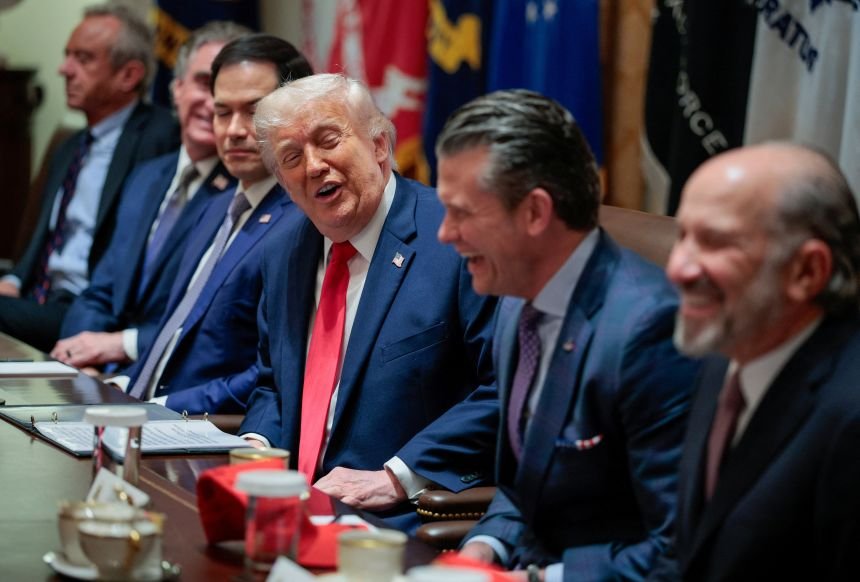
Deep into President Donald Trump’s news conference Monday, it became obvious why he’s so adamant in backing Defense Secretary Pete Hegseth amid an impeachment storm.
Ultimately, Trump is defending himself.
To jettison the former Fox News anchor now would be to admit that the Iran war — of which Hegseth is the administration’s most vehement proponent — was a mistake. A sacking would also undermine Trump’s attempt to recast what is at best an inconclusive military adventure and at worst a strategic disaster.
Trump delivered his most forceful endorsement yet of Hegseth on Monday just after the president’s arch-foe, Republican Rep. Thomas Massie, introduced eight articles of impeachment against the defense secretary in the House. His vote of confidence came in another surreal public appearance that he described as a “little fun” as he again offered Ultimate Fighting Championship czar Dana White the job of press secretary, then said he was “sort of kidding.”
“But really, what has Hegseth done?” Trump asked reporters. “He won the war. He was in charge. He won the war in Venezuela, as I said, (in) 48 minutes. It was flawless. Nobody killed. And he certainly — I think he’s won the war in Iran, but he’s certainly winning the war.”
The special forces raid that extracted President Nicolás Maduro was daring and dangerous, but it was hardly a war. And the idea that the US has won in Iran — at least in a strategic sense — is questionable.

Beyond the war, there are political reasons why a president who is retreating into an ever-smaller inner circle may be loath to let Hegseth go.
The Pentagon chief is the Cabinet member who has most consciously succeeded in replicating Trump’s political id. He dared to kick the press out of the Pentagon; wages culture wars and anti-woke crusades; and seems determined to wear impeachment as a badge of honor. If Trump rejected the man who rebranded the Pentagon the “Department of War,” he’d be trashing his own brand.
Yet as he raged at the perceived unfairness of Hegseth’s position in the White House Briefing Room, Trump also highlighted a political trap closing around him. He’s fighting the last political battle: Millions of midterms voters just rebuked his war and his confrontational politics. By digging in, he may make his plight worse.
Both Trump and Hegseth seem to be living in their own chosen reality amid a war in which a smaller, less powerful, repressive regime has survived the US superpower onslaught. The war has cost tens of billions of dollars and counting; alienated US allies in the Gulf; and triggered an energy and cost of living crisis.
The president said on Sunday’s edition of CBS’ “60 Minutes” that he “wouldn’t change a thing” about the conflict. Hegseth told reporters Monday that he’d be happy to “litigate … the success” of administration military operations “all day long.”
Trump’s claims that he’s eradicated Iran’s nuclear program for good may take years to fully evaluate. But continuing to argue to voters that a war they hate is a triumph seems like an endlessly losing political proposition.

Impeachment is the gravest constitutional fate that can befall a public official. At least it was, in the normal political world that seemed to disingtegrate once Trump took office. Hegseth is accused, among other things, of illegally waging war in Iran in violation of constitutional war powers restrictions; of ignoring laws designed to mitigate civilian casualties; and of abusing his powers by overseeing “extrajudicial killings” against alleged drug boats in the Caribbean and Pacific.
Each of the articles of impeachment — which also cover strikes in Yemen and the attempt to punish Arizona Sen. Mark Kelly for telling service members they can refuse illegal orders — raises a genuinely serious constitutional debate.
“The reality is we’re not indicting him for being bad at his job. In fact, he was very effective at killing schoolchildren in Iran,” Massie said. “He was very effective at extrajudicial killings. There’s no argument in these impeachment articles that he’s ineffective. The argument here is that he’s broken laws and he’s violated the Constitution.”
But in a sense, Trump is correct: This is a deeply political process.
A longtime Trump antagonist, Massie drew the president’s ire for his successful efforts to pass a law opening the Epstein files to public view. The president was instrumental in cutting short Massie’s political career by backing a MAGA primary rival. “He’s a sick, sick guy. There’s something wrong with him, actually,” Trump said Monday, blasting Massie as a “stone-cold loser.”
Massie returns the compliment. And he lampooned Hegseth in predicting how he’d respond in a rare news conference the defense secretary has called for Tuesday. “I hope he addresses the eight articles and doesn’t get up and misquote the Bible in Quentin Tarantino fashion and do some pull-ups and, you know, call everybody fat and gay, like for being for this impeachment,” Massie told reporters.
The timing of Massie’s impeachment drive is also significant. After the Republican midterm wipeout, it will allow aggrieved lame-duck GOP lawmakers to cast a revenge vote against Trump and the war that propelled the loss of their jobs. A sizable group of Republican defectors could undermine Hegseth’s authority and raise the costs to Trump of standing by him.
Democrats are just loving the spectacle.
“I’m a hard yes, as I’ve made clear, on the impeachment resolution,” House Minority Leader and likely next House Speaker Hakeem Jeffries said Monday. He mocked the Iran war plan as “Operation Epic Failure,” adding that “Pete Hegseth has abused his power, undermined America’s national security. And he’s the architect of the reckless and costly failed war of choice in Iran, which has skyrocketed gas prices on everyday Americans, made the country less safe.”
House Democrats would gleefully vote to impeach any Trump official. But they’ll have to walk a fine line in the new Congress as they try to avoid overreaching in their planned Trump investigations while honoring voters’ demands to ease the affordability crisis.
But the current impeachment, brought by a Republican, essentially gives Democrats a free vote and insulates them against any political downside of pursuing the issue themselves.
Hegseth’s gamble — and why he may not ultimately survive

Hegseth’s news conference may not follow Massie’s script. But it’s a risk. If it replicates hyper-aggressive videos he’s released in his own defense — apparently to catch Trump’s eye — he may deepen disquiet about his performance among GOP House members and inadvertently make the case for his impeachment.
He seems safe from being ejected from office in the short term, since a two-thirds majority to convict seems unlikely in any Senate impeachment trial.
But a defense secretary who has angered both parties over the war won’t be out of the woods. On Monday, Republican Sen. Kevin Cramer, who serves on the Armed Services Committee, told reporters he didn’t back impeachment but added: “Whether he should keep his job or not is up to either him and his family or the president,” he said.
And Hegseth could prove to be a liability when Trump needs to get defense spending requests through a Democratic Congress.
Massie told CNN’s Kaitlan Collins on Monday that he believed there was “a high probability” that Hegseth wouldn’t make it to the end of the year in office.
“They stand by them, until the day they don’t,” Massie said, predicting that the new Congress would call in officials who’d served under Hegseth “who’ve seen some things and know some things that aren’t even public yet.”
Then there’s the war that won’t end.
Trump showed Monday he’s still got no plan for a permanent peace, veering between predictions of an imminent deal; claims that it was not a real war anyway; and a warning he was “locked and loaded and ready to go” for a new assault.
If he can’t extricate himself, the war will besmirch his final two years in office. But turning a political page would be tricky with Hegseth still at the Pentagon.
The defense secretary’s most perilous moment may therefore come not after impeachment but at the moment when Trump can best protect himself not by defending Hegseth, but by pitching him overboard.

