When Prime Minister Mark Carney announced the new Productivity Mega Deduction (PMD) at the Canada Investment Summit, business groups reacted with predictable enthusiasm. The policy allows companies to immediately write off the entire cost of about two-thirds of capital assets on a permanent basis.
I have long argued that Canada needs a permanent, immediate write-off for all business investment. The problem has been our timid, piecemeal approach. The earlier Productivity Super Deduction covered only about 15 percent of capital assets and came with an expiry date. The PMD aims to address both: it broadens the scope and removes the ticking clock.
For a company deciding whether to buy a new machine or update equipment, this is a clear win. It lowers upfront costs and gives businesses cash flow when they actually spend money.
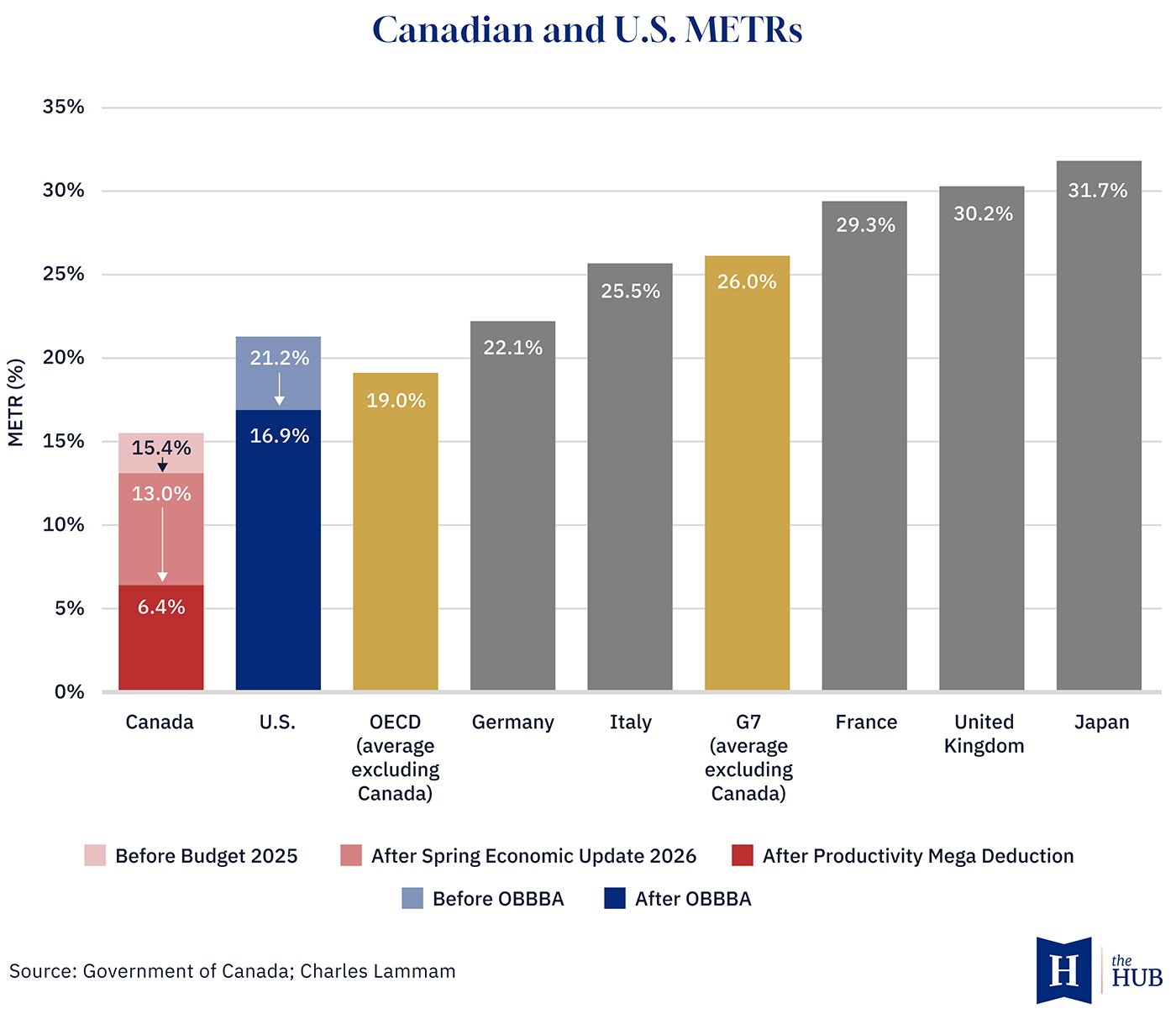
Yet the excitement has spawned a troubling narrative, treating the following widely circulated chart as gospel on Canadian tax competitiveness.

Graphic credit: Janice Nelson
It comes from the federal Department of Finance’s backgrounder. The government claims the PMD slashes Canada’s marginal effective tax rate (METR) from 13.0 percent down to just 6.4 percent. Because the United States sits at 16.9 percent and the OECD average is 19.0 percent, Ottawa now declares Canada the most competitive country in the G7 for new business investment.
Commentators and business leaders have swallowed this 6.4 percent figure whole. The trouble is that it paints a misleading picture of our actual tax environment.
Charles Lammam critiques Prime Minister Mark Carney’s Productivity Mega Deduction (PMD), arguing that while it offers immediate tax benefits for capital investments, it does not address the broader issues of Canadian tax competitiveness. The PMD’s focus on equipment write-offs overlooks the need for comprehensive tax reform, particularly in personal income and capital gains taxes. Lammam emphasizes that Canada’s average corporate tax rate remains high compared to the U.S., and the PMD fails to benefit all sectors equally. Without broader reforms, Canada’s investment challenges will persist despite the PMD’s introduction.

