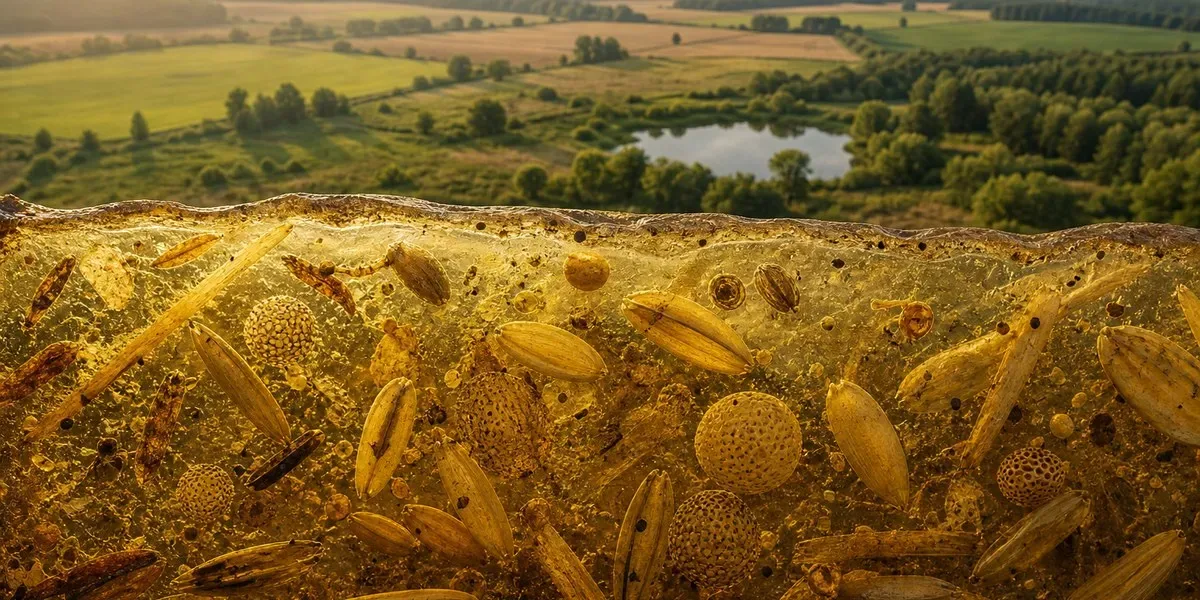
Farmland abandonment across medieval Europe following the devastating Black Death triggered a staggering 40% drop in local plant biodiversity. New research published in Ecology Letters confirms that when rural communities were wiped out and agricultural activity collapsed, the surrounding floral variety did not flourish into an undisturbed natural paradise—instead, it shrank considerably.
The findings challenge deep-seated assumptions about human intervention and nature. By scrutinising fossilised pollen strata spanning centuries, scientists mapped how the sudden cessation of medieval ploughing, grazing, and rotational cropping led to an unexpected ecological decline across multiple regions, including southwestern Great Britain.
The Pollen Record: Tracking Continental Ecological Upheaval
During the 14th century, the Black Death—a bubonic plague pandemic caused by the lethal bacterium Yersinia pestis—wiped out over one-third of the European population. Entire rural settlements vanished almost overnight, leaving vast tracts of arable land uncultivated for generations before human numbers began to recover in the 16th century.
To reconstruct how vegetation responded to this abrupt human exit, an international research team examined over 100 pollen records comprising roughly 4,600 individual samples. The geographic scope stretched across Western Europe, tracing ecosystems from the uplands of southwestern Great Britain and the lowlands of France up to the Swiss Alps.
Researchers used the presence of cereal pollen—specifically wheat, barley, and rye—as a direct proxy for active land management. By classifying geographic zones into three distinct categories, the team isolated how shifting rural activity dictated species variety:
- Areas where agricultural production contracted significantly
- Regions where farming output steadily expanded
- Landscapes showing zero evidence of cereal cultivation
According to the study’s first author, University of York paleoecologist Jonathan Gordon, the overall decline in biodiversity was driven primarily by landscapes with declining agricultural production.
The Recovery Phase
The ecological slump was not permanent, but it took generations to reverse. As human populations gradually recovered roughly 150 years later, renewed agricultural activity and land management spurred floral regeneration. Once regular cultivation returned to the landscape, overall botanical variety rebounded to a level slightly higher than pre-plague baselines.
Mosaic Landscapes vs Modern Industrial Monoculture
The sharp post-plague drop highlights a profound environmental paradox: traditional human farming historically nurtured richer botanical varieties than immediate land abandonment. Rather than creating uniform monocultures, historical agrarian societies maintained intricate mosaic landscapes.

Medieval agricultural systems integrated open crop fields with woodland patches, heathlands, secondary tree cover, and livestock ponds. This complex patchwork provided varied microclimates and soil environments, allowing distinct plant species to thrive side by side.
| Historical Mosaic Farming | Post-Plague Land Abandonment |
|---|---|
| Varied habitat edges (heath, wood, open fields) | Homogeneous scrub and canopy succession |
| Rotational cereal crops (wheat, rye, barley) | Loss of disturbed ground essential for annuals |
| High structural micro-habitat diversity | Sharp 40% decline in overall plant richness |
| Sustained coexistence of wild and managed flora | Loss of species dependent on regular human disturbance |
When the pandemic removed human land managers, aggressive pioneer plants and dense shrubbery expanded unchecked. Without active grazing, clearing, and crop rotations, dynamic border zones disappeared, crowding out smaller, light-demanding wild species.
This historical insight carries urgent lessons for modern conservation across Britain and continental Europe. Today’s commercial farming predominantly relies on vast monocultures, which deplete wild habitats. Paleoclimatologists and ecologists suggest that re-evaluating ancient land-use strategies could illuminate how sustainable agricultural production and rich ecosystem functions can successfully coexist.
💡 The historical record proves that nature and human agriculture are not always natural adversaries when traditional landscape diversity is preserved.
🔍 Understanding how our ancestors managed patchwork field systems could revolutionise future rewilding and farming policy across Britain.
👇 Leave your thoughts in the comments below: Can modern farming recreate the biodiversity-rich mosaic landscapes of the past?