Over the past year, as I’ve spoken to audiences across Canada, one question keeps coming up. If Canadians are so anxious about the economy, frustrated by the cost of living, and worried about their futures, why is Mark Carney’s government so popular?
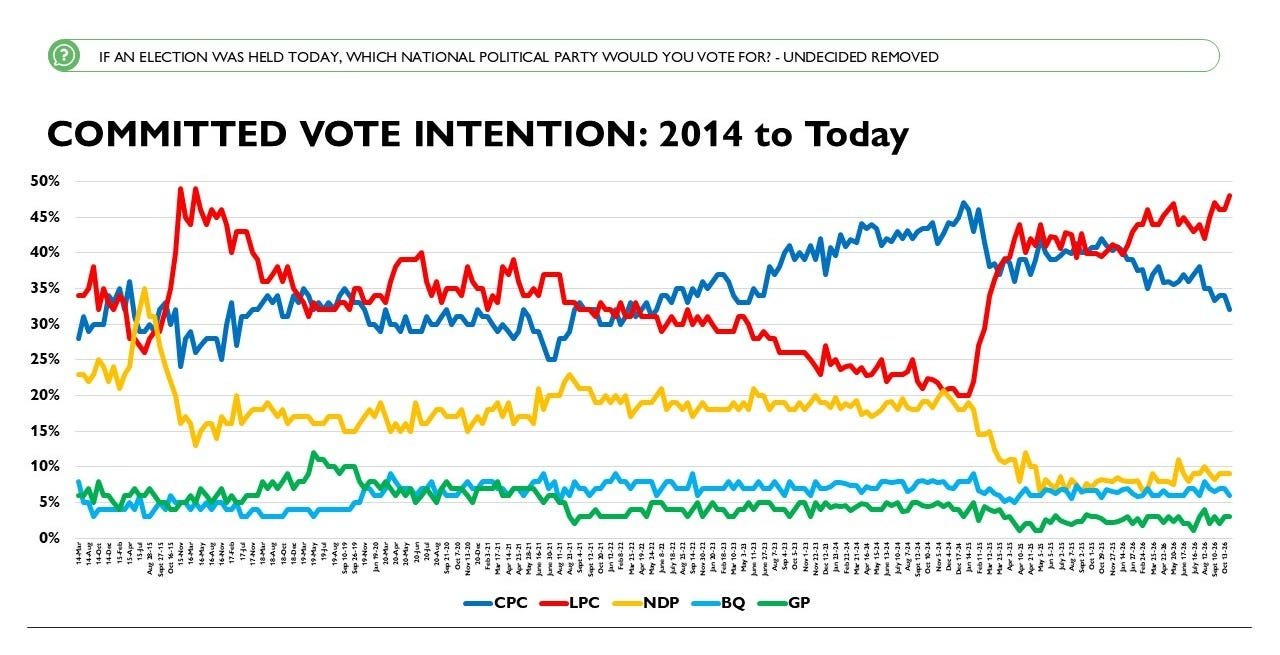
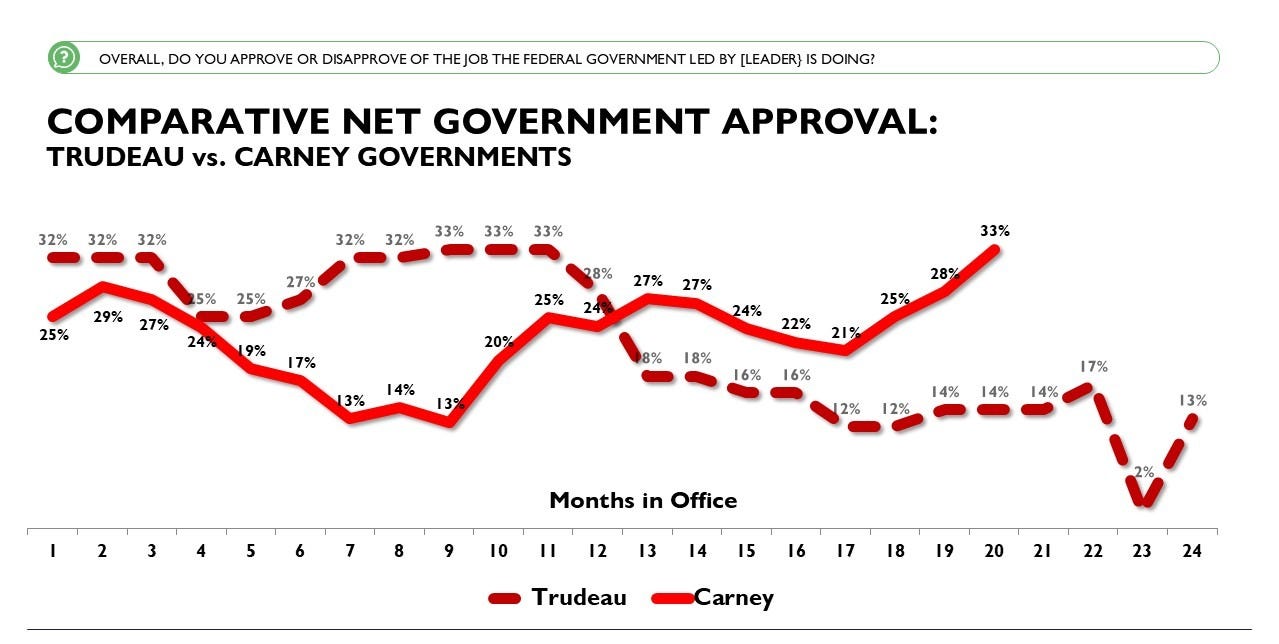
It is a reasonable question. In our latest Abacus Data national poll, the Liberals have reached 48% support, their highest level since April 2016, and 59% of Canadians approve of the federal government’s performance. Carney’s personal impression rating is a remarkable net positive 29.
These are exceptionally strong numbers for a government whose party has been in power for more than a decade, particularly when the economy remains uncertain and a substantial majority of Canadians continue to worry about their financial security.
Now consider what is happening elsewhere in the country.
Over the past thirteen months, voters have
-
replaced the governing party in Newfoundland and Labrador,
-
wiped out the Coalition Avenir Québec in Quebec, and
-
ended nine years of NDP government in British Columbia.
In Ontario, seven in ten residents want a change in provincial government, even as Doug Ford’s Progressive Conservatives remain ahead in voting intentions. In Saskatchewan, the governing Saskatchewan Party is in a statistical tie with the NDP after nearly two decades in power.
And in last week’s, municipal elections across Ontario and earlier in B.C. produced another series of incumbent defeats. Andrea Horwath lost in Hamilton, Carolyn Parrish was defeated in Mississauga, and longtime mayors in communities including Oakville, Milton, Niagara Falls, and Kingston were rejected by voters. Others, including Olivia Chow in Toronto, survived, reminding us that the mood is not uniformly anti-incumbent.
The contrast is striking. At the federal level, a government entering its twelfth year is more popular than at almost any point since its first year in office. At the provincial and municipal levels, governments with much shorter records are facing substantial dissatisfaction.
I think the explanation is that Canadians are living through two different political experiences at the same time.
-
Nationally, they are looking for protection from an unpredictable world, particularly the threat posed by Donald Trump and the United States.
-
Provincially and locally, they are judging governments on whether their lives are becoming easier or harder.
The federal government is being evaluated primarily as a protector. Provincial and municipal governments are being evaluated as providers.
And right now, those are producing very different political outcomes.
To understand this divide, I think we need to start with something Eddie Sheppard and I have been studying since early 2025: the Precarity Mindset.