Washington — President Trump seems to be reconsidering his approach to Democrats after Tuesday’s massive Republican election losses and has so far made contradictory comments about how he plans to deal with them as they take control of the Senate and the House in January.
“We’re going to work with the Democrats,” the president told Politico as GOP defeats were beginning to stack up Tuesday night, though in a phone call with CBS News’ Robert Costa before polls closed, he had said, “I have the ultimate power — it’s called ‘veto.'”
By Wednesday afternoon, he had merged the two approaches.
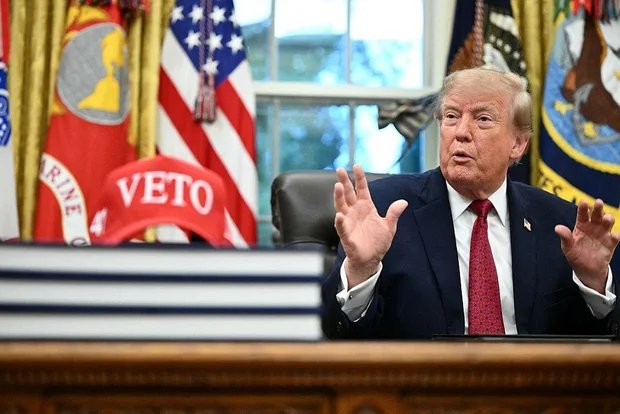
“I’ll get along, probably, with the Democrats, unless they want to be destructive, but I have the power of the veto,” the president told reporters at the White House ballroom construction site Wednesday. On Thursday, a red hat that said “VETO” sat on the Resolute Desk in the Oval Office.
MANDEL NGAN /AFP via Getty Images 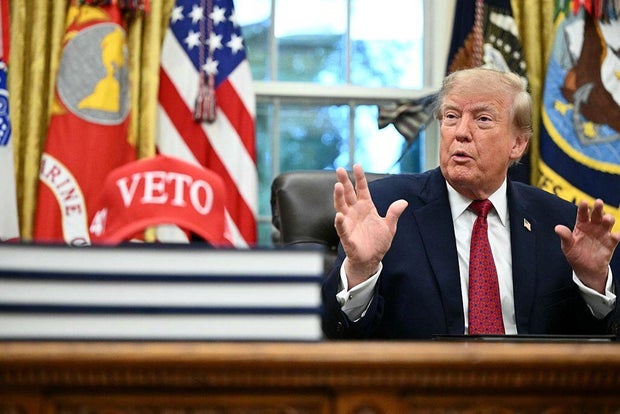
But Democrats may not be the only source of friction ahead. After two years of working in lockstep with Mr. Trump, some Republicans may prove more willing to defy the term-limited president to try to salvage their political careers.
Here’s what the newly empowered congressional Democrats may have in store for Mr. Trump in 2027 for the last two years of his presidency.
Oversight and investigations
The committee chair’s gavel comes with subpoena power, and Democrats plan to wield it.
“Lawyer up,” warned Rep. Robert Garcia of California, the incoming chairman of the House Committee on Oversight and Government Reform. He has been mapping out the panel’s investigative agenda for months.
New probes will focus on the Trump family’s business dealings, corporate corruption, Department of Homeland Security and Immigration and Customs Enforcement actions and the Jeffrey Epstein scandal, Garcia said.
Garcia wants to know more about Donald Trump Jr.’s Bahamas wedding festivities that were partially paid for by a Russian oligarch, a $2 billion investment that Jared Kushner’s private equity fund received from Saudi Arabia’s sovereign wealth fund, the Trump family’s crypto ventures, companies linked to the president’s sons that have received Pentagon contracts, allegations of a pay-to-play scheme and other kickbacks related to DHS contracts and White House ballroom donations.
“Folks that need to be concerned first are administration officials that have caused real harm. We’re going to investigate the abuses,” Garcia said at a news conference in California on Wednesday.
He singled out White House deputy chief of staff Stephen Miller, former DHS official Corey Lewandowski and former DHS secretary Kristi Noem, as well as Trump family members, as possible targets.
“There’s a lot of folks that need to understand that we are going to ask them to testify in front of the U.S. Congress,” Garcia said.
He acknowledged that the Trump Justice Department is unlikely to take any enforcement action against those who don’t cooperate. But he said that in the majority, Democrats will have the power to sue on behalf of the House.
“We have the power of contempt charges. And contempt charges not only go to the DOJ; there’s also a civil contempt process that goes to the courts,” he said.
Democratic Rep. Jamie Raskin of Maryland, who will lead the House Judiciary Committee, has his own lengthy list of investigative targets, some of which overlap with the oversight committee, like the Justice Department’s handling of the Epstein probe and Ghislaine Maxwell’s transfer to a low-security prison.
Raskin also plans to scrutinize what Democrats have characterized as “slush funds” — an international initiative called the “Board of Peace;” the “anti-weaponization” fund created from a settlement of a Trump lawsuit against the IRS and Treasury Department and White House ballroom funding.
“There are private entities that we can subpoena to come in,” Raskin told Punchbowl News, regarding other avenues to gather information from outside of the Trump administration.
Rep. Adam Smith of Washington, the top Democrat on the House Armed Services Committee, said he plans to conduct “vigorous oversight” of the Defense Department.
The “illegal war against Iran is top of mind for me and the American people,” Smith said in a statement Wednesday. He said he also plans to look at “sweetheart deals” and waste, fraud and abuse in government contracts.
Smith also wants to investigate the “unauthorized military strikes in the Caribbean and Latin America, the deployment of the military to U.S. cities, and the blatant and corrosive politicization of our Armed Forces and purging of the ranks based on loyalty and ideology.”
Douglas Kriner, a professor in Cornell University’s Government Department, said “there’s always been greater investigatory activity in divided governments than when the president’s party controls Congress.” He said the House has always been more aggressive in its investigations than the Senate.
A White House official said that if Democrats want to “abuse their power and politicize the process of investigations, subpoenas and destroying lives, they should be reminded that we still control the federal government and all of its powers.”
“As the president has said, he’s willing to work with anyone to continue delivering victories for hardworking Americans,” said White House spokeswoman Lauren Bis. “If Democrats choose to pursue sham investigations and radical left policies, they are choosing to work against the American people.”
Not inclined to impeach Trump at this point
During the campaign, Mr. Trump often predicted he’d be impeached if Democrats took control of Congress, but for now, they’ve shown no sign that this is on their agenda. On Wednesday, House Minority Leader Hakeem Jeffries told reporters, “I haven’t had a single member of the House Democratic Caucus talk to me about impeachment.”
Mr. Trump was impeached twice during his first term when Democrats controlled the House. Both efforts ended without a conviction in the Senate, which requires a two-thirds majority vote.
Even those on the far left, like Rep.-elect Melat Kiros of Colorado, who is among the contingent of democratic socialists joining Congress next year, told CBS News in a recent interview that the party should focus on legislation that could make a material difference in the lives of working-class people.
“I’m not convinced that there is a path forward for impeaching the president that would lead to removal,” she said.
Asked whether he would support impeaching the president, Rep.-elect Chris Rabb of Pennsylvania, another democratic socialist, told CBS News that the question was “too broad” for him to answer.
Some Democratic leaders like Raskin agree there are more important issues to address than pursuing impeachment, even though they believe that Mr. Trump has committed impeachable offenses. Raskin was the lead House manager for Mr. Trump’s second impeachment.
The president also perceives that there’s currently little appetite for a third try.
“Not even a little bit,” Mr. Trump responded when asked if he was worried about being impeached again. “I think it would destroy the Democrat Party if they did that. ‘Cause impeachment for no reason — what, for having a successful country? Our country is more successful now than at any time in its history.”
Taking back power of the purse
Democrats will also be taking back Congress’ power of the purse from Mr. Trump, who often bypassed the Senate and the House, and Republicans in the Capitol, who usually went along with the president’s budget priorities. But their much slimmer House majority often slowed down the process.
Democratic Rep. Rosa DeLauro of Connecticut, who’s expected to lead the House Appropriations Committee, said she plans to use “what tools are available” to rein in the Trump administration.
In a recent interview, DeLauro said she wants to address cost-of-living issues but also said, “I will fight Donald Trump and the Cabinet secretaries as well.”
“I’m going to hold the Trump administration accountable for the corruption,” she said. “I’m going to rein in corruption at the highest level of government. I would do that through appropriations.”
“We will build in guardrails in the appropriation bills,” DeLauro added.
Asked whether she would consider zeroing out funding to enforce accountability, DeLauro said all options “will be reviewed.”
Although congressional Democrats plan to ratchet up the pressure on the Trump administration, they know they’ll need to work with Republicans on major legislation, like funding the government because of the Senate filibuster. The majority of measures need to reach a 60-vote threshold of support in the Senate to overcome a filibuster.
With a few exceptions like the One Big Beautiful Bill Act, “most of what Congress has done in the first two years of the Trump administration has required bipartisan support because it’s had to overcome the filibuster,” said Molly Reynolds, vice president and director of governance studies at the Brookings Institution. “So, in that sense, we would still be looking at bipartisan legislating.”
Kriner suggested Democrats may try to use the appropriations process, limitation riders and other tools at their disposal to influence what Mr. Trump’s agencies can and can’t do. And more than once, the White House Office of Management and Budget has unilaterally made spending decisions about funds that were already appropriated by Congress. The OMB has tried to make the case, Kriner said, that presidents have exclusive powers under Article II to decide how money is spent.
“That’s been the central front of an institutional battle over the first two years of the Trump administration, and it has really big, lasting implications for what the balance of power across the branches is going to look like,” Kriner said.
In contrast with the White House’s pugnacious tone, Mr. Trump has been more conciliatory and said he may work with Democrats.
“My message is congratulations to the Democrats, and I look forward to working with you for the good of our country,” the president told CBS News senior White House correspondent Weijia Jiang on Tuesday night.
What will happen to Trump nominees?
Democratic control of the Senate will make it difficult for the president to get his nominees confirmed.
Mr. Trump has repeatedly said he doesn’t plan to fire Defense Secretary Pete Hegseth. But he also told ABC News’ Jonathan Karl on Wednesday that it would be easier to confirm a new defense secretary before the new Congress is seated in January.
The president will likely have to rely on acting officials for roles that need to be filled, unless he nominates candidates who can win bipartisan support.
Power of the pen
The president has relied on executive authority for much of his second-term agenda, even under the unified control of government he enjoyed during his first two years in office.
Brandon Rottinghaus, political science professor at the University of Houston, said, “That’s been his M.O. He likes it as a streamlined way to pursue his objectives in a way that aren’t checked typically by Congress.”
Rottinghaus noted that President Barack Obama increasingly relied on executive actions after Republicans won back the House in 2010, especially on his immigration priorities, many of which were challenged in court and rolled back by the Trump administration.
“Legislative constraints will encourage presidential unilateralism, but the courts will definitely limit those kinds of actions,” Rottinghaus said.
The president picked up his pen Thursday to sign an executive order designating the Oval Office and Cabinet Room national landmarks, saying future presidents won’t be able to make major changes. But a future president could also sign a new executive order to undo it.
Trump’s relationship with Republicans
Before the elections, most Republicans in Congress supported, defended and voted for Mr. Trump’s priorities. Now, Mr. Trump is looking at what Rottinghaus called a “ticking clock.”
“The last two years are going to be the hardest of his political career,” Rottinghaus said. “His leverage over members of Congress, especially Republicans, will diminish as lawmakers think about their own political futures rather than the president’s.”
“Republicans are going to have to figure out a way forward,” he continued. “You know, they’re going to have to figure out a way forward around Donald Trump.”