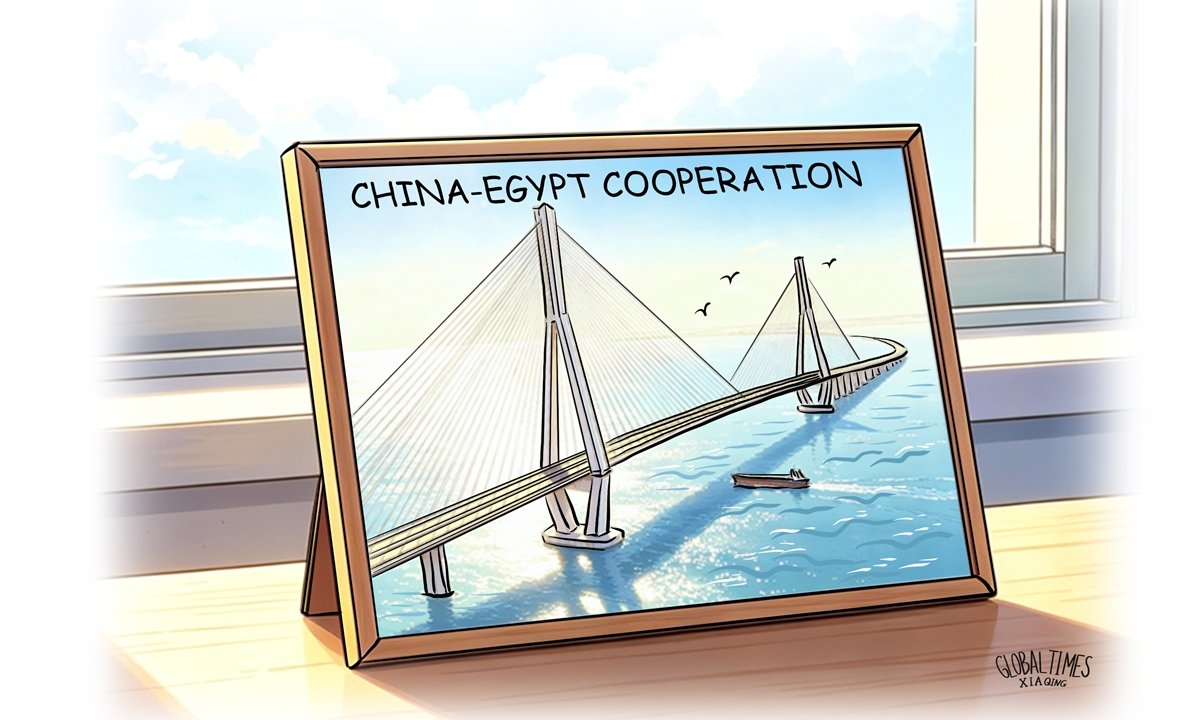
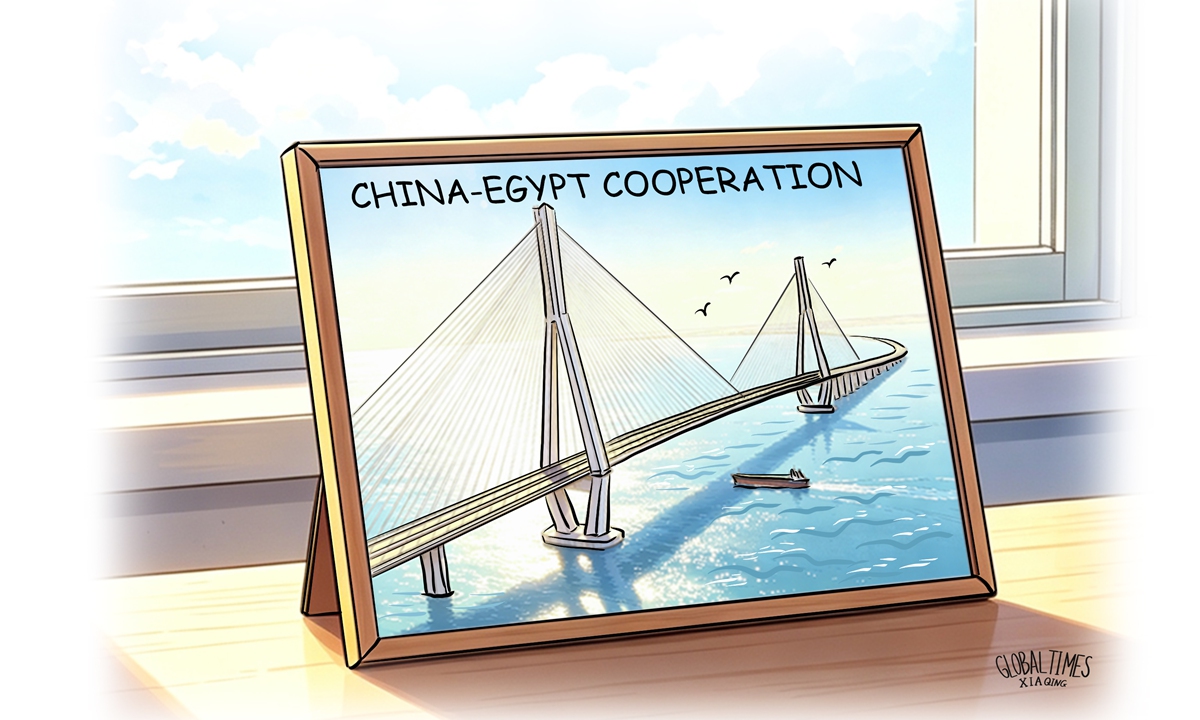
China-Egypt ties. Illustration: Xia Qing/GT
When the winds of the Nile reached Shanghai in the summer of 2024, they carried more than ancient Egyptian artifacts. The exhibition On Top of the Pyramid: The Civilization of Ancient Egypt at the Shanghai Museum attracted remarkable public attention. Chinese visitors queued in large numbers, while additional night tickets were quickly sold out. With a duration of 13 months and over 2.77 million visitors, the exhibition became one of the most iconic cultural events in recent years of China-Egypt cultural exchange. This phenomenal exhibition conveyed a message about the unusual affinity between two peoples whose civilizations have survived for thousands of years.The significance of that moment has become even clearer in 2026, as China and Egypt celebrate the 70th anniversary of diplomatic relations. A recent Global Times Institute survey provides quantitative evidence of something that the Shanghai exhibition revealed qualitatively: China’s interest in Egypt is not confined to government circles or specialists. It has a substantial popular dimension. The survey found that 85 percent of Chinese respondents had some degree of knowledge about Egypt, including around 40 percent who described themselves as very or relatively familiar with the country.
Even more revealing is what comes to mind when Chinese people think about Egypt. 66 percent associated Egypt first with symbols of its ancient civilization, including the pyramids, pharaohs, mummies and the Sphinx, while 39 percent specifically associated Egypt with its status as an ancient civilization. The Nile was mentioned by 30 percent and the Suez Canal by 20 percent.
This tells us something important about the foundation of people-to-people relations: Civilizations can become a common language.
China and Egypt are separated geographically, but they are connected by a powerful historical experience. Both developed sophisticated civilizations around great rivers; both created enduring systems of writing, architecture, administration and knowledge; and both have maintained a strong sense of historical continuity despite enormous transformations over the centuries.
That is why the cultural dialogue between Egyptians and Chinese differs in an important respect from many conventional international cultural exchanges. It is not simply an exchange between two distant cultures; rather, it is, in many respects, a dialogue between two civilizations that recognize elements of their own historical experience in each other.
Civilizational dialogue does not require uniformity. On the contrary, it becomes meaningful precisely because civilizations are different. Mutual understanding grows when people can appreciate differences without treating difference as distance.
China’s history is becoming increasingly familiar to Egyptians through archaeological cooperation, museums, tourism, educational exchanges, Chinese cultural centers and the growing presence of Chinese companies and products in Egypt. The relationship is therefore moving from seeing to understanding.
This evolution is also reflected in the 2026 Global Times Institute survey. Nearly 90 percent of respondents gave positive or neutral assessments of current China-Egypt relations, with 63 percent describing the relationship as very or relatively good. Meanwhile, 99 percent of respondents said China and Egypt should deepen cooperation.
These figures suggest that people-to-people relations should no longer be treated as a secondary component of the bilateral relationship. They are becoming one of its strategic assets. The opportunity is particularly significant in tourism, education, archaeology, media, youth exchanges and digital culture. In particular, in the age of short videos, livestreaming and AI-supported translation, the Nile can reach the Yangtze virtually every day.
The next stage should therefore be to institutionalize this people-to-people momentum. Egypt and China could establish expanded youth and university exchange programs, joint archaeological schools, museum partnerships, Chinese-Arabic cultural content platforms, documentary projects, translation initiatives and joint research programs on ancient civilizations, water management and sustainable development. There is also an economic dimension. Cultural familiarity creates trust, and trust can facilitate tourism, education, investment and commercial relations.
Seventy years after the establishment of diplomatic relations, the China-Egypt relationship therefore possesses something that cannot be created through treaties alone: a growing reservoir of mutual curiosity, respect and cultural affinity.
The challenge now is to transform that affinity into sustained human connections. The future of China-Egypt relations should not be measured only by the number of agreements signed, projects constructed or trade figures achieved. It should also be measured by how many Chinese students learn about Egypt, how many Egyptian students learn about China, how many tourists cross the distance between the two countries, how many researchers work together, and how many ordinary citizens can recognize something of themselves in the civilization of the other.
The Nile and the Yangtze are separated by thousands of kilometers. Yet their civilizations have something profound in common: Both demonstrate that great societies do not survive simply by preserving their past. They survive by continuously renewing it.
In the 21st century, Egypt and China have an opportunity to transform their ancient civilizational affinity into a modern partnership between peoples. The winds of the Nile have already reached the Yangtze. The next chapter should ensure that the winds of the Yangtze reach the Nile as well.
The author is chairman and founder of the Asia Center for Studies & Translation in Egypt. opinion@globaltimes.com.cn