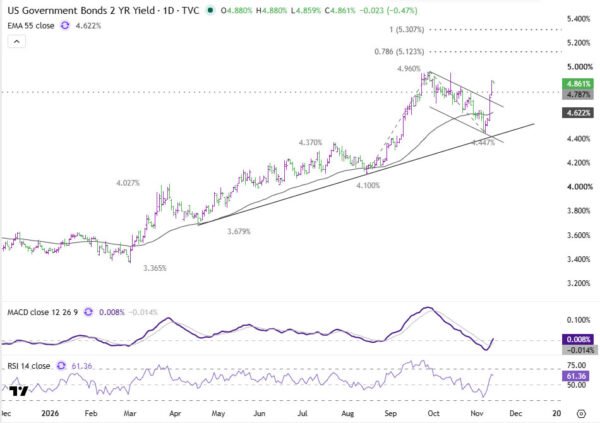
TL;DR: A sharp hawkish repricing of Fed expectations has pushed the US two-year yield toward 5% resistance and dragged precious metals lower, but yields and the Dollar cannot explain silver’s whole slide. Whether yields break through 5% or stall there, together with silver’s 48.60 support, will shape the next phase.
Why Is the US Two-Year Yield Near 5% Putting Silver Under Pressure?
The US two-year Treasury yield is approaching a critical resistance zone around 5% after a sharp repricing of Federal Reserve rate expectations this week, while gold and silver have both fallen approximately 5% since Tuesday morning. The moves highlight renewed pressure on precious metals as markets adjust to the prospect of further monetary tightening. With the two-year yield threatening to resume its broader uptrend and silver’s corrective rebound already faltering, the next test of their respective technical levels could prove decisive for the near-term outlook.
The relationship between yields and precious metals has become particularly evident since Tuesday’s US inflation surprise, although the simultaneous appreciation of the Dollar makes it difficult to isolate the effect of higher borrowing costs. The key question is whether the latest repricing has further to run, or whether the approach of major resistance in Treasury yields will offer metals some relief.
Follow the US two-year yield’s 5% test and silver’s 48.60 support on the ActionForex Telegram channel.
Treasury Yields Reprice in Two Waves as Inflation Challenges Fed Expectations
The US two-year yield has climbed from around 4.55% before Fed Governor Christopher Waller’s remarks on Tuesday to approximately 4.86% in Friday’s Asian session, an increase of nearly 32 basis points.
The first leg of the advance had clear monetary policy catalysts. Waller opened the door to a larger December rate increase, while October CPI subsequently exceeded expectations, reinforcing concerns that inflation was proving more persistent than policymakers had anticipated.
The second leg developed on Thursday, when the two-year yield surged again toward 4.89%. Unlike Tuesday’s move, its immediate catalyst was less clear. The advance began before President Donald Trump’s comments dismissing renewed diplomacy with Iran and before the weekly jobless claims release. Those developments occurred during the broader market adjustment, but neither can confidently explain its beginning.
What matters is that the repricing has continued beyond the initial inflation shock. The market is no longer responding solely to one hawkish policymaker or one disappointing economic release. Investors are reassessing how much further monetary policy must tighten, and how long restrictive conditions may need to persist.
Thursday’s advance also coincided with rising global bond yields and pressure on technology shares. That combination suggests a broader adjustment in financial conditions, although the evidence does not establish a single cause linking all three markets.
Fed Pricing Shifts Toward a Second Hike by January
The evolution of Fed expectations helps explain why short-term yields have remained under upward pressure.
CME FedWatch showed a quarter-point increase as the dominant expectation for the December meeting, with an approximately 11% probability assigned to a larger 50bps move. More significantly, the probability of at least 50bps of cumulative tightening by January climbed from around 68% early Thursday to more than 76% by the afternoon.
- December: a 25bps hike dominant, with about 11% probability for 50bps
- At least 50bps of cumulative tightening by January: about 68% early Thursday to more than 76% by the afternoon
The shift was concentrated in expectations for a second hike rather than a substantial increase in the probability of exceptionally aggressive moves.
Markets are becoming more confident that the Fed will continue tightening beyond December, even without making 50bps increases the central scenario.
That distinction is consistent with the different messages from Fed officials. Waller has entertained a larger December increase following persistent inflation surprises, while Cleveland Fed President Beth Hammack favors smaller, more frequent steps. San Francisco Fed President Mary Daly also expects further tightening but argues that rising bond yields are already helping restrain financial conditions, allowing policymakers to proceed with greater calibration. New York Fed President John Williams reinforced the need for additional action without specifying its timing or magnitude.
The disagreement is therefore less about whether rates need to rise further than about how quickly the Fed must deliver that tightening.
This creates an important tension for Treasury yields. Market pricing already anticipates several additional increases, but persistent inflation and a resilient economy could still prompt investors to reassess the eventual policy peak. Conversely, if the Fed continues signaling gradual action while higher market yields provide additional restraint, the scope for further immediate repricing may narrow.
The available FedWatch readings, last updated Thursday afternoon, imply a tightening path extending well beyond January. However, the next sustained advance in the two-year yield may require markets to price a higher eventual rate peak, rather than simply confirm another near-term quarter-point hike.
Friday’s US PPI release will provide another test of inflation expectations, while December’s employment report and FOMC meeting will offer more consequential opportunities to reassess the path.
Gold and Silver Come Under Pressure as Real Yields and Dollar Rise
The consequences for precious metals have been substantial.
Since Tuesday morning, silver has declined from approximately $52.84 to $50.21, while gold has fallen from around $4,115.59 to $3,915.02. Both have lost close to 5%, accompanied by a Dollar Index advance of approximately 1.6%.
- Silver: about $52.84 to $50.21
- Gold: about $4,115.59 to $3,915.02
- Dollar Index: up approximately 1.6%
The movement is consistent with the traditional pressures that tighter monetary expectations can exert on precious metals.
Higher real yields increase the opportunity cost of holding assets that generate no interest income. A stronger Dollar can also weigh on Dollar-denominated commodities by making them more expensive for holders of other currencies.
The available real-yield figures reinforce that interpretation. The US five-year inflation-adjusted Treasury yield rose by 14 basis points on Tuesday, coinciding with the first phase of the hawkish policy repricing.
The important observation is that higher yields, a stronger Dollar and weaker precious metals have moved together during this week’s tightening adjustment. Their simultaneous movements, however, prevent a reliable separation of the individual contribution from yields and currency appreciation.
Nor does this relationship explain silver’s entire correction. Earlier declines occurred while Treasury yields were retreating, suggesting that other forces were also affecting the metal. Monday provided another counterexample, with precious metals advancing despite an increase in real yields as the Dollar weakened.
The evidence therefore supports a narrower conclusion: this week’s renewed tightening expectations have provided an additional headwind for precious metals, rather than a complete explanation for silver’s broader downtrend.
That distinction becomes important as both markets approach major technical levels.
ActionForex’s Technical View: US Two-Year Yield, 4.96–5.00% Resistance in Focus
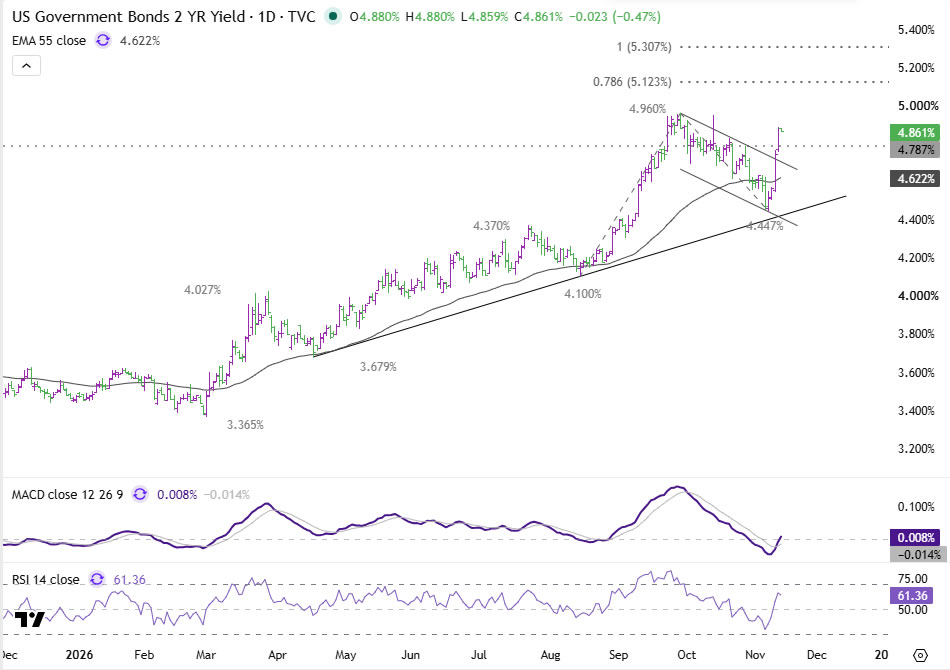
Technically, the strong break above 4.787% resistance strengthens the case that the corrective pullback from 4.960% has completed at 4.447%.
The subsequent rebound suggests that the broader uptrend from 3.365% may be resuming, with the next important test concentrated around the previous 4.960% high and the psychologically significant 5.000% threshold.
A decisive break through the 4.960–5.000% resistance zone would confirm renewed upside momentum, bringing the 78.6% projection of the advance from 4.100% to 4.960%, measured from 4.447%, into focus at 5.123%.
Rejection near 5.000% could trigger another retreat. However, the broader outlook would remain bullish while the 55-day EMA, currently around 4.622%, holds. Under that scenario, a breakout could be delayed rather than abandoned.
For precious metals, the distinction between rejection and a confirmed breakout is consequential. A sustained move above 5% would signal additional pressure from the front end of the Treasury market, while a failed attempt could moderate that pressure, depending on the accompanying movement in real yields and the Dollar.
ActionForex’s Technical View: Silver, Failed Recovery Puts 48.60 Back in Focus
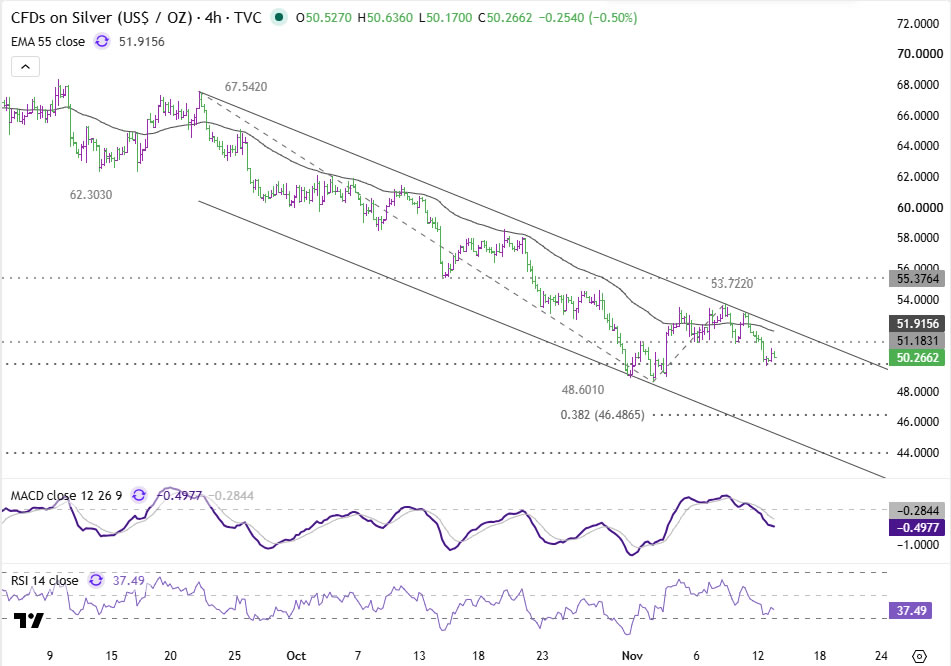
Silver’s near-term technical picture has deteriorated following the break below 51.18 support, suggesting that the corrective recovery from 48.60 has already completed at 53.72.
With price trading below the four-hour 55 EMA, currently around 51.91, and the descending channel intact, the immediate outlook remains bearish.
A retest of 48.60 is now favored. A decisive break below that support would extend the decline from 67.54 toward the 38.2% projection at 46.48.
Conversely, a break above the four-hour 55 EMA would delay the bearish scenario and suggest that the corrective pattern from 48.60 is extending through another rebound, potentially beyond 53.72.
The stronger resistance at 55.37, previously support, would need to be overcome to weaken the near-term bearish structure more meaningfully.
Medium-Term Silver Outlook Remains Bearish
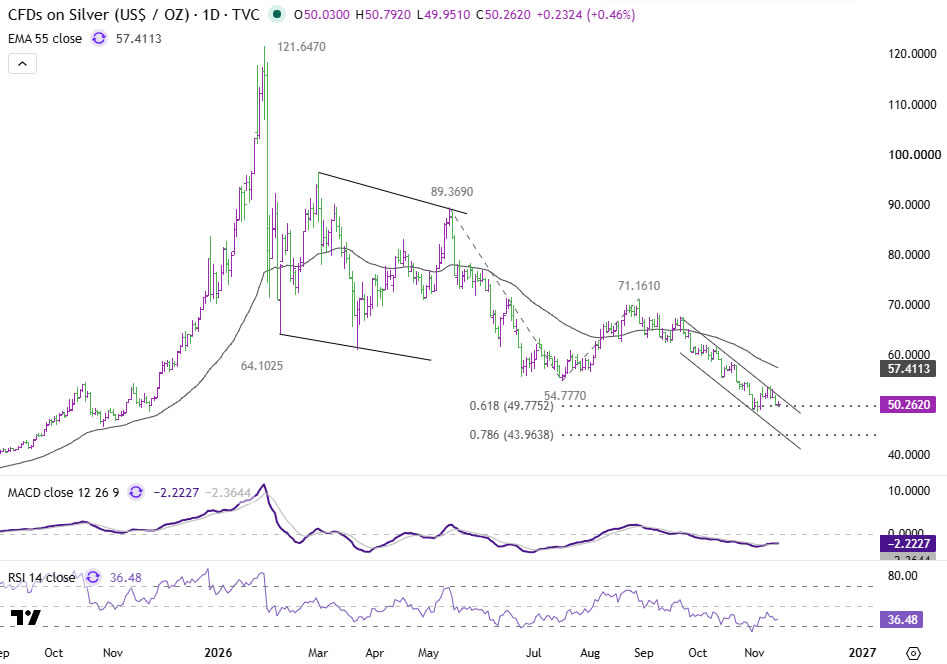
The daily chart reinforces the broader downside risk.
Silver’s rebound from 54.77 to 71.16 failed to reverse the correction from 89.36, and the subsequent decline has kept the metal below its falling 55-day EMA, currently around 57.41.
The broader downward structure therefore remains intact.
A firm break of 48.60 would open the way toward the 78.6% projection of 89.36 to 54.77 from 71.16, near 43.96.
The 46.48 four-hour projection represents an intermediate downside objective, while 43.96 would mark a deeper extension of the medium-term decline.
Silver is also approaching the 61.8% projection around 49.78, which provides another nearby reference before the 48.60 support test.
Two Critical Levels Could Determine the Next Move
The immediate outlook brings together two important technical tests: 4.960–5.000% in the US two-year yield and 48.60 in silver.
A confirmed yield breakout would support the case for additional monetary tightening pressure, particularly if real yields and the Dollar also advance. Under those conditions, silver’s bearish technical structure would face another challenge, with a break below 48.60 opening deeper downside targets.
But the relationship is not automatic. Treasury yields could retreat from resistance while silver remains weak for other reasons, just as silver could stabilize despite elevated yields if currency movements or other market forces become more supportive.
For now, the macroeconomic backdrop and silver’s technical structure point in the same bearish direction. The next question is whether Treasury yields can extend their breakout attempt toward 5%, or whether resistance there will slow the latest phase of pressure on precious metals.
Key Takeaways
- The US two-year yield rose from about 4.55% to about 4.86% since Tuesday, in two waves, and is approaching the 4.960–5.000% resistance zone.
- Fed pricing has shifted toward a second hike by January, with at least 50bps of cumulative tightening rising from around 68% to more than 76% on Thursday.
- Silver and gold have each lost close to 5% since Tuesday as the Dollar Index rose about 1.6%, though yields and the Dollar do not explain silver’s whole decline.
- A decisive break through 4.960–5.000% would target 5.123% in the two-year yield, while rejection could delay the breakout if the 55-day EMA near 4.622% holds.
- Silver favors a retest of 48.60, and a break lower would open 46.48 and then 43.96, while 55.37 is the resistance that would weaken the bearish structure.
Stay ahead of the 5% yield test and the silver support that could give way with it—join the ActionForex Telegram channel for regular market updates and analysis.