Event
In September, Türkiye was hit by a financial scandal reportedly amounting to USD 20 billion. The case became known as the “Fonzi scandal”, a name combining “fund” with a reference to Ponzi schemes.
Impact
The scale of the scandal and the profile of those involved have had significant repercussions for the Turkish economy. The case has also raised serious questions about regulatory oversight and the authorities’ failure to intervene earlier.
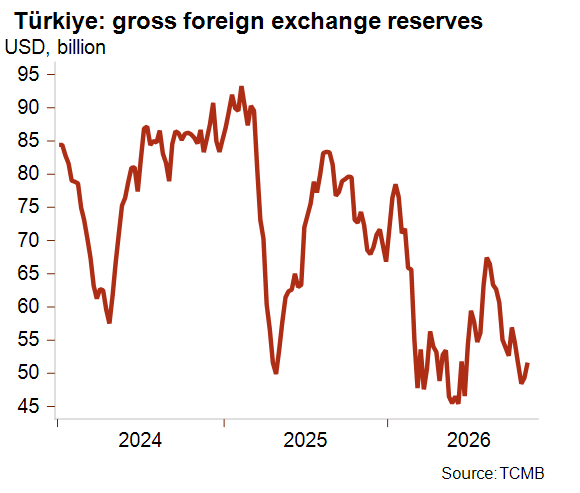
The Turkish stock market fell sharply, consumer confidence weakened and gross foreign exchange reserves declined (see graph). In October, MSCI, a global index provider, took measures affecting the MSCI Türkiye indexes and could reclassify Türkiye from an emerging market to a frontier market at its next review in June 2027. Such a move would further undermine investor confidence.
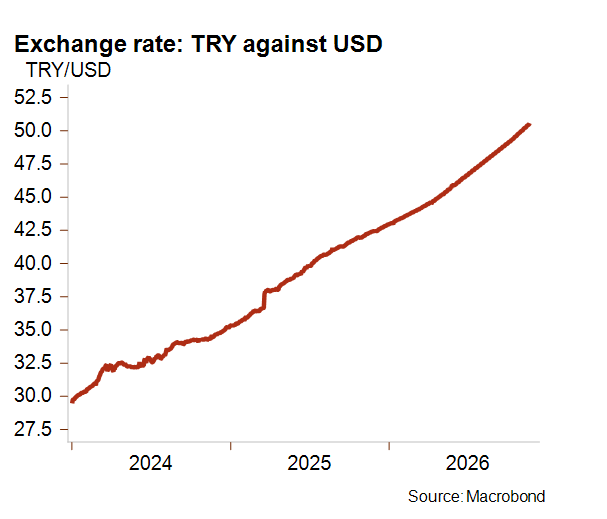
These recent developments are particularly concerning given Türkiye’s main economic vulnerabilities: weak external liquidity and heavy reliance on foreign capital. The scandal has damaged foreign investor confidence and put renewed pressure on foreign exchange reserves excluding gold (see graph) which the central bank partly uses to manage the depreciation of the Turkish lira (see graph). These reserves cover less than two months of imports. Meanwhile, rising energy import costs are increasing current account payments. According to the IMF, the current account deficit is expected to widen from 1.9% of GDP last year to 2.9% in 2026. The external financing environment could also become more difficult because of higher interest rates and increasing financial market risks linked to AI.
In this context, Credendo’s short-term political risk outlook is negative, reflecting heightened liquidity risks. The medium- to long-term political risk outlook nevertheless remains stable in category 4/7, as Türkiye’s underlying solvency position remains strong.
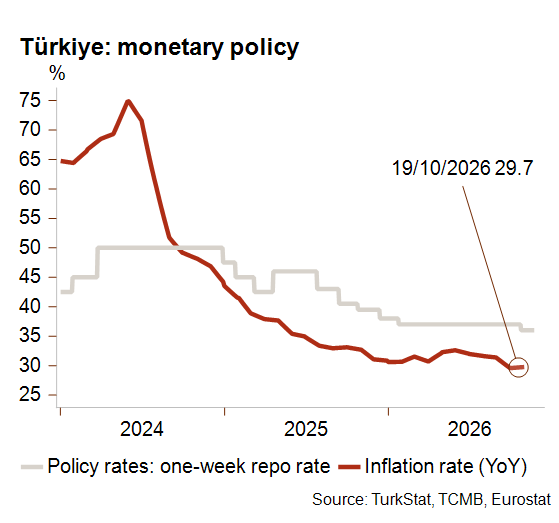
Persistently high inflation represents another major macroeconomic vulnerability. Despite the financial scandal and higher energy prices associated with the conflict in the Middle East, the central bank reduced its policy rate to 36% as inflation continued to moderate amid weaker consumer confidence. However, annual inflation remained close to 30% in September (see graph) and continues to be an important source of social discontent.
Analyst: Pascaline della Faille – P.dellaFaille@credendo.com