
Photo by Alex Wong/Getty Images
-
Trump called his four-day Asia tour “one of the most successful presidential visits in American history,” citing more than 20 world leaders met, two new trade deals signed, and $17 billion in commercial agreements secured at the ASEAN Summit in Manila.
- The first-ever US-China-Russia trilateral summit produced a joint nuclear declaration but no binding commitments on Ukraine, Iran, tariffs, or Taiwan — the four disputes most consequential to the region.
- Philippine Airlines committed to purchasing 20 Boeing 787 Dreamliners with GE engines, the Philippines agreed to source 100% of its agricultural products and energy from the United States, and Trump described the bilateral deal as the largest in both nations’ history.
- Trump threatened to impose heavy taxes on US companies building AI data centers abroad, said he and Xi Jinping agreed on joint AI “guardrails,” and expressed interest in seeing Jensen Huang return to Nvidia — all while acknowledging a rift between Commerce Secretary Howard Lutnick and Treasury Secretary Scott Bessent over chip exports to China.
- The 90-minute-plus briefing — Trump’s first since the midterm elections — also touched on national tech outages, a Greenland political announcement, Democratic outreach, and new Chief of Staff Stephen Miller, who spoke from the podium.
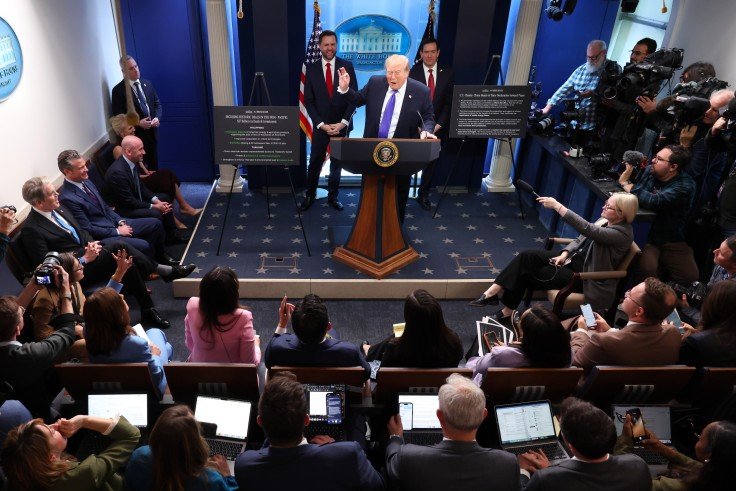
President Trump stood at the White House briefing room podium on Friday flanked by Vice President JD Vance, Secretary of State Marco Rubio, and newly appointed Chief of Staff Stephen Miller, delivering what became a nearly two-hour ranging account of his four-day Asia tour and much else besides. It was his first formal press conference since the midterm elections, and he moved through it at a pace that defied easy summary — covering the China summit, a Boeing deal, artificial intelligence, the Nvidia feud inside his own cabinet, Iran, Ukraine, tech outages, and a brief but striking remark about Greenland, all before wrapping up with an assessment of Hakeem Jeffries.
The Trip by the Numbers
Trump opened by framing the journey in quantitative terms. He said he met with more than 20 heads of state, attended four major international summits, and secured two new trade deals with roughly ten more expected in the near term. At the ASEAN Summit in Manila, he said the United States locked in more than $17 billion in commercial agreements that he said would benefit thousands of American workers. He called the trip the most successful presidential visit to Asia in US history. Both Vance and Rubio spoke before Trump took questions, with Rubio — who accompanied the president throughout — recounting his own assessment of what the week produced.
The Xi-Putin Summit: Historic Optics, Limited Outcomes
The centerpiece of the journey was an unprecedented gathering at Kylin Villa in Shenzhen, where Trump sat alongside Chinese President Xi Jinping and Russian President Vladimir Putin in the first trilateral meeting the three leaders have ever held. The 90-minute session on the sidelines of APEC produced a four-point joint declaration reaffirming that “a nuclear war cannot be won and must never be fought,” pledging to expand global refined petroleum supply, rejecting the International Criminal Court’s jurisdiction, and calling for United Nations structural reform. Ukraine, Iran, Taiwan, and tariffs — the four flashpoints most central to regional security — did not appear in the text.
At Friday’s briefing, Trump described “great electricity” in the room during the trilateral and praised the reception Xi gave him at the airport tarmac. He defended calling Putin a friend in direct terms: “I have fantastic relationships with Putin. That’s a very good thing,” adding that the relationship gives the United States “a lot of additional strength” given Russia’s nuclear arsenal. Rubio, for his part, said it would be “absurd and dangerous” for the leaders of the three largest nuclear powers not to meet regularly.
The Philippines Deal: Boeing, Agriculture, and Energy
Among the most concrete outcomes of the Manila leg was a sweeping bilateral agreement with the Philippines. Trump confirmed that Philippine Airlines signed a commitment to purchase 20 Boeing 787 Dreamliner aircraft equipped with General Electric engines, a transaction he said would support roughly 47,000 American jobs. Beyond aviation, the Philippines agreed to source all of its agricultural products from US farmers beginning January 1 and to meet 100% of its energy needs through American suppliers. Trump described the overall deal as the most expansive bilateral agreement the two countries have ever reached. Thailand also substantially concluded a reciprocal trade agreement, adding to what Trump characterized as a broader diplomatic harvest from Southeast Asia.
Artificial Intelligence: Guardrails, Data Centers, and Jensen Huang
Trump confirmed that he and Xi had agreed on joint “guardrails” for artificial intelligence development — a framework intended to reduce the risk of an unchecked technological competition between the two powers. He also announced plans to impose heavy financial penalties on US companies that build AI data centers outside the country, an idea he acknowledged he had not yet formally briefed to his own team. The Quad partnership — comprising the United States, Japan, Australia, and India — launched a Superintelligence Accelerator initiative during the same trip.
Trump then turned to a domestic controversy within his own administration. He said he would “love to see” former Nvidia CEO Jensen Huang — recently removed amid a reported chip export scandal — return to lead the company. He also acknowledged a reported rift between Commerce Secretary Howard Lutnick and Treasury Secretary Scott Bessent over the question of semiconductor sales to China, though he expressed continued confidence in Lutnick.
Ukraine: What Putin Said — and What Russia Did Afterward
On Ukraine, Trump said Putin told him directly that he would never have invaded if Trump had been in the White House. He described the Russian president as “having a hard time” and called the conflict “stuck,” while asserting that both sides want to end the war. He added that he sees a genuine path to a negotiated outcome. The claim came despite Russia continuing military strikes after the China meetings concluded. Senior advisors Jared Kushner and Steve Witkoff held parallel talks with Ukrainian President Volodymyr Zelensky and European leaders in Germany on the same day, suggesting coordinated back-channel diplomacy remains active.
Iran: Dirty Bomb Threat, Naval Blockade, and “Decades of Lies”
Trump addressed reports of a dirty bomb threat targeting Washington, D.C., calling the reports a rumor while stating flatly that the United States “will not allow” such an attack. The US naval blockade of the Strait of Hormuz — in force since April 2026 after Islamabad negotiations collapsed — was reaffirmed as ongoing, with Trump saying America maintains total control over the waterway. He said the United States wants a “real deal” with Iran but accused the government in Tehran of “decades of lies” at the negotiating table, warning that Iran will never be permitted to acquire a nuclear weapon under his watch.
Nationwide Tech Outages and Air Traffic Control
Trump addressed a series of recent nationwide technology outages that rattled critical infrastructure during his trip abroad, characterizing them as unrelated incidents rather than a coordinated attack. “All separate events,” he said. He used the moment to reiterate his call for Congress to fund a full modernization of the country’s air traffic control system, calling the current infrastructure “ancient” and warning it poses a genuine public safety risk. The Federal Aviation Administration attributed a recent ground stop to a hardware failure; the director of national intelligence indicated the broader outages stemmed from software patches.
Stephen Miller, Democrats, and the Midterms
New White House Chief of Staff Stephen Miller took the podium during the briefing and claimed the administration’s first-year record was without parallel in modern history. Trump praised Miller and drew a pointed contrast with the midterm results, saying Republicans lost ground precisely because he was not on the ballot himself. When asked about Vice President Vance’s suggestion that the Iran conflict cost the GOP seats, Trump called the assessment “very accurate.”
On the question of bipartisan cooperation, Trump said he is open to working with Democrats but would veto any legislation they pursue without his involvement. He called House Minority Leader Hakeem Jeffries “a streetwise guy” and described a recent call with Texas Governor-elect Gina Hinojosa as “very productive.” The Senate-passed permitting reform bill — which Trump said would save American households $1,300 per year — now moves to the House, where he urged rapid action.
Greenland: One Line, No Elaboration
In what may prove to be one of the more consequential asides of the briefing, Trump told reporters that Greenland’s political status had been “approved yesterday” and that the United States “has it powerfully.” He offered no context, no timeline, and no details. The remark is certain to trigger a sharp diplomatic response from Copenhagen and Brussels, where any assertion of American authority over the Danish autonomous territory has been categorically and consistently rejected since Trump first raised the issue during his first term.
© {{Year}} Latin Times. All rights reserved. Do not reproduce without permission.