The standard for Android smartphones in the modern age is that they come with a big touchscreen that handles just about every input, with a handful of physical buttons on the side. There was a time, though, when physical buttons ruled the roost. The time when keyboard phones dominated the market feels like an age ago.
When Android keyboard phones were all the rage, there was a lot more variance in the market. Manufacturers had to get creative to stand out, and get creative they did. This meant that we got some incredible smartphones with really cool hardware, albeit a little gimmicky. It was one of my favorite eras for smartphones, and the choices below elbowed their way to the front of the pack, standing out amongst the crowd.
6
HTC Dream (T-Mobile G1)
The OG

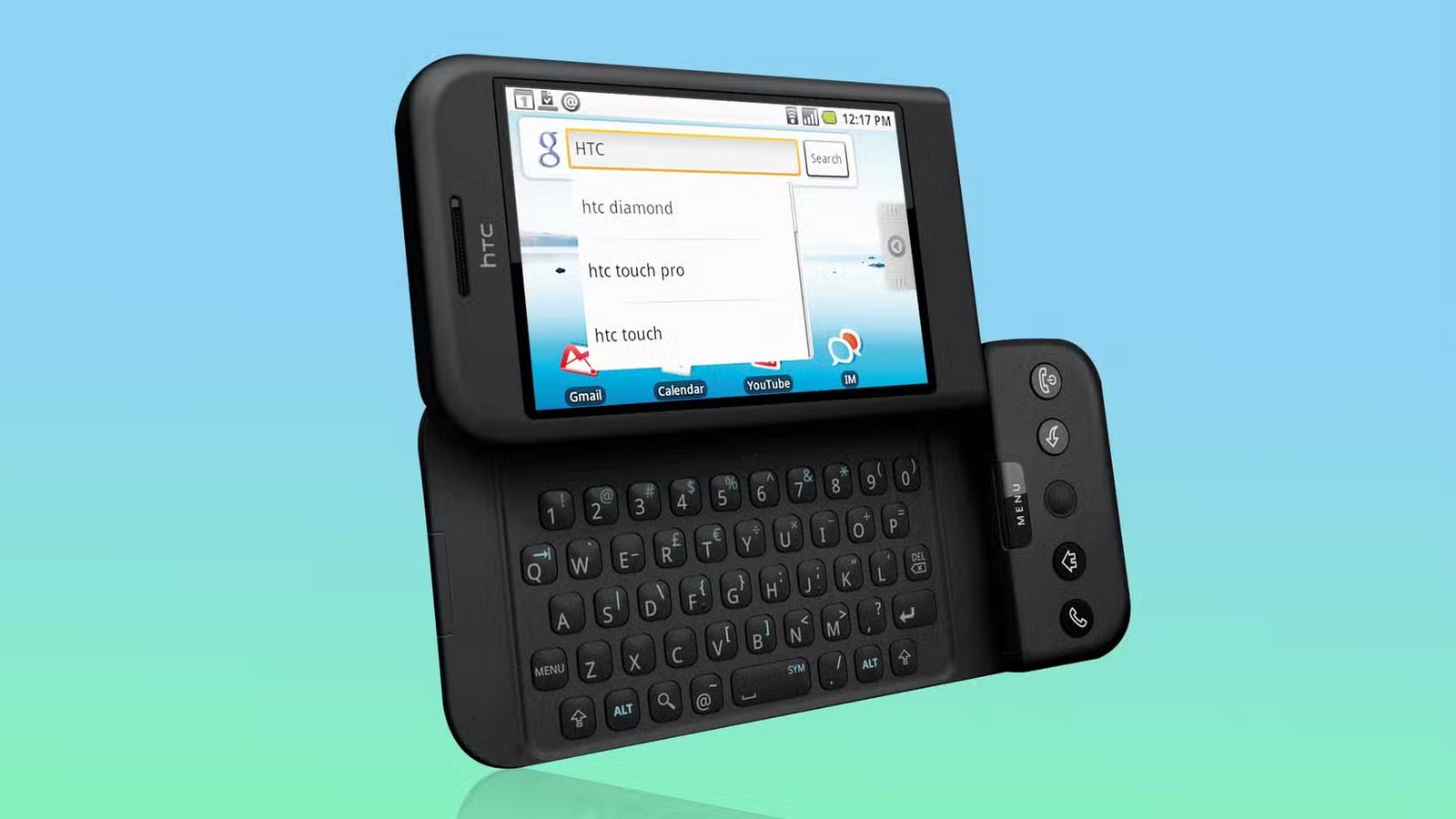
While not without its flaws, the HTC Dream makes this list for its history alone. Released back in 2008, it was the first ever commercially available Android phone. It shipped with Android 1.0, and introduced early versions of Gmail, Google Maps, and the Android Market. It put the operating system on the map. It was widely known as the T-Mobile G1 in the U.S.
It came with a slide-out QWERTY keyboard, which was paired with a trackball and physical shortcut keys that sat on a chin next to it. As well as being able to use these physical inputs, you could also make use of the 3.2-inch touchscreen.
The HTC Dream was the first of its kind, but it wasn’t without its quirks. The chin could make it feel a bit awkward to type on for prolonged periods of time, and it lacked a couple of features that you could get on rivals at the time, such as a 3.5mm headphone jack and stereo Bluetooth. Regardless, it has earned itself a warm place in history for being the first available Android phone.
5
Blackberry PRIV
A Hail Mary

By 2015, Blackberry was already becoming a bit of a fringe brand, after dominating the market for years through the 2000s. The PRIV was the brand’s attempt to prove that they weren’t done yet. It was also their first phone to run Android, shipping with Android 5.1.1.
The keyboard on the PRIV was one of its coolest features. It looked like a normal touchscreen phone, featuring a 5.4-inch curved AMOLED display, but it featured a lip at the bottom for you to slide the screen up and reveal the keyboard. The four-row QWERTY keyboard was really satisfying to use, even one-handed.
The PRIV had decent specs for the time, coming with a Qualcomm Snapdragon 808 and Adreno 418 GPU, as well as 3GB of RAM and 32GB of internal storage. Its build quality was its weak point, though, with it feeling a bit cheap compared to other flagships at the time.
4
HTC Desire Z (T-Mobile G2)
A spiritual successor

Released in 2010, the HTC Desire Z, marketed as the T-Mobile G2 in the States, was a brilliant smartphone back in its day. It’s design and build quality were fantastic. It shipped with Android 2.2 (Froyo), and was officially upgradable to Android 2.3 (Gingerbread).
The design of the keyboard was one of the coolest parts of the Desire Z, meaning that the screen would lift and sit flush when you were using the keyboard. The QWERTY keyboard paired nicely with the 3.7-inch S-LCD screen, which was pretty crisp for 2010.
While it was a bit heavy and its keyboard was a little cramped, the Desire Z showcased just how strong HTC’s offerings were back in this era. The specs were great, and the build quality was really solid compared to other offerings available at the time.
3
Unihertz Titan 2
The last bastion
While physical keyboards are mostly extinct in 2026, there are a few smaller brands still releasing devices. Unihertz is one of these brands, with the Titan lineup still going strong. The Titan 2 made some big improvements over the original Titan, and while it is still considered fairly niche, it is a genuinely solid option in 2026.
Those who fondly remember the golden age of Blackberry will love the keyboard on the Titan. The backlit keys featured fantastic tactile feedback, and the touch scrolling was also super familiar. It’s MediaTek Dimensity 7300 and ARM Mali-G615 MC2 GPU mean that it offers pretty decent performance. It also features 12GB of RAM and 512GB of storage. It shipped with Android 15, but is slated for upgrades all the way up to Android 19.
It has a couple of weak points, including its camera, but as a keyboard phone it stands nearly unopposed in the market.
2
Blackberry KEY2
A bitter-sweet goodbye

The Blackberry KEY2 was the last Blackberry branded device ever released, hitting the market in 2018 and officially marking the end of an era. To be fair, though, it was technically built and designed by TCL, releasing the phone under license. It still carried the essence of a Blackberry in a lot of ways, though, and was a fantastic phone.
As a keyboard phone, the Blackberry KEY2 got things right. It featured satisfyingly tactile keys and strong ergonomics. It also came with some really strong privacy-focused features, impressive battery performance, and niceties like 3.5mm headphone jack and SD card slot.
Getting a modern keyboard phone came with some tradeoffs, the worst of which being that it was stuck on Android 8.1, with no way to upgrade. This meant that a lot of reviewers were pretty harsh on it. As a keyboard phone, however, I still think it is one of the best.
1
Motorolla Droid 4
The king of keyboard phones
For keyboard phone enthusiasts, it won’t be all that surprising that the Droid 4 claims the top spot on this list. It launched in 2012, and is widely considered to be the most impressive keyboard phone ever made. When it shipped, it came with Android 2.3 (Gingerbread).
The five-row QWERTY keyboard is commonly praised as one of the best to ever grace a smartphone. For people who texted and emailed a lot, there was no better choice, with its keyboard making it feel more like a mini computer rather than a smartphone.
Its 4-inch LCD was probably the least impressive thing about the Droid 4, but it more than made up for it in other ways. The performance on offer was great, and the fact that it came with 4G LTE was really impressive for the time as well.
I miss the era of keyboard phones dearly
There is no denying that the practicality and versatility of a large glass screen is hard to beat, but putting a list like this together makes me miss simpler times. Keyboard phones had so much character, and the layout meant that manufacturers had to get creative with their designs. In the modern age, they will likely remain pretty niche, but I will always look back fondly on many of the devices listed above.