Key Points
-
Tesla appears to have curbed some of its recently higher production costs.
-
Recent figures confirm the company’s electric vehicles are marketable at a premium price, and that its EV business is viable.
-
This sustained profitability makes Tesla’s ongoing transition to an artificial intelligence robotics outfit easier.
- Motley Fool Issues Rare “Total Conviction” Buy Alert ›
Tesla‘s (NASDAQ: TSLA) recently reported quarterly results raise as many questions as they answer. While revenue of just over $28 billion topped estimates of $27.9 billion, and earnings of $0.48 per share beat estimates of $0.43, investors apparently balked at the company’s 2026 spending outlook.
Not because it was raised, but because it was lowered, from around $25 billion to $20 billion, and will largely be funded from operating cash flow. The market is interpreting that as a sign that Tesla’s transition to predominantly an artificial intelligence (AI) technology company isn’t happening very quickly. And maybe that’s an accurate assessment.
Missed AI’s “Act 1”? Act 2 Could Be 15x Bigger. Most investors think they missed the AI boat because they didn’t buy Nvidia in 2005. But according to our analysts, we’re only at the end of “Act 1″—the R&D phase. “Act 2” is the global rollout. Continue »
In the meantime, though, Tesla remains first and foremost an electric vehicle (EV) company that’s using that business’s bottom line as a springboard for its AI-driven robotaxi and robotics ventures. And we’re seeing encouraging progress on the electric vehicle front, not so much in terms of volume, but at least in terms of profitability.
When it was needed the most, a small step forward
Whether Tesla’s EV business is a meaningfully reliable growth engine has been up for debate since 2022, when Chinese rival BYD Company (OTC: BYDDY) began getting real traction in China as well as in Europe. Tesla cut prices, which, of course, crimped profits.
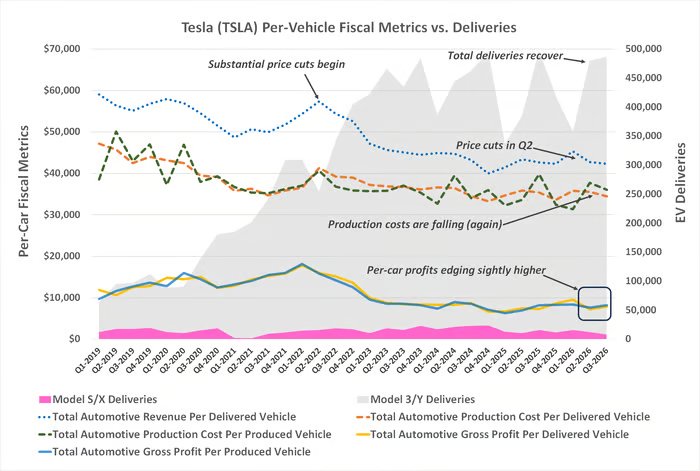
There’s a glimmer of hope, though. While average selling prices have dropped since the first quarter — partially reflecting more sales and production of the lower-cost Model 3 — the latest numbers show that for the second quarter in a row, Tesla’s per-car production costs have fallen as well, from $37,748 in Q2 to Q3’s $36,077.
This has allowed per-delivery automotive gross profits to bounce back from Q2’s plunge to $7,213 to $7,864 in Q3. Gross profits per manufactured vehicle also snapped back by a similar degree, negating any worries that the recovery is merely a matter of the difference between the quarter’s delivery figure and its production tally.
Data source: Tesla. Chart by author.
Just buying stress-free time
This isn’t necessarily thrilling. As the graphic above illustrates, per-car profits are far from soaring.
They’re not sinking, though, and that’s a win in and of itself following a concerning decline in Q2. This slight recovery confirms there’s at least some degree of profitable marketability for Tesla’s electric vehicles in an increasingly competitive environment.
More than anything, though, the decrease in EV manufacturing costs says current shareholders who own Tesla stock for its potential on the robotics and robotaxi fronts don’t need to worry about a struggling electric vehicle business taking time, attention, and resources away from those efforts. Tesla’s EV business can stand on its own, even if its growth is modest.
That being said, don’t misunderstand. Tesla is mostly an electric vehicle company now. In just a couple of years, however, it plans to be an AI robotics and robotaxi outfit that also happens to manufacture EVs. That evolution is what this expensive and volatile stock is really pricing in here.
Missed AI’s “Act 1”? Act 2 Could Be 14x Bigger
Most investors think they missed the AI boat because they didn’t buy Nvidia in 2005.
But according to our analysts, we’re only at the end of “Act 1″—the R&D phase. “Act 2” is the global rollout, a massive technology build-out that Google’s CEO says could be more profound than fire or electricity.
While everyone watches the chip designers, one “backbone” company provides the critical technology that Nvidia and AMD literally cannot function without. We’ve detailed this under-the-radar player in our new AI Playbook.
James Brumley has no position in any of the stocks mentioned. The Motley Fool has positions in and recommends Tesla. The Motley Fool recommends BYD Company. The Motley Fool has a disclosure policy.