Key Points
Last month, Tesla (NASDAQ: TSLA) launched the Cybercab, its first autonomous vehicle (AV) built for commercial service, in Austin, Texas. Every driverless ride before the launch used a modified Model Y. The Cybercab is a two-seat vehicle with no steering wheel, accelerator, or brake pedal.
Robotaxis could be one of the main drivers of future growth for Tesla stock. After a little over a month of Cybercab service in Austin, demand is strong, but it’s still a fairly small-scale operation.
Missed AI’s “Act 1”? Act 2 Could Be 15x Bigger. Most investors think they missed the AI boat because they didn’t buy Nvidia in 2005. But according to our analysts, we’re only at the end of “Act 1″—the R&D phase. “Act 2” is the global rollout. Continue »
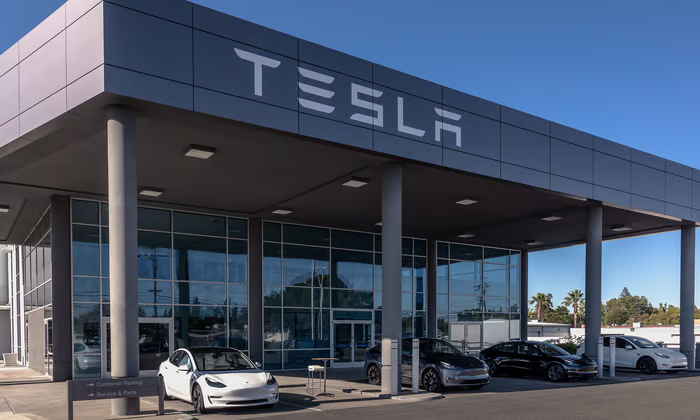
Image source: Tesla.
The latest Tesla Cybercab numbers
Tesla has 739 AVs registered with the Texas Department of Motor Vehicles as of Oct. 10, including 420 Model Y vehicles and 319 Cybercabs. Those numbers have risen rapidly. On Sept. 4, the day Cybercab service launched in Austin, Tesla had 420 AVs registered, including 45 Cybercabs. Its fleet has expanded significantly, most notably when it registered 150 Cybercabs on Oct. 8.
That’s the statewide total, though, and just because an AV is registered doesn’t necessarily mean it’s actively giving rides. RobotaxiTracker, a third-party tracking platform, reports that Tesla has 277 in-service autonomous vehicles in Austin, of which 107 are Cybercabs.
For comparison, Waymo has a fleet of over 300 autonomous vehicles in Austin, according to RobotaxiTracker, so Tesla’s fleet is in the same ballpark. However, Waymo is the more convenient option, as it’s available 24/7 through the Uber app. Tesla offers robotaxi service in Austin from 6 a.m. to 11 p.m. CEO Elon Musk has said this is to avoid running over small pets, which are hard to see at night. Tesla is aiming to solve that issue so it can have robotaxis in service around the clock.
Although Cybercabs make up 39% of Tesla’s robotaxi fleet in Austin, they account for a much smaller share of rides. There have been 531 Cybercab rides reported on RobotaxiTracker so far, accounting for about 11% of Tesla’s total robotaxi rides in Austin.
A promising start, with a long way to go
When it comes to Tesla’s robotaxis, the number of registered vehicles gets the most attention, but what really matters is how many people are using the service. The demand is there, as demonstrated by Waymo’s success so far. But Waymo has the advantage of being offered through Uber’s app, which has over 200 million monthly users. You need to download the Tesla Robotaxi app to use its service.
On a positive note, anyone in Austin who’s 13 or older can now hail a Tesla Cybercab. The service covers 264 square miles, which is most of the city. Tesla’s robotaxi service has started out with high demand. Wait times topped an hour on launch day, and the Tesla Robotaxi app reached No. 1 in the App Store’s travel category.
Going forward, investors should monitor Tesla’s fleet size, particularly the number of in-service Cybercabs and reported Cybercab rides. It’s also important that Tesla expand the service to other cities and provide 24/7 availability, since demand for ride-hailing services tends to spike at night after bars close. If Tesla can roll out robotaxi service in more major metro areas, it could be a sizable new source of revenue for the EV maker.
Missed AI’s “Act 1”? Act 2 Could Be 14x Bigger
Most investors think they missed the AI boat because they didn’t buy Nvidia in 2005.
But according to our analysts, we’re only at the end of “Act 1″—the R&D phase. “Act 2” is the global rollout, a massive technology build-out that Google’s CEO says could be more profound than fire or electricity.
While everyone watches the chip designers, one “backbone” company provides the critical technology that Nvidia and AMD literally cannot function without. We’ve detailed this under-the-radar player in our new AI Playbook.
Lyle Daly has positions in Tesla. The Motley Fool has positions in and recommends Tesla. The Motley Fool recommends Uber Technologies. The Motley Fool has a disclosure policy.