Key Points
-
Tesla’s electric vehicle sales declined in 2024 and 2025, but they are slowly recovering this year on the back of price cuts and rising oil prices.
-
Nevertheless, chief executive Elon Musk recently pulled two of Tesla’s most premium vehicles off the market to focus on other product platforms instead.
-
Tesla’s earnings have plummeted over the last two years, resulting in a sky-high valuation that leaves its stock vulnerable to a correction.
- These 10 stocks could mint the next wave of millionaires ›
Many investors own Tesla (NASDAQ: TSLA) shares because future product platforms like the Cybercab autonomous robotaxi and the Optimus humanoid robot carry so much potential, but over 70% of the company’s revenue still comes from selling passenger electric vehicles (EVs).
Tesla is coming off two straight years of declining EV sales, which dramatically weighed on its financial results. Fortunately, sales returned to growth in the first half of 2026, and last Friday, the company reported more deliveries for the third quarter (ended Sept. 30) than Wall Street expected.
Missed Nvidia in 2009? This Rare Signal Is Flashing Again. In 2009, a “Double Down” signal flashed for a little-known chipmaker called Nvidia. For the first time in years, that same “Total Conviction” signal is flashing for a company 1/100th the size of Nvidia. Continue »
Are these green shoots in the EV business enough reason to buy Tesla stock? The answer might surprise you.
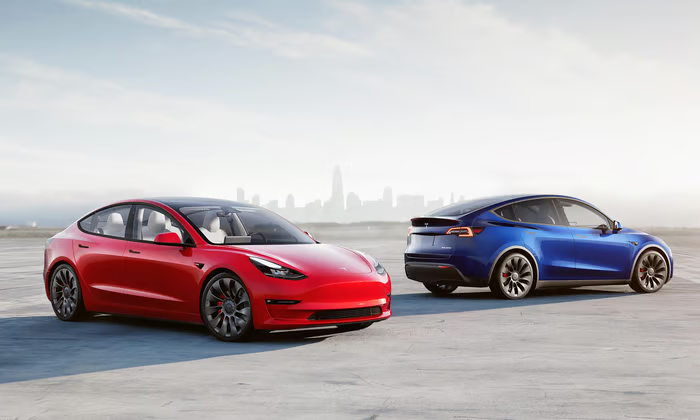
Image source: Tesla.
Tesla’s EV business is recovering, but is it sustainable?
Tesla delivered 838,149 EVs during the first half of 2026, a 16% increase from the year-ago period. The company then delivered 486,532 vehicles during the third quarter, and although that was actually a 2% decline compared to the same quarter last year, it topped Wall Street’s average estimate of 461,974.
But there are a couple of caveats to the broad recovery in Tesla’s EV business. First, the company has slashed prices across the board to boost sales, sparking a sharp decline in its earnings (more on that later). Second, oil prices have surged since February due to the ongoing war between the U.S. and Iran, pushing many consumers into the EV camp. This is benefiting the entire industry, so Tesla has merely been in the right place at the right time.
Lower prices and the broad shift to EVs haven’t erased the real threat to Tesla’s business: Competition. Over the last few years, the company has lost market share to low-cost brands from China like BYD, Geely, and Zeekr. They offer EVs with comparable features at much lower starting price points, and they are flooding important markets like Europe, where EV adoption is outpacing regions like North America.
Moreover, legacy European brands like BMW and Mercedes-Benz, which operate at the more premium end of the market, have launched a series of enticing EVs this year which could erode Tesla’s market share even further. But rather than trying to compete, Tesla’s chief executive Elon Musk actually decided to pull premium vehicles like the Model S sedan and Model X SUV from the market earlier this year.
Tesla is now repurposing those production lines for its Optimus humanoid robot. Therefore, if we think about the medium to long term, the recent recovery in the EV business probably isn’t sustainable because the company appears to be gradually pulling back from the industry.
Tesla stock has a serious valuation problem
Tesla will report its complete third-quarter operating results on Oct. 21, but they are unlikely to show a meaningful reversal in the company’s dwindling profits. Tesla generated earnings of $1.08 per share over the last four quarters (to June 30), down 75% in just the last two years.
As a result, Tesla stock is now trading at a sky-high price-to-earnings (P/E) ratio of 343, making it nearly 10-times as expensive as the Nasdaq-100 index which has a P/E of 35.2. In other words, the EV giant appears significantly overvalued compared to a group of America’s largest tech giants.
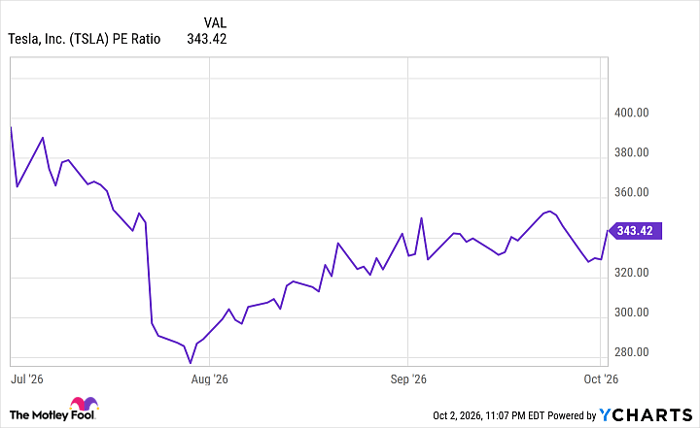
TSLA PE Ratio data by YCharts
Ordinarily I’d say valuation alone is enough of a reason to completely avoid Tesla stock, but I understand some investors want to hold out for the Cybercab and Optimus, which could genuinely serve much bigger markets than passenger EVs. The Cybercab, for instance, could generate revenue for Tesla around the clock by autonomously hauling passengers and even small commercial loads.
Optimus, on the other hand, could serve factories, offices, and even households alike. In fact, Musk thinks humanoid robots will outnumber humans by 2040, which is why he predicts Optimus could generate $10 trillion in revenue for Tesla over the long term.
However, investors shouldn’t disregard the challenges ahead. The Cybercab is still in the testing phase, and it can’t operate at scale until the unsupervised version of Tesla’s full self-driving (FSD) software receives regulatory approval across several U.S. states. It’s falling behind Alphabet‘s Waymo, which is already completing over 500,000 paid autonomous rides in 15 American cities every week.
Optimus also faces a number of hurdles. Tesla is still trying to perfect the robot’s hands by making them as human-like as possible, which is a big engineering challenge. Plus, there is no existing supply chain for humanoid robots, so Tesla has to design and manufacture most of the components in-house.
With all of that in mind, it could take years before the Cybercab and Optimus are commercialized at scale. That’s why I personally wouldn’t buy Tesla stock at the current price — the EV business alone simply doesn’t justify its valuation.
Don’t miss this second chance at a potentially lucrative opportunity
Ever feel like you missed the boat in buying the most successful stocks? Then you’ll want to hear this.
On rare occasions, our expert team of analysts issues a “Double Down” stock recommendation for companies that they think are about to pop. If you’re worried you’ve already missed your chance to invest, now is the best time to buy before it’s too late. And the numbers speak for themselves:
- Nvidia: if you invested $1,000 when we doubled down in 2009, you’d have $608,222!*
- Apple: if you invested $1,000 when we doubled down in 2008, you’d have $63,654!*
- Netflix: if you invested $1,000 when we doubled down in 2004, you’d have $361,650!*
Right now, we’re issuing “Double Down” alerts for three incredible companies, available when you join Stock Advisor, and there may not be another chance like this anytime soon.
*Stock Advisor returns as of October 6, 2026.
Anthony Di Pizio has no position in any of the stocks mentioned. The Motley Fool has positions in and recommends Alphabet and Tesla. The Motley Fool recommends BYD Company and Bayerische Motoren Werke Aktiengesellschaft. The Motley Fool has a disclosure policy.