With their instantly recognisable branding and menu items, home-grown chains like Red Rooster and Hungry Jack’s have remained fast food fixtures for generations of Australians. But they once shared the suburban strip with a broader cast of homegrown competitors, from Ollie’s and Big Rooster to Eagle Boys.
Some were swallowed by bigger rivals, while others lost ground as competition intensified, leaving once-familiar names to linger in childhood memories and old TV advertisements.
Over the past decade, brands like Guzman y Gomez, El Jannah and Betty’s Burgers have made their mark on Australia’s fast-food landscape. Here, we look back at the OG chains that paved the way for a new generation.
Ollie’s aka Ollie’s Trolleys
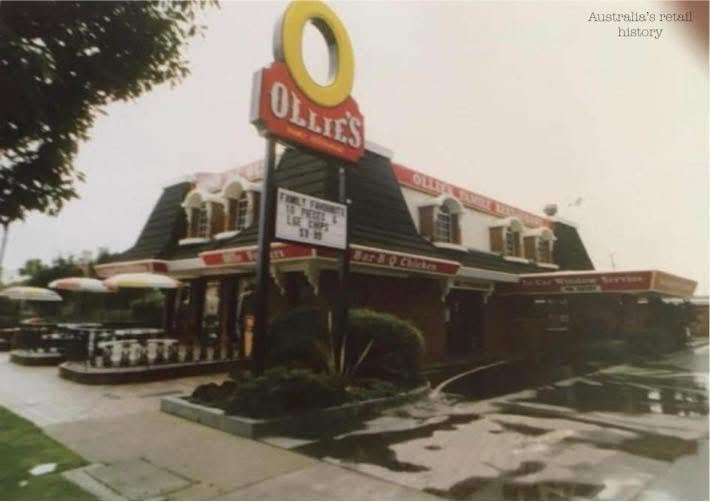
Victorians of a certain age are bound to remember Ollie’s – the Australian fried chicken chain with roots stretching back to the late 1960s. With its tram-themed branding, buckets of chicken and towering ice cream sundaes, Ollie’s Trolleys offered a homegrown alternative to the Colonel.
Its story reportedly began with a 1964 trip to America, where Shepparton couple Peter and Maria Copulos found inspiration in the country’s fast-food chains.
Their Parklake Fried Chicken business evolved into Ollie’s Trolleys and later Ollie’s Family Restaurants, with Tina Arena, a young Portia De Rossi and Skyhooks frontman Shirley Strachan helping sing its praises in television ads.
The chain grew to 32 outlets, including locations in regional NSW, but its biggest rival eventually came calling. In 1990, KFC acquired the business and most Ollie’s restaurants subsequently converted or closed.

Ollie’s with rather familiar red and yellow signage. Picture: Supplied
Pizza Haven vs Eagle Boys
When we think of pizza wars, Pizza Hut’s enduring rivalry with Domino’s instantly springs to mind. But two homegrown pizza heroes once fought just as fiercely for a slice of the action.
Before ordering pizza meant opening a delivery app, Pizza Haven and Eagle Boys were battling for a place beside the family telephone. Is 131 241 forever etched in your brain, too?
Pizza Haven began in the Adelaide suburb of Glenelg in 1984, when the Christou brothers backed their ambitions with a $24,000 mortgage on their parents’ home. The gamble paid off, growing into a network of around 180 outlets across Australia and New Zealand.

Gabriel, Bill, Louis and Evan Christou founded Pizza Haven in South Australia in the 1980s. Picture: Supplied
Three years later, Tom Potter opened the first Eagle Boys in Albury, NSW. Its distinctive pink branding became another familiar sight on suburban shopping strips, as both Australian chains competed with Domino’s and Pizza Hut for the Friday night takeaway dollar.
Their timelines converged in 2008, when Eagle Boys acquired Pizza Haven’s remaining 35 Australian stores, offering franchisees the chance to switch brands. But the bigger bird would soon face its own reckoning.
Eagle Boys entered administration in July 2016. Pizza Hut acquired the brand later that year, with more than 50 stores subsequently converted, bringing another homegrown name under a global rival’s roof.

Eagle Boys was a Friday night takeaway hit, noted for its pink branding. Picture: Supplied
Adam Hickey, founder of branding agency Orand, noted the pizza wars revealed how discounting and delivery infrastructure favoured the bigger US operators.
“Back then, if you wanted to deliver to customers you had to build the infrastructure yourself – with your own drivers, phone lines and eventually your own ordering tech,” he said. “That’s a fixed cost that only pays off at scale, so it became a moat for the big pizza chains.”
Pizza Hut’s famous delivery mascot, Dougie the Pizza Boy, represented more than a memorable advertising campaign, but a comprehensive delivery system that smaller competitors had to match.
Aggressive discounting soon squeezed the market, while Domino’s gained ground through digital ordering and delivery technology. As Domino’s market share grew, Roy Morgan research found Eagle Boys’ customer numbers fell 61% between 2012 and 2016.
“When the category turns into a fight over price and technology, scale wins,” Hickey said, adding that Domino’s and Pizza Hut are still paying the price of decades of discounting.

Pizza Hut later acquired and rebranded Eagle Boys outlets in the mid 2010s. Picture: Supplied
Big Rooster
Before Red Rooster ruled the roast, Big Rooster was a rival joint in Australia’s chicken takeaway market.
Established in Perth the 1970s, the homegrown chain became a familiar sight across Queensland, competing for family dinner orders with Red Rooster and Kentucky Fried Chicken.
Founded by brothers Phil and Nick Tana, Big Rooster offered an alternative to the Colonel’s fried fare, with, like Red Rooster, roast chicken the core of its menu.
The company began franchising in 1979, spreading its wings as Australians developed a growing appetite for the convenience of a takeaway chook. Queensland became its stronghold, while the broader network included outlets in NSW and the Northern Territory.

Inside a Big Rooster back in the day. Picture: Supplied
But Australia’s rival roosters eventually ended up in the same coop. Coles Myer, which owned Red Rooster, acquired Big Rooster’s NSW stores in 1986, before snapping up the remaining Queensland chain in 1992. The purchases expanded Red Rooster’s network, with Big Rooster outlets taking on its competitor’s name.
While the brand has all but vanished from Australian streets, Big Rooster continues to trade in Papua New Guinea with 30 locations.
The secret sauce was scale
For Australia’s forgotten fast-food chains, building a recognisable brand was only part of the battle. Buying power, advertising and efficient systems helped determine which names endured.
Mr Hickey said American chains arrived with established franchise systems, global purchasing power and property and marketing resources that smaller family operators struggled to match.
“Systemising was the secret sauce,” he said.

You could feed a whole family for $7.50 at Ollie’s. Picture: Supplied
By the 1990s, Australia’s fast-food market was maturing, with its biggest operators tightening their grip just as customers were tightening their belts.
For the larger chains, scale also meant their advertising dollars went further.
“Every dollar of national TV advertising was spread over hundreds of outlets, so they could keep their brand front of mind in a way the locals couldn’t.”
The latest commercial property news
Get the latest news and insights straight to you.