Key Points
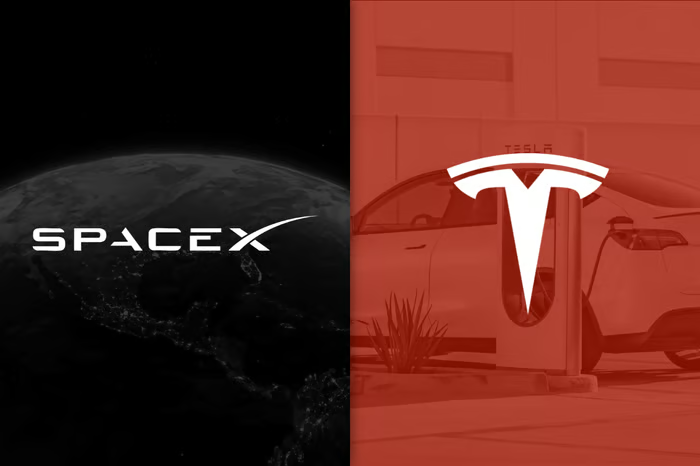
Elon Musk is the CEO of two publicly traded, trillion-dollar corporations. The first, Tesla (NASDAQ: TSLA), has produced outstanding returns since its 2010 IPO. The second, Space Exploration Technologies (NASDAQ: SPCX), has been on the market for only four months, but it holds the record for the largest IPO in history. Tesla and SpaceX are excellent businesses, but which one will be the better performer over the next five years?
Image source: The Motley Fool.
Missed AI’s “Act 1”? Act 2 Could Be 15x Bigger. Most investors think they missed the AI boat because they didn’t buy Nvidia in 2005. But according to our analysts, we’re only at the end of “Act 1″—the R&D phase. “Act 2” is the global rollout. Continue »
Tesla’s next era of growth may be about to start
Tesla is one of the leaders in the electric vehicle (EV) market. The company’s Model Y has been the best-selling car (EV or not) for the past three years. However, Tesla’s future is increasingly tied to other projects, especially its robotaxi ambitions. The company has made progress on that front recently. Tesla launched the Cybercab in early September, a vehicle specifically designed for its robotaxi fleet.
It carries only two passengers and has no mirrors, steering wheel, or pedals. It is likely cheaper to manufacture than Tesla’s Model Y, which the company used for its robotaxi service until now. Tesla has another advantage: it offers subscriptions to its Full Self-Driving (FSD) software for $99 per month. The more people opt in, the more data it has to train and improve its FSD software, which can confer a competitive edge. Over the next five years, the company could make significant progress with its robotaxi fleet.
Musk once promised that the company would have a million robotaxis on the road by 2020. That didn’t come close to happening: It only launched the service last year. But if the EV maker can scale its fleet to one million by 2031, and assuming significant utilization and reasonably competitive average per-ride prices, the robotaxi business might generate higher profits than EV sales. EV adoption may also rise through 2031.
Between these two businesses, and other potential projects, such as the company’s humanoid robots, Tesla’s profits and stock price could rise significantly over the next five years.
SpaceX is revolutionizing multiple industries
SpaceX has already revolutionized space travel through its pioneering work with reusable rockets. The company now dominates the space launch market, and it is also the leader in satellite-based connectivity. Over the next five years, the rocket company could make more breakthroughs. Consider SpaceX’s work with Starship, a next-gen rocket, the largest ever built, that is also being designed to be fully reusable (its current Falcon 9 is only partially reusable).
Starship could be central to several of SpaceX’s ambitions. It could help the company further reduce space launch costs and increase its profits and margins. It may also allow SpaceX to launch its next-gen Starlink V3 satellites, which are more powerful than its current satellites, thereby helping it improve and expand its connectivity business.
SpaceX is also looking to circumvent the power limitations of the Earth-bound artificial intelligence (AI) infrastructure build-out by sending AI satellites into orbit, which could help it tap into what the company estimates is a multi-trillion-dollar market. SpaceX has made progress on Starship this year and has also signed several AI compute deals. Provided that continues, the stock may soar through 2031.
Which one should you buy?
Tesla currently generates higher revenue and profits, but in their latest respective quarters, SpaceX’s top and bottom lines grew much faster. SpaceX’s second-quarter revenue of $7.8 billion was up 92% year over year, while its net loss of $541 million was significantly better than the $1 billion net loss reported in the prior-year quarter. Meanwhile, Tesla’s second-quarter revenue jumped 26% year over year to $28.2 billion. Its net income of $1.1 billion declined 5% year over year.
SpaceX has several advantages over Tesla: it is the leader in space launch and satellite-based connectivity, has so far left its competitors in the dust, and benefits from contracts with government agencies that provide it with a somewhat steady stream of revenue. However, SpaceX is investing significant sums in its AI ambitions, which could reduce margins, particularly if those investments don’t pay off. SpaceX also faces various regulatory-related risks.
Then again, all these risks apply to Tesla as well. One thing is for sure: both companies will be volatile moving forward. There is speculation that they will merge, but if they don’t, SpaceX arguably has higher upside potential over the next five years, though it also carries more uncertainty.
Missed AI’s “Act 1”? Act 2 Could Be 14x Bigger
Most investors think they missed the AI boat because they didn’t buy Nvidia in 2005.
But according to our analysts, we’re only at the end of “Act 1″—the R&D phase. “Act 2” is the global rollout, a massive technology build-out that Google’s CEO says could be more profound than fire or electricity.
While everyone watches the chip designers, one “backbone” company provides the critical technology that Nvidia and AMD literally cannot function without. We’ve detailed this under-the-radar player in our new AI Playbook.
Prosper Junior Bakiny has no position in any of the stocks mentioned. The Motley Fool has positions in and recommends Tesla. The Motley Fool has a disclosure policy.