Key Points
-
Tesla is already profitable and could become significantly more so as it scales its robotaxi business.
-
SpaceX has an enormous total addressable market and is the undisputed leader in space travel.
-
Both companies are trading at frothy valuations.
- These 10 stocks could mint the next wave of millionaires ›
Tesla (NASDAQ: TSLA) went public in 2010 and has crushed broader equities since. The man who has led the company through that entire period, Elon Musk, recently took another one of his companies public: Space Exploration Technologies (NASDAQ: SPCX). The rocket company has moved sideways (more or less) since its record-breaking IPO in June, but it boasts attractive opportunities that may enable it to follow in Tesla’s footsteps and deliver life-changing returns over the long run. But could it outperform Tesla through 2031? Let’s find out which of these Musk-led companies is the better buy.
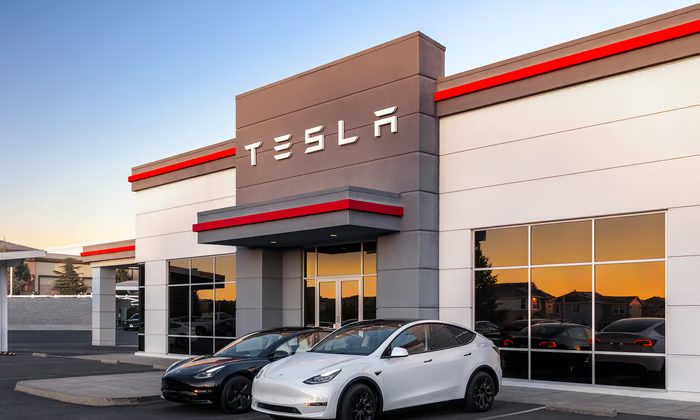
Image source: The Motley Fool.
Missed AI’s “Act 1”? Act 2 Could Be 15x Bigger. Most investors think they missed the AI boat because they didn’t buy Nvidia in 2005. But according to our analysts, we’re only at the end of “Act 1″—the R&D phase. “Act 2” is the global rollout. Continue »
The case for Tesla
Tesla remains one of the leaders in the electric vehicle (EV) market that it helped pioneer. The company’s Model Y has been one of the world’s best-selling cars — EV or not — for the past three years. However, Tesla’s future is increasingly tied to projects beyond its core EV business. One potential lucrative opportunity is robotaxis. Tesla first launched its robotaxi service in Austin last year and has since expanded the service to several other cities.
Also, it recently debuted the Cybercab, a two-seater with no mirrors and no steering wheel built specifically for its robotaxi fleet. If Tesla can scale this fleet and it achieves significant utilization, the company could transform its business.
Tesla also has several advantages over most other corporations seeking to dominate this market. The company’s large existing vehicle fleet provides it with significant data to train and improve its autonomous driving software. And the more users (or self-driving vehicles) within its ecosystem, the more it can enhance it. Now, Tesla does face several risks. One of them is competition.
Waymo, which Alphabet owns (NASDAQ: GOOG) (NASDAQ: GOOGL), has a larger robotaxi fleet than Tesla. The company also has to deal with regulatory obstacles. The recent debut of the Cybercab was quickly followed by a federal safety investigation. That said, if Tesla can make significant progress with this and other projects, such as humanoid robots, the stock could soar over the next several years.
The case for Space Exploration Technologies
SpaceX’s business spans space travel, satellite-based connectivity, and artificial intelligence (AI). The company’s connectivity segment currently accounts for most of its operating profits, but SpaceX itself has identified AI as its largest opportunity by far. The company sees a $28.5 trillion opportunity, with $26.5 trillion of that coming from AI. How does SpaceX plan to tap into this market? The company offers AI compute capacity and has signed several deals this year with some notable clients, including Alphabet and Anthropic, which could soon go public.
SpaceX signed another deal worth $1.11 billion per month (with an unnamed customer) earlier in September. If it can continue attracting clients, the company may see its AI revenue growth accelerate. SpaceX is also betting on disruptive innovation. The company wants to send AI satellites into space to circumvent some of the limitations of the Earth-bound AI build-out.
The company will need its next-gen rocket, Starship, for that project. Starship is designed to be a fully reusable rocket that SpaceX is still testing. It holds the key to some of its space-bound plans, including AI satellites, a larger constellation of more capable Starlink satellites to expand its connectivity business, cheaper space travel, and more.
There is considerable uncertainty, and SpaceX could encounter significant trouble, particularly if Starship’s progress stalls. But the upside opportunity is enormous, and if the company can execute flawlessly, it could beat the market through 2031.
Which is the better choice?
Tesla currently generates higher revenue and profits. The EV company’s second-quarter sales jumped 26% year over year to $28.2 billion. However, its adjusted net income dropped 17% year over year to $1.2 billion. That’s partly because Tesla is investing heavily in projects such as robotaxis, but, as a counterpoint, the company benefited from higher EV demand due to rising oil and energy prices during the second quarter.
That may not become a consistent growth driver. Meanwhile, even though SpaceX is investing heavily in AI, its bottom line is improving and could continue doing so as revenue scales. In the second quarter, SpaceX’s revenue grew by 92% year over year to $7.8 billion, and its net loss was $541 million, much better than the $1 billion net loss reported in the year-ago period.
Analysts expect SpaceX’s revenue to continue growing at a good clip and for the company to become profitable. It could boast higher revenue and profits than Tesla within a few years. And SpaceX arguably has more lucrative opportunities and a lead in its core markets that Tesla doesn’t have in its own industry. Does that mean SpaceX is the better buy? We can’t conclude that before considering valuation.
SpaceX is trading at 200x forward earnings versus 158.7x for Tesla. Both companies are richly valued, but more so for SpaceX, which partly reflects the higher value the market places on its growth prospects. So, what’s the verdict? Both of these will be volatile stocks moving forward, but Tesla is the better option for relatively less aggressive investors, while SpaceX is a great pick for those with a serious appetite for risk.
Don’t miss this second chance at a potentially lucrative opportunity
Ever feel like you missed the boat in buying the most successful stocks? Then you’ll want to hear this.
On rare occasions, our expert team of analysts issues a “Double Down” stock recommendation for companies that they think are about to pop. If you’re worried you’ve already missed your chance to invest, now is the best time to buy before it’s too late. And the numbers speak for themselves:
- Nvidia: if you invested $1,000 when we doubled down in 2009, you’d have $585,136!*
- Apple: if you invested $1,000 when we doubled down in 2008, you’d have $65,062!*
- Netflix: if you invested $1,000 when we doubled down in 2004, you’d have $383,680!*
Right now, we’re issuing “Double Down” alerts for three incredible companies, available when you join Stock Advisor, and there may not be another chance like this anytime soon.
*Stock Advisor returns as of September 28, 2026.
Prosper Junior Bakiny has positions in Alphabet. The Motley Fool has positions in and recommends Alphabet and Tesla. The Motley Fool has a disclosure policy.