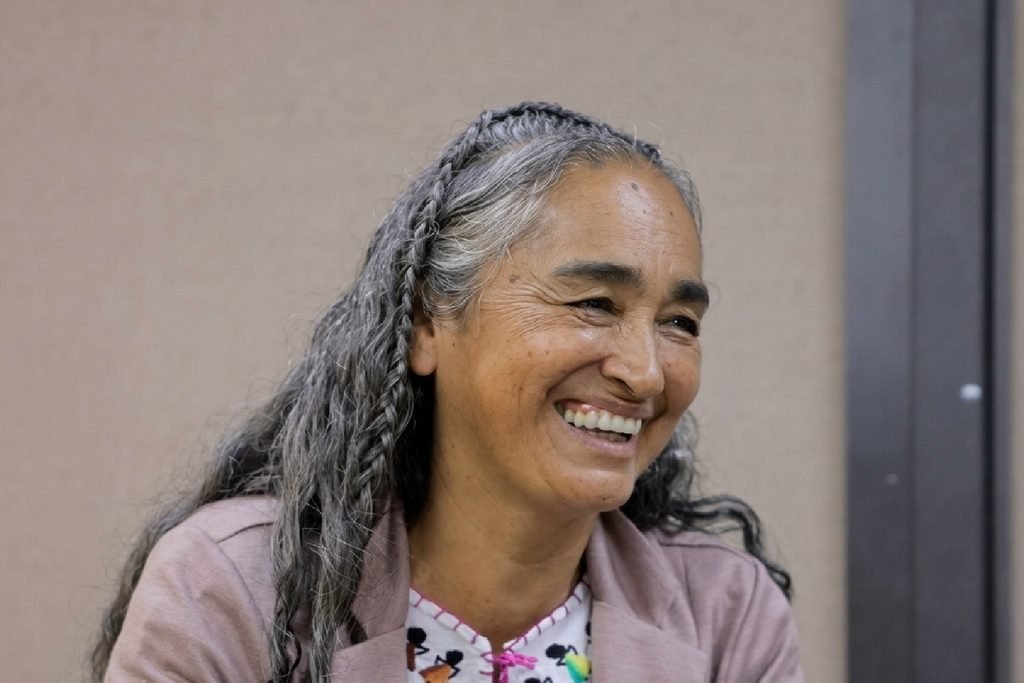

For Maria Nilsa Garzon Diaz, a small coffee grower from the department of Cauca, it seemed that everything was working against her. Because of a fire, she lost the house where she lived in Rosas, a municipality also permanently affected by natural disasters and disturbances to public order. Despite the adversities, she managed to take a sample of the coffee she produces to the international fair organized by the National Federation of Coffee Growers and Corferias, in Bogota.
On the list of 55 participants from different parts of Colombia, there were 14 from Antioquia, that powerful coffee-producing department; thirteen from Tolima, nine from Huila, six from Norte de Santander, and four from Cundinamarca. Garzon Diaz and another coffee grower were the only ones from Cauca, joining other smaller delegations: two from Caldas, one from Risaralda, one from Santander, and one from Valle del Cauca.
Several buyers raised their bids
Garzon Diaz almost failed to make it to what was called the International Hybrid Grand Auction because of one of those terrorist attacks that frequently occur on the Pan-American Highway, which connects the country’s southwestern region, where the department of Cauca is located, with Bogota.
Despite everything, the coffee grower presented her product. In the bidding to purchase the best coffee, experts demonstrated an appetite for the beans produced by Garzon Diaz. The 200-pound lot brought by the Cauca producer under the Fructifero brand received 135 bids, in which several buyers raised their offers to secure that coffee.
Until they reached the figure of US$400, the highest price paid at a coffee auction in the country, according to the National Federation of Coffee Growers (FNC). The purchase was made by Cafe 18, the specialty coffee shop brand of Banexport, a company dedicated to coffee development and the export of high-quality coffees.
“Bids usually start at US$100 and move within that range. But on this occasion, a record was set: US$400 per pound,” Julián Ruiz, one of the owners of Banexport, would later say with admiration, commenting on the true scramble that took place to get Garzon Diaz’s coffee.
Buyers from Belgium, Japan, China, South Korea, Spain, the United States, the United Kingdom, Germany, Taiwan, Malaysia, Turkey, and Colombia participated in the auction. Of the 1,048 lots received, 55 were preselected by the competition, evaluated by an international jury, and 12 reached the final, with coffees from eight departments.
New coffee variety introduced in Colombia
The success achieved by the coffee grower from Cauca became known at the same time that the FNC officially introduced Celestra, a new coffee variety developed by the National Coffee Research Center, Cenicafe, which seeks to gain a foothold in specialty coffee markets thanks to its distinctive sensory profile.
The variety stood out at the Ninth National Filtered Coffee Championship, which also took place at Corferias, where it was used by the winning barista, Carlos Escobar.
Celestra emerged from the cross between traditional red Caturra and the wild Ethiopian lineage ET42. According to German Bahamon, general manager of the FNC, it is a productive variety of medium stature with dense beans and good performance in the Supremo grade.
In the cup, the coffee is characterized by bright citrus acidity, a medium creamy body, and a prolonged aftertaste. Its aromatic profile combines notes of chocolate, coconut, and caramel with hints of grapefruit, ripe orange, and yellow flowers, attributes that give it an exotic expression within the country’s coffee offerings.
However, the variety presents an agronomic challenge, as it is susceptible to coffee leaf rust, a condition that must be taken into account in its cultivation. The FNC explained that rather than developing a resistant variety, the idea was to bet on a type that would be more competitive in the market because of its quality.
The impressive sale of coffee from producer Garzon Diaz of Cauca and the introduction of the new Celestra variety prove that Colombia’s coffee industry is in demand, is growing and innovating, and represents the livelihood of hundreds of thousands of people.
Polish the English for natural journalistic flow