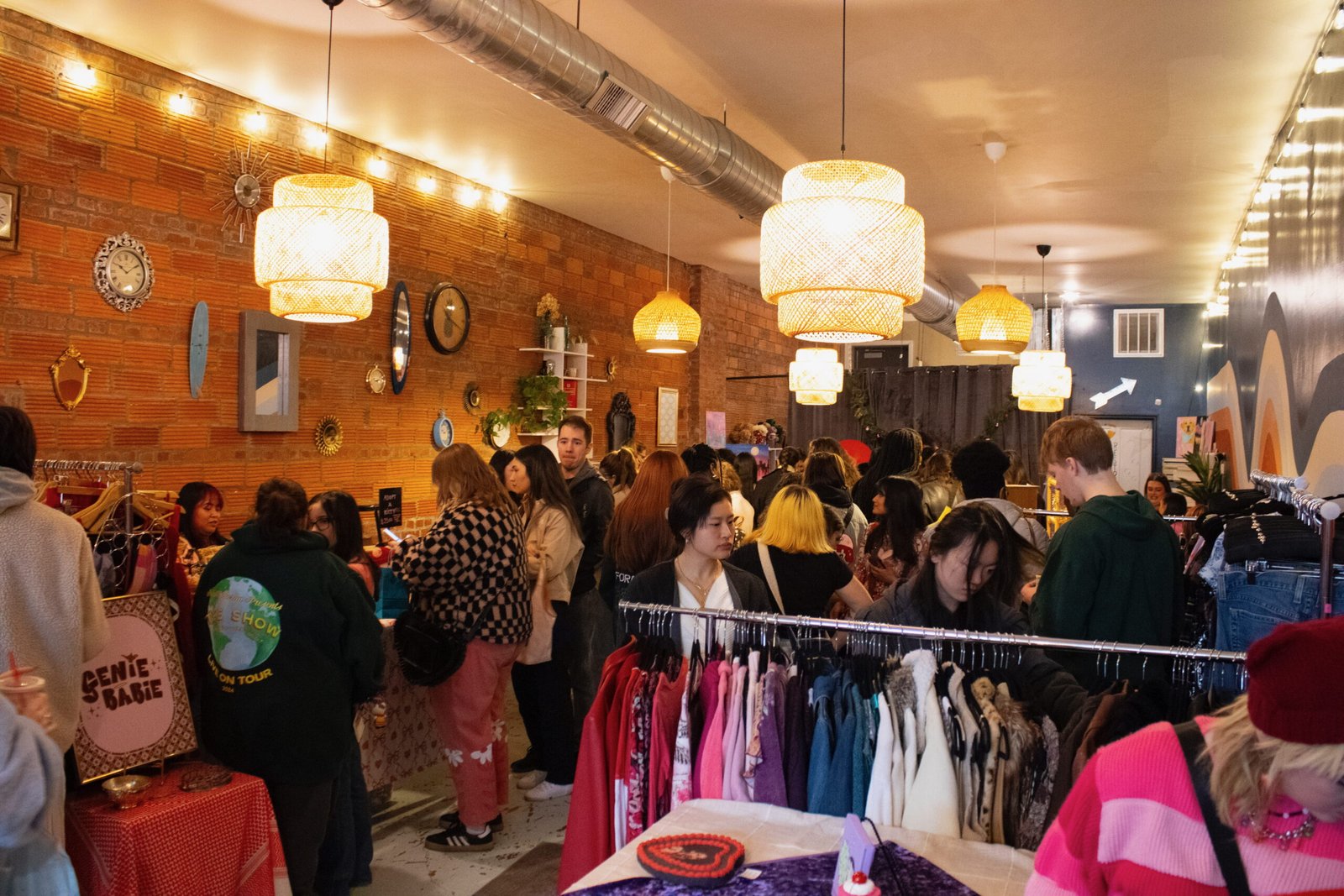

Shoppers browse vintage clothing and local vendor items at Dollhouse & Co.’s Sanrio-themed Kitty’s Sweetheart Market in February. Credit: Courtesy of Sania Mohamed.
On Ohio State’s South Oval, a cluster of about 20 vendors gathered under tents, offering a wide range of Ohio State-branded T-shirts, hoodies, jackets and sweatshirts.
At this Oct. 5 pop-up market, other vendors displayed jeans, dresses, blouses, jewelry, boots and purses — all different items that share one key difference: most ranged in age from 10 to 20 years old. This event reflects a much larger trend, in which college students are turning away from fast fashion in exchange for vintage clothing or thrift store purchases.
Tasha Lewis, a professor in the Department of Human Sciences and a professional in retail studies, with a focus on sustainability in fashion, said that while vintage buying is inherently different from thrift shopping, both appear to be here to stay.
“Secondhand is more recent clothing that people have, and your vintage clothing is going to be your older clothing that might be [a part of] fashion cycles, something coming back that could be like 20 years old or more,” said Lewis.
Lewis said many young adults are choosing to invest in vintage clothing for its durability.
“A lot of times, there are natural fabrics in the older garments,” Lewis said. “A lot of our newer ones have synthetics like polyester and nylon. Some of the older ones, you can get really good wool.”
When browsing vintage clothing, Lewis said shoppers have the opportunity to seek out styles specific to their personal style.
“When people are looking for a very specific type of garment or style, that’s why vintage is popular,” Lewis said. “[It is] something that no one else has, because usually in these markets, you’re not going to see 50 of something. It’s kind of a unique proposition.”
At the Oct. 5 pop-up, Lola Nauman, owner of Dust Bunnies Vintage, located in Franklinton, sold vintage purses, necklaces, rings, hats, jackets and other accessories out of her tent.
“I feel like a lot of our customer base is our students who we see in-store, but not everybody has a car, so it’s great,” Nauman said. “We can bring the vintage to them instead of them being in the store. It’s awesome.”
Taylor Kullman, owner of First Class Vintage, said her recently launched business, which sells vintage tank tops, jeans, purses, watches and necklaces, has received a positive response from customers.
“People are realizing that investing in pieces that are going to be timeless is more worth your while than a Shein order,” Kullman said. “It’s more sustainable.”
Lewis said fashion trends often recycle about every 20 years, where old trends recirculate and become popular again. She also said “fast fashion shaming” is relevant, and discussed how students might feel “peer pressured” to not buy new clothing items.
“[It’s] this idea of fast fashion changing how people think about consumption and disposable fashion, and thinking it’s better to reuse something to find something,” Lewis said. “It’s more economical.”
Recycling clothing is also put to use by Ohio State through events such as the Reid Family Career Closet, Lewis said, which provides students with easy access to professional clothing.
“They have professional clothing for students,” Lewis said. “Students just sign up. You come take it for free.”