
Look, we don’t need to spend two thousand words debating whether the Resident Evil 2 remake is a good game. It first dropped back in 2019, and if you haven’t played it by now, you’ve either been living under a rock or you just don’t like getting your face chewed off in dark corridors. It’s a modern survival horror benchmark. End of story.
What actually matters in this Resident Evil 2 review is how Capcom’s RE Engine holds up running natively on the Nintendo Switch 2. Note the word natively. Back on the original Switch, we got palmed off with those dodgy Cloud Versions that turned into a blurry slideshow the second someone in the house microwaved a pie or started streaming Netflix. This new Deluxe Edition port ditches the server farms and runs straight off the Switch 2’s local silicon.
I’ve put about five hours into the Switch 2 version so far, splitting my time right down the middle between the TV and playing undocked. I’ve loved every minute of it. When developers do the work properly, Nintendo’s new hybrid punches well above its weight.
Quick Facts
- Developer: Capcom
- Publisher: Capcom
- Platforms: Nintendo Switch 2 (Reviewed), PS5, PS4, Xbox Series X|S, Xbox One, PC
- Reviewed on: Nintendo Switch 2 (Docked & Handheld)
- AU Release Date: 16 October 2026 (Digital) / 29 January 2027 (Physical)
- RRP (AUD): $62.95 (Digital eShop) / $69.95 (Physical Deluxe Edition)
- ACB Rating: R18+ (High Impact Violence, Blood and Gore)

Back to the RPD (For the Fiftieth Time)
If you somehow missed this one the first time around, here’s the short version. It’s September 1998, and Capcom’s favourite pharmaceutical company, Umbrella, has turned the Midwestern town of Raccoon City into a buffet for the undead via the T-Virus. You play as either rookie cop Leon S. Kennedy on the worst first day on the job in history, or college student Claire Redfield, who rides into town looking for her missing brother, Chris.
After a brief, chaotic introduction at a rain-soaked petrol station and a fiery crash near the city centre, both characters end up separated and funnelled into the Raccoon City Police Department (RPD). The RPD is a masterclass in level design. It’s an old art museum converted into a precinct, which is a convenient excuse to lock every second door behind a spade-shaped key, a statue missing a sceptre, or a weird medallion puzzle.
Unlike the action-heavy shooter fests of the middle Resident Evil era, this remake drags you right back into proper survival horror. Inventory space is tight. You start with a handful of hip pouches, and every item—from green herbs and gunpowder to a spare combat knife—takes up precious grid slots. Zombies aren’t cannon fodder here, either. They’re absolute bullet sponges that lunge unpredictably, absorbs three or four 9mm rounds to the skull without flinching, and have a nasty habit of getting back up ten minutes later if you didn’t pop their heads properly.

You’re constantly doing mental maths. Do I waste five bullets dropping this bloke shuffling down the West Office hallway, or do I shoot his kneecap off, sprint past him, and board up the window so his mates can’t climb in from the alleyway? Add in blind, ceiling-crawling Lickers that hunt purely by sound, and the heavy footsteps of the Tyrant (Mr. X) relentlessly stalking you from room to room in his trench coat and fedora, and the tension rarely lets up.
Because the Switch 2 release is specifically the Resident Evil 2 Deluxe Edition, you get all the extra trimmings baked into the $62.95 digital price tag (or $69.95 if you wait for the physical cart in January). That includes a pile of cosmetic outfits like Leon’s Arklay Sheriff gear and Claire’s Elza Walker suit, three bonus Samurai Edge handguns sitting in your item box, and the best inclusion of the lot: the Original Ver. Soundtrack Swap.
Flipping that toggle replaces the modern ambient audio with the classic 1998 PlayStation synth music and menu sound effects, which hits the nostalgia nerve hard.
Resident Evil 2 Review: Handheld Mode & Audio
Taking a game that looks this good on a portable screen used to come with a laundry list of ugly compromises. Not here. In handheld mode on the Switch 2, the visuals are smooth and fluid. Throughout my time crawling through the dim corridors of the precinct, I didn’t spot any distracting visual artifacting—none of that weird checkerboard fizzing or ghosting around moving objects that usually plagues aggressive upscalers on portable hardware.
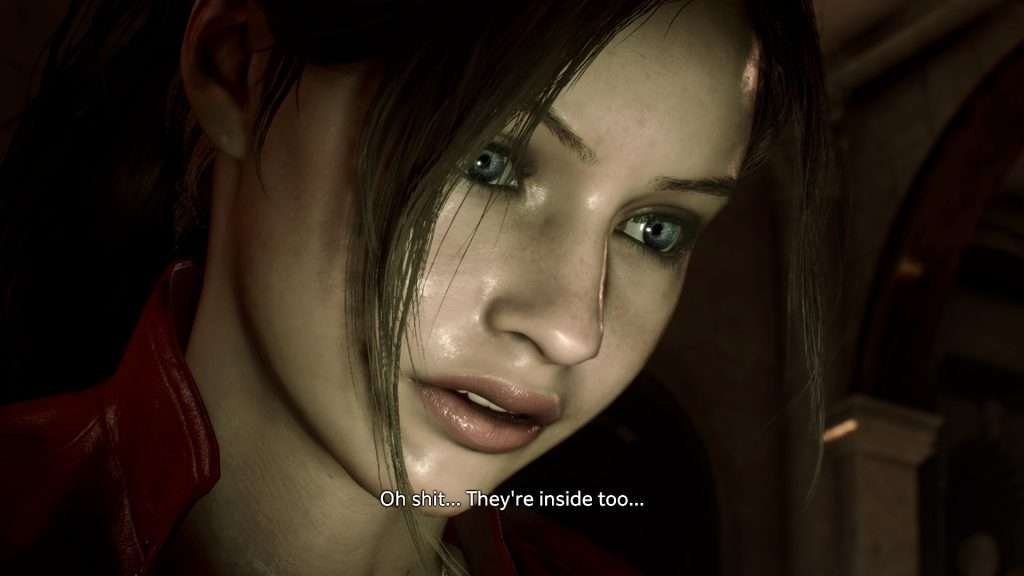
In fact, some of the lighting and shader effects caught me off guard. Rain and blood both have a subtle, realistic shimmer when the light hits them at an angle. Walking Leon in from the pouring storm outside and watching the water glisten on his tactical vest under the main hall’s chandeliers looks top-tier on the handheld screen. Skin textures and clothing details hold up really well, too. If I’m being nit-picky, there’s a touch too much post-process softening across the image, likely from the anti-aliasing smoothing out the edges, though it barely gets in the way.

There is one graphical quirk that refuses to go away, though. Character hair. Whenever a character’s hair is left loose rather than tied back, it looks wispy and jagged around the edges. It’s something I’ve noticed across almost every game I’ve tested on the Switch 2 hardware so far. It seems to be a baseline limitation of how the console’s GPU and upscaling pipeline handle fine alpha transparencies and sub-pixel strand rendering at lower internal resolutions. It won’t ruin your night, mind you, just don’t stare too closely at loose fringes during cutscenes.
Where the Switch 2’s handheld hardware really surprised me is the audio. By pairing the built-in stereo speakers with some clever spatial audio processing, the directional sound is spot-on. You can clearly tell whether a zombie is banging on a shutter behind your left shoulder or shuffling down the stairs ahead of you. Playing in bed with the lights off, those tiny speakers managed to get me with a fair few genuine jump scares.

That said, don’t bother playing this on your lunch break in a noisy breakroom or on the couch next to your partner with the volume dialled down. Resident Evil 2 leans heavily on its audio cues—the wet squelch of a Licker on the ceiling, the creak of a floorboard, the distant thud of Mr. X’s boots. Playing on low volume without headphones guts the atmosphere and makes it harder to survive. Do yourself a favour and plug in a decent set of cans when you’re out and about.
Docked Mode: 4K, HDR, and Fluid Frame Pacing
Slotting the Switch 2 into the dock and throwing it onto a big screen with 4K output, Variable Refresh Rate (VRR), and HDR enabled is a massive step up. Everything that looked good on the portable screen looks flat-out brilliant on the telly.
The HDR implementation does a lot of heavy lifting in a game that’s ninety percent pitch-black hallways and flickering fluorescent tubes. Your torch beam cuts cleanly through the gloom without washing out the surrounding blacks into a murky grey soup, and the specular highlights on wet pavement and gore pop right off the panel. Yes, that wispy, jagged hair is still there on the big screen, and that slight over-smoothing on skin textures carries over from handheld mode, too. Even with those minor blemishes, docked mode is a serious visual upgrade.

Performance-wise, I couldn’t fault the fluidity of the gameplay one bit. The frame pacing feels locked in. Now, with my IT hat on, I’m sure if you hooked the HDMI output up to a capture rig and ran a frame-time graph, you’d find a couple of minor dips when multiple zombies and particle effects crowd the screen. To the naked eye, though, I didn’t spot a single frame rate slowdown across my entire docked sessions.
Whether Capcom pulled this off through clever rendering trickery, aggressive dynamic resolution scaling, or just tightly optimised code and GPU drivers, I honestly don’t care how the sausage is made. The result is what counts. Excellent visuals paired with fluid, responsive gameplay are much more achievable on the Switch 2 than the armchair hardware critics give it credit for. In Belter terms, the little rig holds high-G burn without blowing a gasket.

The Joy-Con Problem
The biggest downside to playing Resident Evil 2 on the Switch 2 has nothing to do with Capcom’s code and everything to do with Nintendo’s packed-in controllers. The Joy-Cons are still a pain in the arse for serious shooters and survival horror.
When you’re trying to line up a precise headshot on a swaying zombie while walking backwards down a tight corridor, those small thumbsticks and cramped button layouts just don’t cut it. To actually enjoy my time with the game, I ditched the standard Joy-Cons completely.
For docked play on the couch, a Pro Controller is mandatory. For handheld sessions, I use a third-party handheld dock controller that the Switch 2 tablet body slots straight into. It gives the portable unit proper, chunky ergonomic grips and full-sized buttons and thumbsticks that feel much closer to a standard Xbox controller. Once you fix the ergonomics with proper hardware, the aiming feels snappy and the cramped-hand fatigue disappears.