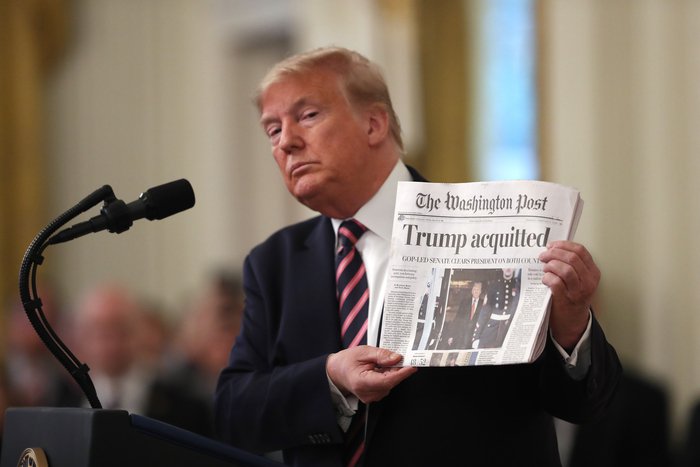
New book: How Politics Threatens the News Eight years of Trump vs. The Washington Post Despite journalistic achievements, the press faces a fight for survival Since Trump’s second term began, it has become ‘spoils’

The four people entered the White House grounds at 6:50 p.m. for a ‘private dinner.’ The president and first lady welcomed them courteously, and the president’s son-in-law was also present.
Then, at 7 p.m., a scoop suddenly broke: a special counsel was investigating business dealings between the president’s son-in-law and Russia. As it happened, the newspaper’s executives and editorial leaders—the people behind the scoop—were seated across from the president. The two sides to the story were facing each other across one table. An odd tension filled the room. Then someone broke the awkward silence: “How very Shakespearean—a dinner with the enemy.”
Hard to believe, but this really happened on June 15, 2017.
They were The Washington Post’s owner, Jeff Bezos; publisher Fred Ryan; editorial page editor Fred Hiatt; and managing editor Martin Baron, who oversaw news coverage. With this report, The Washington Post came to be seen as not merely ‘Trump’s enemy’ but ‘the enemy of the state,’ and the ‘president’s hard punches’ soon landed on Amazon and The Washington Post. A newly translated edition of Martin Baron’s book, How Politics Threatens the News, documents that brutal ordeal.
For context, Baron served as editor of The Boston Globe (2001–2012) and editor-in-chief of The Washington Post (2013–2021). He was the real-life model for the editor played by Liev Schreiber in the film Spotlight, and wrote this book in 2023.
The book takes readers back to the time The Washington Post was acquired.
Newly installed as editor-in-chief, Baron heard that Amazon founder Bezos would buy control of The Washington Post for $250 million from the Graham family, which had owned it for 80 years. The stated reason for the sale hit like a dagger: “The Washington Post was in trouble. Both print and online advertising were declining, and paid digital subscribers were only a hope.” Bezos saw the entire English-speaking world as a market for the company and was fully committed. But the threat was not a shrinking news market or a changing media landscape. The threat to him was the ‘resentful president of his own country.’
In fact, Trump’s chances of running for president seemed slim. In a joint poll by The Washington Post and ABC, only 4% of registered Republican voters supported him. But Baron had a different premonition. When Trump said, “The United States is a punching bag in trade deals,” the event venue erupted with enthusiasm, revealing just how angry voters were at the established powers. Trump’s candidacy, which had seemed absolutely, utterly impossible, became reality. Trump became a major subject of coverage for The Washington Post.
As The Washington Post ‘went after’ Trump day after day, their relationship deteriorated. In the author’s view, Trump was following a ‘historic path of falsehoods.’ By this point, Trump had chosen his target: Bezos. He publicly said that if he became president, he would ‘punish’ Amazon. It reflected his mindset, expressed in his words: “If someone screws me over, I like to hit back even harder. You have to give it back 15 times over.”
But the book says Bezos did not back down. The Washington Post held its ground in the face of a presidential candidate who boasted of having the Midas touch despite going bankrupt six times, and who misstated by a wide margin the number of floors in buildings he owned. To Trump, Bezos, Amazon and The Washington Post were an ‘axis of evil,’ but owner Bezos urged his staff on: “We’re not at war with them. They may be at war with us, but we just have to do our jobs. Just do your jobs.”
In this climate, The Washington Post won an astonishing 10 Pulitzer Prizes during Baron’s tenure. Its journalists relentlessly explored the blurred line between truth and fiction that Trump had created, unleashing scoop after scoop as if breaking through a dam.

But this book is a far cry from a paean to the company where the author worked and its owner. The mood grows somber again, both within and beyond its pages. Once surpassing The New York Times in monthly visitors, The Washington Post has struggled to find a viable business model despite its ambitious digital transformation. The book also details a flurry of proposals: “We need to create a visually appealing app that readers will gladly pay for”; “We need to bring the best features of the print newspaper to the app”; “We need to remove the name The Washington Post from the app”; and “We need to test everything on the website.” The stark reality was that journalistic achievements did not naturally translate into a news organization’s survival, making these concerns raw and unvarnished.
Baron left The Washington Post in 2021 after serving eight years as editor-in-chief. Then, when Trump’s second administration took office, Bezos had changed noticeably, in the author’s view. He donated $1 million to Trump’s inauguration, and Amazon invested $40 million in producing a documentary about the first lady. Baron criticizes him, saying, “He became the president’s spoils.” In the Korean edition’s preface, Baron unleashes his feelings as if raining down artillery fire.
A memoir of ‘Trump vs. The Washington Post’ and a reflection on why media exist when they must worry about survival even after winning 10 Pulitzer Prizes. Readers interested in the crisis facing journalism will find themselves reaching for a highlighter.

By Martin Baron, translated by Jeon Mi-young, published by Wisdom House
This article has been translated by GripLabs Mingo AI.