On the afternoon of Saturday, September 5, a steady stream of visitors passed through the flagship store of the Paul Smith label in London’s elegant Mayfair district: the director of a national museum in Norway, an architect overseeing the design of a new airport, and others from Athens, Toronto, Mexico City, and various parts of the United States.
They were all helped by a tall, slender 80-year-old man, impeccably dressed in a tailored jacket, sporting stylish glasses and a tousled mane of hair. None realized they were being attended to by Paul Smith himself, the grand old man of British fashion, who, at the height of his fame and success, still cannot resist serving customers, like an eternal Saturday boy (the traditional term for the student hired to help out during a shop’s busiest afternoon of the week) who relishes human contact
“They are the ones who pay my wages, just as readers pay yours,” Smith tells EL PAÍS. “And you always meet very interesting people.”
Smith has just published his memoir, Threads: My Life in Style, but, he explains, his aim is less to look back on the past than to show a new generation of designers that it is still possible to succeed the old-fashioned way: through hard work, sacrifice, personal conviction, and boundless curiosity.

“I have always been a very curious person, but with my feet on the ground,” he says. “Unlike other brands or designers, I never chased rapid success. I was content for things to go well and to enjoy the day-to-day. I have been with my girlfriend, now my wife, Pauline, since 1967, and we are not the kind of people who are constantly searching for love, a job, success or whatever. We haven’t needed to.”
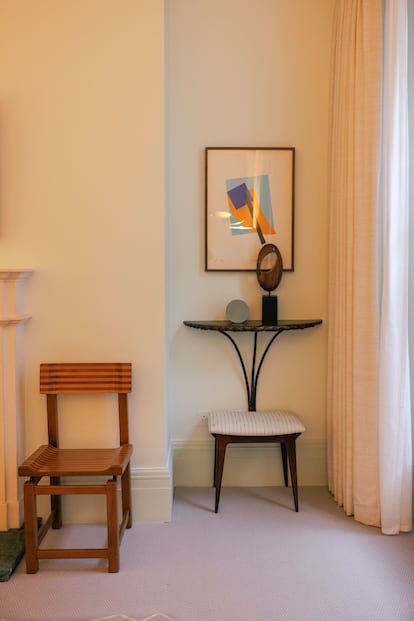
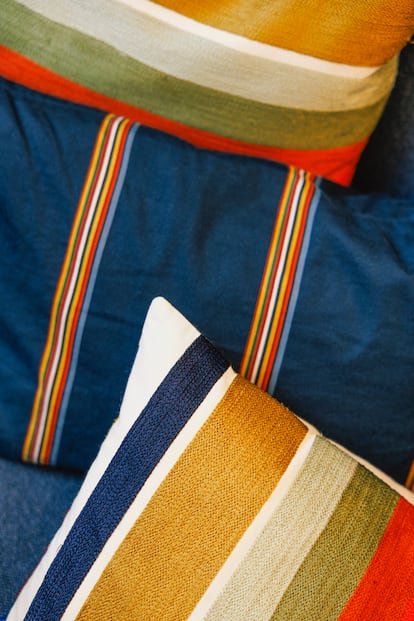
The interview takes place in the Paul Smith Grand Suite at Brown’s Hotel, directly opposite the store. It comprises three luxurious rooms decorated with all the flair and attention to detail that have made the British designer famous. The walls are covered in contemporary art, on loan from Smith’s vast personal collection. Some of the furniture consists of classic pieces personally chosen by him; others come from the collection he designed for the legendary Milan-based manufacturer De Padova. The tiles around the fireplace feature the multicoloured stripe motif that has become synonymous with the Smith brand worldwide and were made from clay sourced from the Thames.
Such is the level of attention to detail shown by the boy from Nottingham who left school at 15, had his cycling ambitions derailed by an accident, and discovered a different path in a fabric workshop.

But the true guiding force in Smith’s life has been Pauline Denyer, six years his senior, whom he met when he was 21 and still living with his parents.
“She was the perfect balance between someone grounded, humble and provincial who hadn’t seen much of the world, and a London lady who had studied at the Royal College of Art, worked with people like David Hockney or Peter Blake, and mixed with George Harrison of the Beatles. She gave me an instant London jolt,” the designer says with a laugh.
Smith is playful, witty, talkative and kind, very kind. No question seems to unsettle him, and at no point does he try to present himself as a legend. He has simply enjoyed a remarkable life, one that has allowed him to meet fascinating people. For years, he embodied a modern, vibrant Britain that captivated the rest of the world.
But he describes his success with a modesty that hardly does justice to reality: the ability to draw on his country’s classic traditions, give them an unexpected twist, add surprising splashes of color and, above all, never compromise on quality.

“Pauline raised my standards. And that was very important. She wouldn’t let me use certain buttons because they weren’t good enough quality. Or she would force me to add more stitching to certain finishes, to improve the buttonhole of a jacket, or to use better fabrics,” Smith admits.
“When I began in this profession, in the early 1980s, there was definitely something you could call a British style. Tweed was widely worn; there was a very English country look and a city look, because the class system still endured. There was upper class and working class, and the former oscillated between country wear and business suits,” the designer explains as he sips a coffee and devours a croissant brought to him by his personal assistant. It’s little surprise. Smith has been up since 5:30 a.m., as he is every day, swimming laps before starting work.
“Then came air conditioning, heating, travel, good cars and good hotels, and with them a whole range of very lightweight Spanish and Italian fabrics. The look became more international, so the supposed British touch of Paul Smith became more of an egocentric, playful, humorous accent, reviving the spirit of the Swinging Sixties in England [the cultural revolution of the vibrant 1960s on London’s Soho and Carnaby Street],” he continues.
Today, his empire spans 130 stores, including 20 in Japan, where his success has been particularly remarkable, and employs more than 1,200 people. In its most profitable year, the company posted earnings of more than €235 million ($264 million). His iconic pink store in Los Angeles has become a landmark of contemporary architecture and design.
From the tiny windowless clothing store tucked away in a Nottingham alleyway, grandly named Paul Smith Vêtements Pour Homme, to his breakthrough success in the United States in the 1970s, with his first New York store and regular appearances at Studio 54 alongside the celebrities of the day, a common thread runs through the story: his determination to retain control of the business and, through that control, preserve the freedom to take risks and be creative. Stardom was fun, he says, but incidental.
“It was never something I thought about too much,” he says. “I still dress very famous people. But I think of them as ordinary people, with their own emotions. With a mother and a father. With good days and bad days. It was exciting, of course, and flattering. But Pauline always kept my feet on the ground. She is a shy woman who shuns exhibitionism and dislikes frivolous conversation,” says Smith, who values what he learned from all those relationships.
“I always try to see things in a new light. That’s something I learned from David Bowie. He always saw the world differently than you or I. He was like a chameleon. He would come to my office and everything inspired his curiosity. ‘What book is that, Paul?’ ‘Whose painting is that?’ He was very curious, but somehow I always gave him an answer,” recalls Smith.
Through the Paul Smith Foundation, he has dedicated himself to teaching young designers the basic business skills he had to learn on his own, from accounting and tax management to strategies for growth and expansion. Practical knowledge that has become all the more valuable in a world that, he says, has made life harder for him and many other business owners.
“The world has become a mess, with more than 80 dictators in power. With wars in more than 60 countries,” he says. “And then came Brexit, and later the pandemic. We are still recovering from those 16 weeks when everything came to a standstill. And with Brexit, overnight we lost a trade agreement with 26 of the 65 countries we sell to. Of course I voted against it. It was the fault of politicians who used meaningless words, who promised we’d be more independent and everything would be better. But businesspeople didn’t want it, and we miss the way things were.”
Today, roughly a quarter of Paul Smith’s customers are in their twenties. Given the veteran designer’s energy, curiosity and spark, it is easy to see how he has managed to strike that difficult balance: retaining the loyalty of one generation while appealing to the next.
Sign up for our weekly newsletter to get more English-language news coverage from EL PAÍS USA Edition