Follow us on Google News

Over 8,000 hoax bomb threats have targeted schools, airports, airlines, media outlets, and other institutions across Europe over the past month, triggering widespread evacuations, flight diversions, and temporary broadcast disruptions. The wave of emails has affected several countries, with Britain, Ireland, and Italy bearing the heaviest impact, alongside institutions in Bulgaria and France. Cyber security specialists and European authorities are now working to trace the network behind the campaign and examine possible foreign interference.
The threatening messages warned of planted explosives and bloodshed, with several carrying the subject line “Death is near.” Investigators found that the emails were sent simultaneously to large numbers of institutions and shared clear similarities in language and distribution methods. On October 19, St John the Baptist Primary School in Belfast, Northern Ireland, received an email claiming a bomb had been placed inside the building. Principal Chris Donnelly treated the message with caution because it lacked specific details and had been sent to several other schools, keeping students safely indoors while conducting a room-by-room search. Police later confirmed that around 300 schools in Northern Ireland received similar hoax messages that day. According to data from cyber security firms Proofpoint and Mimecast, at least 33 schools in Scotland and roughly 25 organizations in Bulgaria, mainly healthcare providers and anti-corruption or whistleblower bodies, were also targeted on October 19. Reviews of eight emails written in English, Bulgarian, and Italian showed common patterns and revealed that attackers used at least four hijacked email accounts, including one belonging to a former graduate student from Taiwan.
Threats Resume Across Aviation and Media Sectors
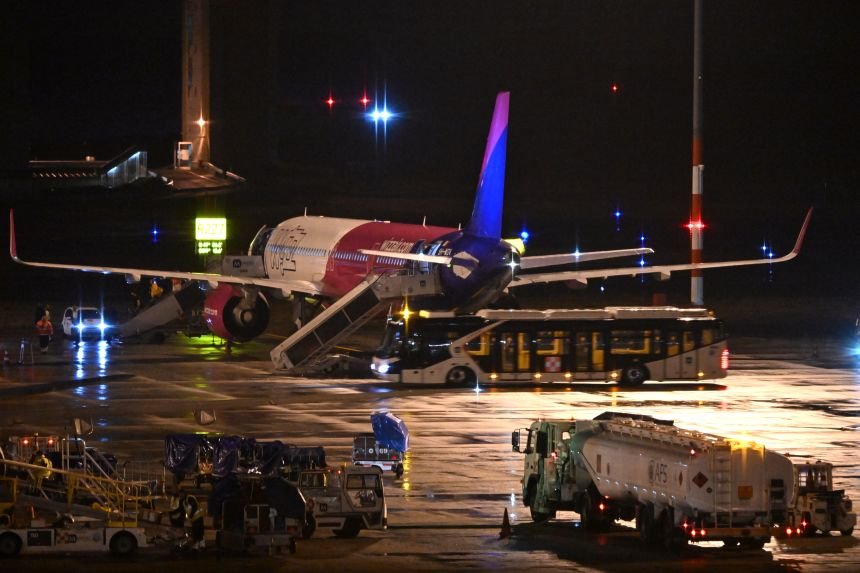
Following a two-week lull after October 19, the campaign resumed on November 2 when a Wizz Air flight from London to Sofia was diverted to Budapest after a bomb alert. The next day, seven additional flights and a cruise ship off the coast of Greece were targeted, followed by further aviation alerts across Europe on November 5. Aviation monitoring specialists reported that more than 50 flights operated by around 15 airlines received hoax bomb threats between November 2 and November 6.
The tone and branding of the November emails shifted from the earlier wave. While October messages referenced Sharia law, the November emails were sent under the name of Male State, a small Russian anti-women group whose founder has denied any involvement. One message warned, “Today your sky will be red,” alongside general threats of bombs and bloodshed. On November 6, at least 12 media organizations were targeted, including France’s TF1, Bulgaria’s Nova, and Ireland’s public broadcaster RTE, which briefly halted some broadcasts and evacuated staff from its headquarters.
Single-Day Surge Hits Thousands of Schools
The largest single-day wave occurred on November 11, when roughly 6,300 schools in Italy received bomb threat emails using the name “Misogynistan,” which investigators linked to Male State. Authorities evacuated schools across Italy in response. On the same day, around 1,000 schools in Scotland, 300 in Northern Ireland, and nearly 300 in Ireland received similar messages, including several institutions previously targeted in October.
Authorities Probe Potential Foreign Interference
European officials suspect foreign involvement, though investigators have not yet independently confirmed that a single group sent every email. Similarities in wording, distribution tactics, and repeated targeting of the same schools have led authorities to suspect a coordinated operation. French Interior Minister Laurent Nunez stated that the possibility of foreign interference clearly exists and did not rule out the role of Russia or another country. Europol is actively investigating the origin of the threats, while Ukrainian officials have previously accused the suspected Russian mercenary hacker group Da Vinci Group of sending hoax bomb alerts. French cyber security firm Intrinsec also noted similar threats against Western government institutions in 2024. Despite recognizing the messages as hoaxes, officials face the ongoing challenge of treating every alert seriously, as school leaders note that no threat can be ignored in case a future warning proves real.