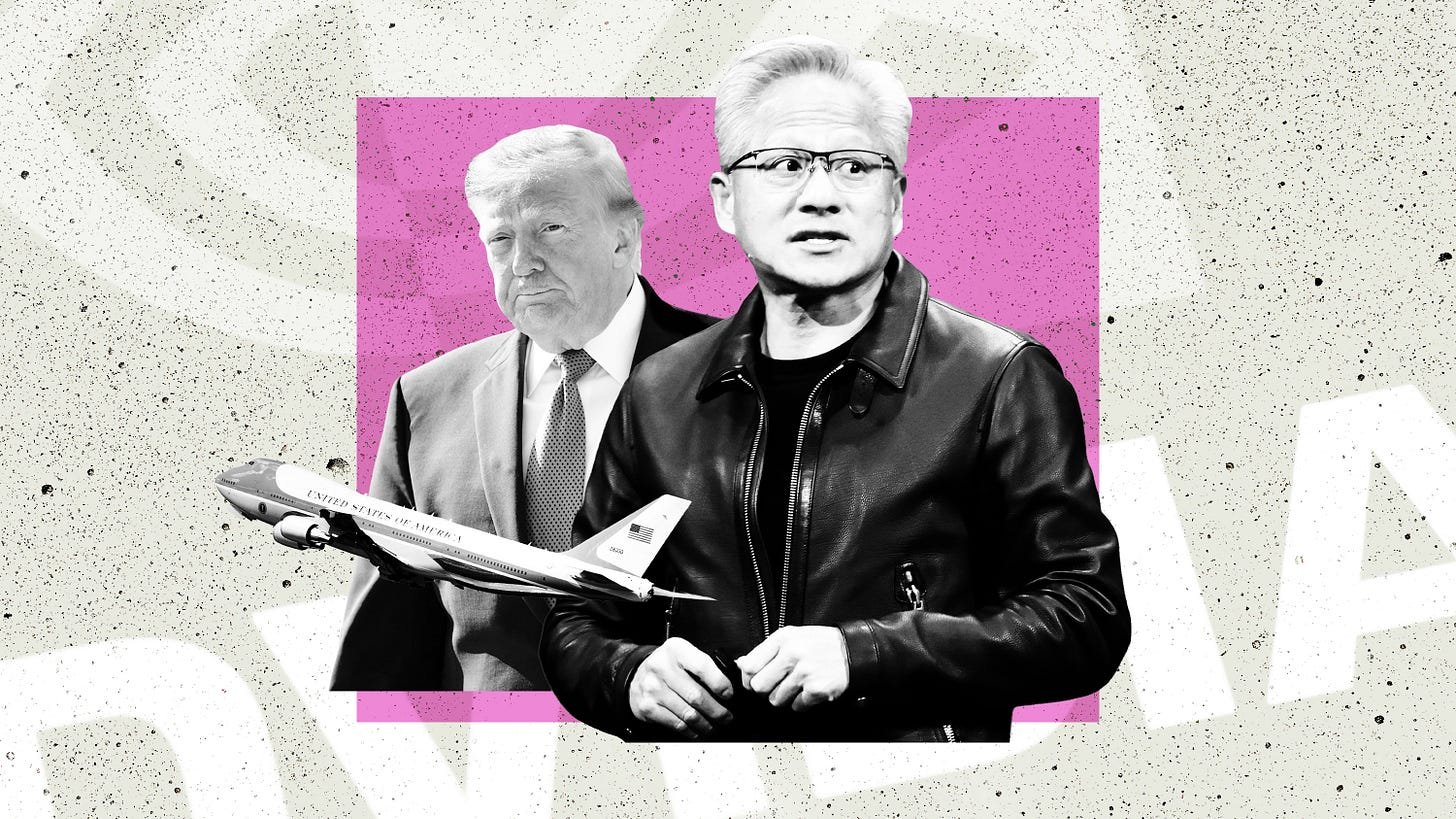
THE MOST SALACIOUS PART of the Nvidia story is the apparent honeytrap that ensnared the company’s founder, Jensen Huang, and ultimately led to his resignation on Thursday.
Yet far more scandalous than Huang’s affair(s) is the apparent coverup by a Trump administration so keen to protect its friends, and so eager to juice the stock market, that it was willing to trade away U.S. interests.
Put another way, the horndog may be the headline. But the real story is the transactional way the Trump administration handles all of America’s economic security.
This is one of the biggest national security scandals in decades. It also could cause serious economic damage, as it undermines our domestic AI industry and boosts China’s. Heads. Should. Roll.
As you’ve probably heard by now, Huang had an affair with a woman U.S. intelligence services believed to be a Chinese spy. The administration knew about Huang being compromised. Donald Trump did, too. The president was warned at least twice, including once right before he picked up Huang on Air Force One en route to Beijing. And yet the administration did nothing.
Actually, worse than nothing: Officials bent U.S. policy to be more favorable to Nvidia and China, and to make it easier for the former to supply the latter.
Why did Trump do that? Charitably, he was persuaded by Huang’s entreaties to loosen export controls on Nvidia’s chip sales to China. Back in May 2025, for instance, the administration announced it would not enforce and ultimately scrap Biden-era restrictions on advanced-chip exports to many countries, including potential transit points for re-shipments into China. The Commerce Department also appears to have cleared chip sales to companies that may not exist (or that do exist, but are under sanctions).
Commerce also halted an investigation into one of those shell companies—Megaspeed, the company formerly led by Huang’s paramour, alleged Chinese agent Alice Huang—apparently after an inquiry from Nvidia. And Commerce declined to put Megaspeed on a trade blacklist that would restrict its access to U.S. technology, despite recommendations from the intelligence community and White House officials, based on concerns it was a front for the Chinese government. As of Thursday, Nvidia still lists Megaspeed as a “cloud partner” on its website.
In other words, even as Trump and his lackeys claimed that the United States dare not regulate AI because constraining U.S. tech firms might enable China to “win” the AI race, the administration turned a blind eye to sales of AI-critical chips to an apparent Chinese spy. In many ways, these export controls—first put in place under Trump 1.0 and then expanded under Biden—had become ornamental.
The question is: Why would an administration populated by purported China hawks look the other way?
We don’t know for sure, but a few pieces of information seem pertinent when answering that question.
Huang has, shall we say, a very cozy relationship with Trump, who continued to praise Huang even after he resigned from the company. Nvidia “donated” $25 million to Trump’s ballroom, tied for the largest amount given. And in April 2025, Huang attended a $1-million-per-plate candlelight dinner at Mar-a-Lago, where he reportedly persuaded Trump to postpone planned restrictions on chip sales to China.
But even without a seven-figure entrance fee, Huang and Trump kibitzed on the phone all the time, according to reporters who cover Nvidia. Trump likes winners, and until recently, Nvidia was the most valuable company in the world. So Huang was a fun friend to keep around.
Trump also seems to fancy himself as being in business with Nvidia.
You may recall that when Trump gave permission to Nvidia to sell its powerful H200 chips to China, he imposed one big condition: that the United States get a cut. Chips manufactured in Taiwan had to be routed through the United States on their way to China so Trump could collect his 25 percent tariff. As for what became of those chips once they ended up in China, Trump doesn’t appear terribly bothered: He believes himself to be close personal friends with Chinese President Xi Jinping, as well.
Finally, the AI boom is propping up much of the economy and stock market right now: Ten stocks heavily exposed to AI account for about 40 percent of the entire S&P 500 index’s total market cap. Want to keep the gravy train going? That means keeping the whole sector strong—and the sector in turn critically depends on Nvidia.
Nvidia’s chips are key inputs in data centers around the world. They’re used to train AI models run by the major hyperscalers (Google, Amazon, Microsoft, etc.). And Nvidia’s relationships with other companies in the sector are even more incestuous: The firm is not just a supplier to the troubled AI cloud platform CoreWeave, for instance; it’s also among the largest shareholders and a major customer of CoreWeave, too. This is the “circular financing” you may have heard about. Nvidia has been nicknamed the “central bank” of the AI buildout for good reason. In addition to designing chips, it is guaranteeing leases, backstopping debt, and buying equity stakes in many of the companies it sells to. Even power companies can’t escape Nvidia’s orbit.
The upshot is that Nvidia and Huang had a huge financial interest in being able to sell to more customers, including those in China. But so too did anyone else who might have worried that curbing Nvidia’s sales—or worse, revealing its role in a sexpionage scandal—might destabilize the overall AI industry, and by extension, the overall stock market.
Not that there’s anyone in government who might prize stock-market performance over U.S. security.
— When Huang testifies before Congress later this month—as is now expected—lawmakers need to focus their questioning on conversations he had not just with Trump but with Commerce Secretary Howard Lutnick. If recent reporting is accurate, Lutnick’s behavior could be described as either lazy foot-dragging or outright insubordination. It would also be worth asking why Nvidia abruptly changed how it publicly reported sales so that it no longer disclosed revenue from Singapore. (Megaspeed is a Singaporean company.)
— The Economist suggests this may have been the most expensive affair in history, as it wiped out perhaps a half-trillion dollars’ worth of Nvidia’s market cap.
— The Committee for a Responsible Federal Budget has been tracking how well the economic projections from the White House Council of Economic Advisers over the past two years have matched reality. Turns out—you may want to sit down for this—the administration forecasts were on the rosy side.
— Dems’ solution to high house prices is . . . subsidizing demand.
— Beef prices are not coming down anytime soon, either.
— Interesting observation from a new Foreign Affairs article on the “luxury of children”: “Richer and more educated households in the United States and other advanced economies now tend to have more children than poorer and less educated ones, reversing a pattern that had held for centuries.”
— Kalshi has parted ways with Donald Trump Jr., who was a paid adviser to the firm. I interviewed Kalshi CEO Tarek Mansour at a recent event at the Economic Club of New York. When I asked him about his company’s relationship with Don Jr., Mansour said the president’s eldest son was hired because he has a large social media following, and the hire was not a “political decision.”