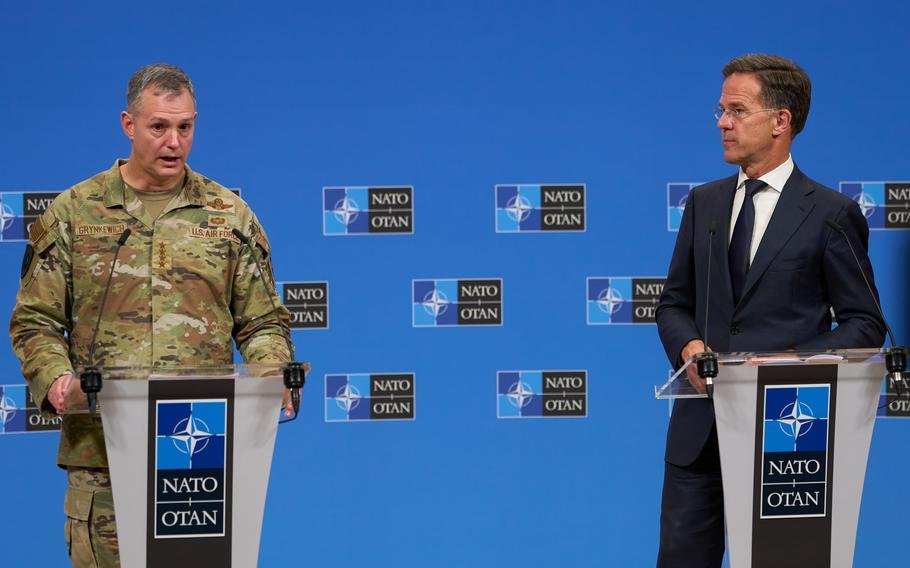

Gen. Alexus Grynkewich, NATO’s supreme allied commander in Europe, left, and NATO Secretary-General Mark Rutte hold a news conference at NATO headquarters in Brussels on Sept. 12, 2025. Grynkewich warned European lawmakers this week that drones can threaten NATO countries far beyond the alliance’s eastern flank. (NATO)
The growing reach of drones means NATO can no longer regard countries bordering Russia as the alliance’s only front line, its top military commander said this week, warning that the current period of heightened security could last for years.
“In a way we are all eastern flank nations now,” Gen. Alexus Grynkewich, NATO supreme allied commander Europe and head of U.S. European Command, told European Union parliamentarians in Brussels.
Poland and the Baltic states, which lie along NATO’s so-called eastern flank, have traditionally been viewed as the alliance’s most exposed territory. But recent drone incidents, airspace violations and suspected sabotage farther from Russia have raised security concerns across Europe.
“Those drones can go thousands of miles,” Grynkewich said. If one gets through, “it’s not just a threat on the eastern flank; it’s a threat to the entire alliance, including all the way in North America.”
Grynkewich said the overall security environment is “unsettled” and “likely to become even more so over the next several years.”
In recent weeks, Russian drones have repeatedly approached or crossed into NATO airspace, sparking concerns about a potential escalation. There also have been instances of manned aircraft crossing allied borders.
Last week, a Russian military helicopter briefly entered Polish airspace from the Kremlin’s military exclave of Kaliningrad.
Grynkewich also cited recent attempts at sabotage farther west. In August, an explosive-laden drone was found near a Ukrainian cargo plane at a civilian airport in Leipzig, Germany. The government has blamed Russia for the incident.
The latest reported instance of Russian sabotage emerged Tuesday, when Estonia announced it arrested suspects involved in an August arson attack on a robotics facility. Estonia said the incident was ordered by “special services” of the Russian Federation.
State-directed sabotage is growing increasingly brazen, Grynkewich said. He called for better intelligence sharing among allies and publicly assigning blame to Russia or any other state involved, when appropriate.
“Once we have confidence in the attribution, we do need to make that public,” he said. “Bringing that attribution out publicly will let state sponsors know that we understand what they’re doing, and that increases costs on them.”
Grynkewich also reiterated his concern that allies must be ready for conflicts in more than one region at the same time.
China, Russia, Iran and North Korea are “collaborating in ways directly counter to all of our global interests,” Grynkewich said.
The war in Ukraine could be “a sobering preview of how future simultaneous and potentially protracted conflicts might look,” Grynkewich said.