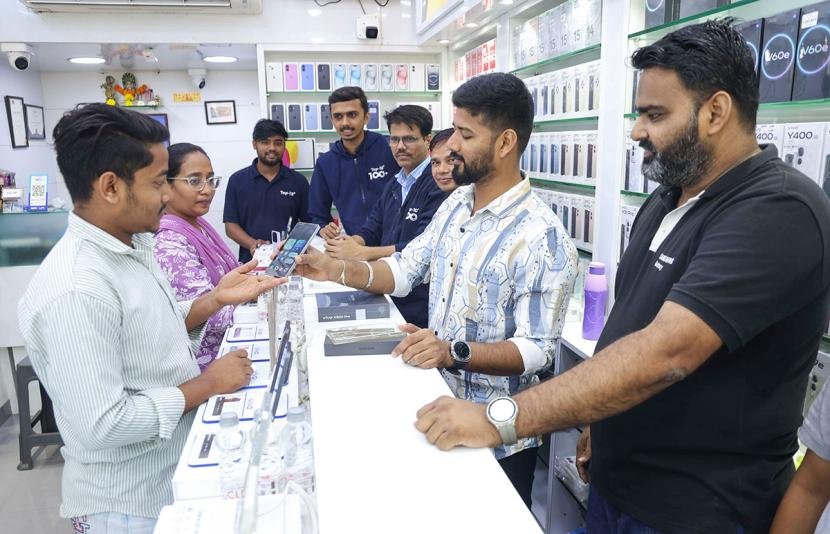
As many as 15,000-20,000 frontline retail jobs have reportedly been rationalised, with further cuts feared.

Kindly note the image has been posted only for representational reasons. Photograph: ANI Photo
Happy Diwali may be the greeting doing the rounds on mobile phones, but the festival of lights this year appears far from happy for those running and working in the ubiquitous neighbourhood cellphone shops.
It should really be the peak season of sales for the country’s 150,000-plus mobile retailers — about half of whom own a single store — but their cash registers haven’t been ringing.
The lack of buyers worries Pawan Bhagat, who owns one of four mobile retail stores in Baisi city of Bihar’s Purnia district: “My business has halved to Rs 10 lakh a month. Most of my buyers look for entry-level phones below Rs 15,000 — but their prices have shot up by 80 per cent, which they cannot afford.”
“So there is no Diwali demand like last year,” he said.
Dharmendra Mehta Rai’s three mobile shops lie more than 2,000 km away, in Gujarat’s Kutch district. But his story is the same.
“My investment to stock 60-70 phone models has doubled to Rs 30-35 lakh, while my sales have halved; for the first time, I have had to take a bank loan.
“I am thinking of getting into lifestyle fashion or men’s accessories or childwear business to hedge and supplement my income.”
Key Points
- India’s mobile retailers are facing a weak Diwali season as smartphone prices surge and consumer demand falls.
- Entry-level smartphones below Rs 15,000 saw their market share plunge from 41 per cent to 18 per cent.
- Retailers report falling sales, higher inventory costs and growing pressure on their businesses.

Smartphone Sales Plunge 26 Per Cent
The brunt of the demand destruction has been borne by a people’s favourite — entry-level smartphones in the sub-Rs 15,000 category.
In the third quarter of CY2025, they accounted for 41 per cent share of total mobile phone shipments in the domestic market. In the same quarter in this calendar year, they plunged to a mere 18 per cent, according to Counterpoint Research.
This is because entry-level smartphone prices have moved to a higher segment of over Rs 15,000 to Rs 20,000 amid a global spike in memory chip prices on account of the West Asia crisis.
This has made entry-level phones unaffordable for many price-conscious customers, who have now either postponed purchases or gone for refurbished used phones.
Mobile phones priced under Rs 15,000 saw sales plummet 65 per cent over the same period.
Indeed, the chip crisis has hit shipments across all price segments, impacting even the big boys such as Samsung, Apple, Vivo, Oppo and Xiaomi.
Overall, shipments are down 26 per cent in Q3 CY26, from 48.4 million phones last year to 35.8 million, according to global technology research firm OMDIA. The fall marked a decade’s low.
Neil Shah, founder of Counterpoint Research, said: “We expect the festive and holiday momentum in Q4 CY26 to stay relatively subdued compared with last year with volumes projected to decline by 12 per cent year-on-year.”
To be sure, despite the sharp volume fall, growth in value terms, said Shah, is projected to go up by at least 1 per cent by end-CY26, showing resilience in the market.
That is also the result of pricier phones. Mobile players have pushed the average selling price (ASP) of phones by over 16 per cent this year, driven not only by higher memory chip prices but also by a shift in consumer preference towards premium phones.
Customers are buying fewer phones, but going in for premium ones.
Sanyam Chaurasia, principal analyst in OMDIA, said: “Last calendar year the shipments were pegged at 153 million phones. This year we project it will go down to 132 million. And the pricing pressure will continue till at least the first half of CY2027 — one will see a low single digit decline next year too in phones.”
But retailers see an even sharper impact. Kailash Lakhyani, chairman of the All India Mobile Retailers Association of India, which represents independent mobile retailers, said: “We expect a sharp contraction. Shipments will settle down at 105-110 million this year.”
Mobile Retail Jobs Face The Axe
Demand destruction has also led to pressures on mobile retail jobs.
Lakhyani said that, based on feedback from retailers, as many as 15,000 to 20,000 frontline retail jobs have been rationalised as footfall and sales volumes shrink.
He added that if Diwali does not show a turnaround, another 12 to 15 per cent jobs may go.
With production in factories being cut back, 30,000 contractual and daily wage workers are also facing job losses, he said.
Even mobile companies which offer free manpower (known as promoters) to retailers to help push their brands in stores, especially during the festive season, have pruned them substantially to cut costs.
Shah said that there is already a 20 to 30 per cent cut in these brand-sponsored promoters.
Small Retailers Struggle With Margins
The mobile distribution game is now divided.
On the one hand there are the big retailers, with a chain of stores across cities and towns, which are well funded.
On the other are the large number of small independent players who depend substantially on selling entry- and mid-level phones.
One trend, said Rai, is that many small retailers are taking up franchises of the bigger retail chains by merging their business and giving up their independent status, hoping things will work better that way.
“Small retailers get less margins from brands (5.5 per cent average), which are linked to overall sales compared with the bigger players who generate large volumes (over 9 per cent).
“By becoming a franchisee they can take advantage of higher margins even after paying a small percentage to the chain (around 1 per cent).”
Other retailers have taken to buying online, where phones are cheaper, and then selling through their stores.
Madhav Sheth, founder of NxtQuantum Shift Technologies which has launched the Ai+ range of phones, said: “Channel distribution accounts for about 40 per cent of the selling price of the phone.
“In comparison, it is half or a quarter on online sales, so the difference in price is huge, which eventually customers have to pay.” Sheth reckons that around 10 per cent of sales is carried out by retailers who buy online and sell offline.
Homegrown Brands Fill Market Gap
Of course, NxtQuantum and many other homegrown phone brands like Mivi and Boltt, which have started out recently, are smartly filling up the vacuum in entry-level phones, where global players have reduced exposure.
As a result, the share of these homegrown players in the total mobile market went up from a mere 2 per cent in Q3 CY 2025 to 7 per cent in CY 2026, according to Counterpoint.
NxtQuantum sold its phones, including those priced under Rs 20,000, exclusively through Flipkart.
According to Counterpoint, its shipments in Q3 CY 2026 grew by a staggering 306 per cent — albeit from a lower base — year-on-year.
Sheth acknowledged that offline still accounts for 45-60 per cent of overall sales because of the comfort factor as well as the ability to touch and feel a product.
The question is how much premium customers would like to pay for this comfort.
“We have signed up directly with 6,000 retailers who are ready to work with us at a lower margin which will benefit the consumers and grow the business.”
There are others like Finland’s HMD Global, which have also rushed in to fill the gap.
Ravi Kunwar, CEO and vice president India and Asia Pacific at HMD Global, said: “This year the increase in price has been in a way where price elasticity is impacting the consumer.
“So if someone is looking for a Rs 10,000 phone his price flexibility would be Rs 1,000 to Rs 2,000, but now the price has gone up to Rs 20,000 he won’t buy.
“We saw this as a white space and entered in it and gained share.”
The company launched the Vibe 2 in June and sold over 100,000 units in the first four hours on Flipkart and followed it up with the Vibe Pro last month — all below the sweet spot of Rs 15,000.
But Kunwar points out that the signs are that global companies which had vacated this large entry-segment market — according to analysts, mostly Chinese, turned off by wafer thin margins — are preparing to come back because of its size and economies of scale.
The question now is whether that will be enough to spur demand and get volumes back up again.
The small retail mobile store owners are clearly not hopeful of such a Diwali miracle.
Feature Presentation: Ashish Narsale/Rediff