Last week’s Milan Fashion Week – which featured spring/summer 2027 clothes across over 200 events – opened with a gala dinner bringing together star designers and luxury CEOs for prime minister Giorgia Meloni. It ended with a mass anti-fur demonstration marching past the Duomo, organized by animal-rights movement CAFT.
And the polemic continued on the runway…
Prada: Certainly not skirting the issue

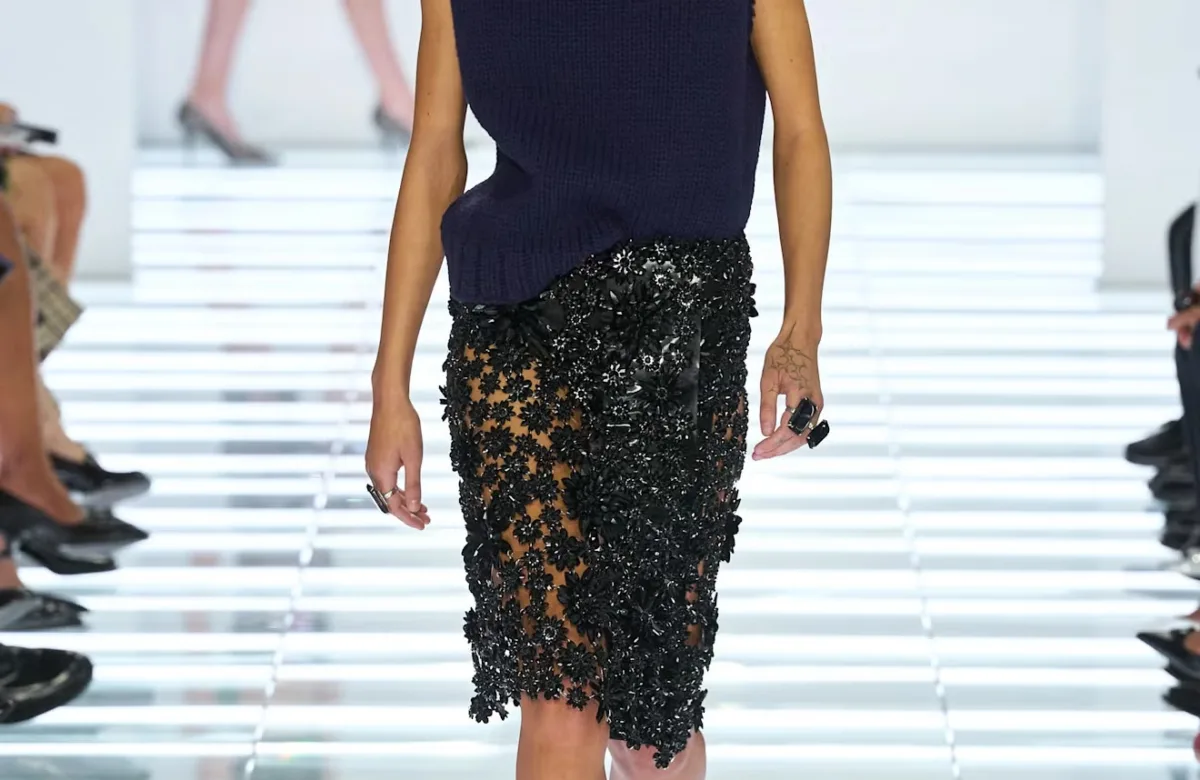
In this season’s standout collection, designers Miuccia Prada and Raf Simons delivered a hymn to the skirt. More than 60 of them appeared on the runway: pleated, crafted in Re-Nylon, fastened with Velcro, cut with dramatic slits or sharpened into pencil-thin silhouettes, and embellished with fabric flowers and crystals.
Then came a dose of subversive chic: micro satin and muslin bras, or horizontal bands of fabric that sometimes extended across the upper arms. Suspended from hooks, the latest micro-Prada nylon bags completed the look. Italians interpreted this as a political statement, after Italian Foreign Minister Antonio Tajani caused an uproar by saying that a woman who wears “longer skirts” will be “a less flashy but more reliable, more serious woman, who will certainly be a good mother.” Asked about the remarks, Miuccia chuckled: “The skirt is like a T-shirt, you can put any idea you want on it.”
After the collection enjoyed a deafening roar of approval, Milan daily Corriere della Sera’s Jane Austen-inspired headline read: “Prada, Clothes, and Prejudice.” Ariana Alessi, the wife of fashion billionaire denim emperor Renzo Rosso, did not mince her words: “Patriarchy must be resisted. I didn’t think men who spoke like that still existed.” Which brings us to…
Diesel: Farewell, Bordello style

Renzo Rosso presides over a stable of brands including Marni, Jil Sander, Maison Margiela, and Diesel, where departing designer Glenn Martens – who will now focus his attention on Margiela – marked his final show with what looked like a mini orgy. He hired 200 performers from La Horde, the Marseille-based troupe, and scattered them among the audience of 1,500. They began embracing, making out, and stripping one another of their clothes, all to the soundtrack of Donna Summer’s Love to Love You Baby.
On the runway came party gear: skirts and jeans that looked invaded by moths; sweaters with eroded necklines; and some remarkable denim jackets coated in wax, appliquéd to resemble leather, or foil-printed and lasered.

The show — indeed the entire fashion week — underlined fashion’s importance to Italy. A McKinsey & Company study commissioned by Camera della Moda, Italy’s fashion governing body, estimates that fashion accounts for 5 percent of the country’s industrial production and employs more than one million people when the wider supply chain is included.
Italy remains an educational magnet, too. The study – entitled ‘The State of Fashion’ – estimates that 70 percent of the students in Italy’s top five fashion schools are foreigners. And even though the fashion system has been rocked by allegations of sweatshops supplying some of the industry’s biggest-name runway brands, the country remains a huge shopping magnet. Italy ranks second in the world for tax-free spending, with 68 percent of all visitors giving fashion as their first or second reason for choosing to visit.
Fendi: Raffaella Carrà and roll

A huge leap from Diesel’s Coachella clobber was Italian 1980s glamor at Fendi, where hundreds of well-heeled VICs gathered for a collection inspired by the Italian television showgirl and gay icon Raffaella Carrà. The resulting look was fluid: black trousers and tops, semi-sheer gilets, body-con shorts, and bloomers. Silk and animal prints were finished with lace, embroidery, and intarsia, and topped with rugged mink or fox gilets.
“It’s my Italian background… punk and bourgeois,” smiled Fendi’s Roman-born couturier Maria Grazia Chiuri, whose invitation and entrance cited E.E. Cummings’ poem, ‘I like my body, when it is with your body.’
Jil Sander: Minimalism is alive and well

An imperfect but beguiling modern minimalism is alive and well at Jil Sander. “Creating a collection is like going to therapy. You take things apart to understand what you want to keep. Then you put them back together,” explained Simone Bellotti, the Italian creative director of this Hamburg-born house.
Seams, darts, and lapels were subtly shifted, twisted, and distorted – especially at the back – so every single look felt like a new tailoring concept. Knitwear was crumpled and fine wool suiting was elongated, even as coats ballooned gently away from the torso. Above all, the clothes exuded a sense of wealth, suggesting a client so successful they never need to try too hard.
Giorgio Armani: Steady ahead with Silvana

According to the terms of his will, the descendants of Giorgio Armani are instructed to sell at least 15 percent of his company within 18 months of his passing (meaning by March 2027), followed by a larger sale in three to five years. But given the classy elegance of the house’s latest signature collection by his niece Silvana, there seems little urgency to sell up.
Presented on Sunday to an enthusiastic front row that included Claire Danes and Elizabeth Debicki, the SS27 show featured a slick black, white, and cream vision of alluring fashion. Graphic zig-zag patterns were inspired by menswear tailoring, from the perfectly cut linen pantsuits, long shawl-collar blazers, sequined jackets, and a black crepe pant suit worn with white gloves that was inspired by the look Giorgio wore to his Holy Communion in 1942.

Three days earlier, Emporio Armani presented an elongated array of cool, casual looks – mostly in shades of gray and ecru – inside the Tadao Ando-designed theatre. It was the final collection before the 2027 debut of former Versace designer Dario Vitale, who will take the reins at Emporio. Another indication, perhaps, that the House of Armani is very much on the move – and in no mood to put itself on the block.
Loro Piana: Elegantly practical

Those in search of understated yet practical elegance will always find a home at Loro Piana, which presented what may have been its most accomplished collection yet inside the Braidense Library.
This was true ‘quiet luxury’: creamy cardigan jackets; toggle-free cashmere duffel coats; protective suede field jackets; and perfectly cut double-breasted camel blazers. There were suede blouses with contrasting gabardine sleeves, alongside a rich selection of jet-black assassin’s suits and ladies’ tuxedos. It was a brilliant display of the house’s particular genius. Loro Piana, frustratingly, does not like to reveal the names of its design duo – a pity, given that they are among the best teams working in Italian fashion today.
Tod’s: Polished and perforated

A smart and stylish collection by Tod’s was presented inside the contemporary art museum Padiglione d’Arte Contemporanea. This season was focused on the gommino – the classic loafer that forms the foundation of yet another Italian billionaire’s fortune, Diego Della Valle.
Every second look seemed perforated: trench coats, hacking jackets, tote bags, and, of course, the gommino. Occasionally these were juxtaposed with sleek tinted plastic, seen in handbags and more loafers. The footwear’s importance was underlined at the entrance, where half a dozen artisans skillfully sewed together pristine new pale-beige gomminos.
Capasa Milano: A masterclass in Italian shoemaking
A love of artisanship was also apparent at Capasa Milano, whose latest shoe collection featured leathers lovingly hand-beaded before assembly. Supple multi-pleat moccasins, low-rider suede Italo-Chelsea boots, and desert boots were all manually shaded with rare waxes. For gents who yearn for unique artisanal footwear, Ennio Capasa is the holy grail designer.
Max Mara: Utilitarian luxe

Max Mara’s British designer Ian Griffiths is famous for referencing strong women in his collections, from Renaissance queens to literary lionesses. This season, his muse was Freya Stark, a British-born, Italian-raised explorer who famously photographed the southern Arabian desert.

The result was hyper-elegant and practical clothes such as wonderful flowing trenches and coats with deep pockets and clasps, and stylish military overalls. It’s the kind of gear that Stark would have worn when she sailed down the Red Sea in the 1930s searching for the frankincense route and the lost city of the Queen of Sheba. Though the collection lacked oomph for eveningwear, it was a precious statement of urban explorer chic.
Gucci: The Store Show

Gucci’s mononymic designer Demna called his latest collection The Store Show, building a giant virtual boutique for 800 guests, rendered in travertine and velvet, its shelves groaning with product. Consumers have been conspicuous by their absence in Gucci stores over the past two years, but this array of ideas looks likely to lure a few back. The clothes were a cunning blend of revamped Tom Ford classics and Demna’s voluminous vision at his last job at Balenciaga, which, like Gucci, is owned by French luxury group Kering.
Related article: London Fashion Week’s Renaissance: Why British Fashion Is Fighting Back

Demna pointedly named his target “The Rebellious Aristocrat, The Snob, and The Eccentric.” For the first, he designed white jeans and riding boots; country house trenches and wide belts with giant horse-bit buckles. For lofty snobs, there were outlandish faux fur fox and leopard coats. And for the eccentric among us, spidery, scrunched-up pants worn with Gucci red and green rugby sweaters and leather blousons.
Demna saved his biggest statement for the accessories. Boots came sharpened with G-emblem spurs, while horse-bit stilettos rose into exaggerated, almost weapon-like heels. For men, elongated moccasins were cut from soft leather and finished with burnished bamboo-cane tassels.
Lug Von Siga: Milan’s latest discovery is a Turkish designer

“It’s about empowerment and sustainability in Anatolia,” explained Turkish designer Gül Ağış, the Marangoni-trained founder of Lug Von Siga, who eschewed the rustic palette one might expect, instead working in some forty shades of ecru and cream.
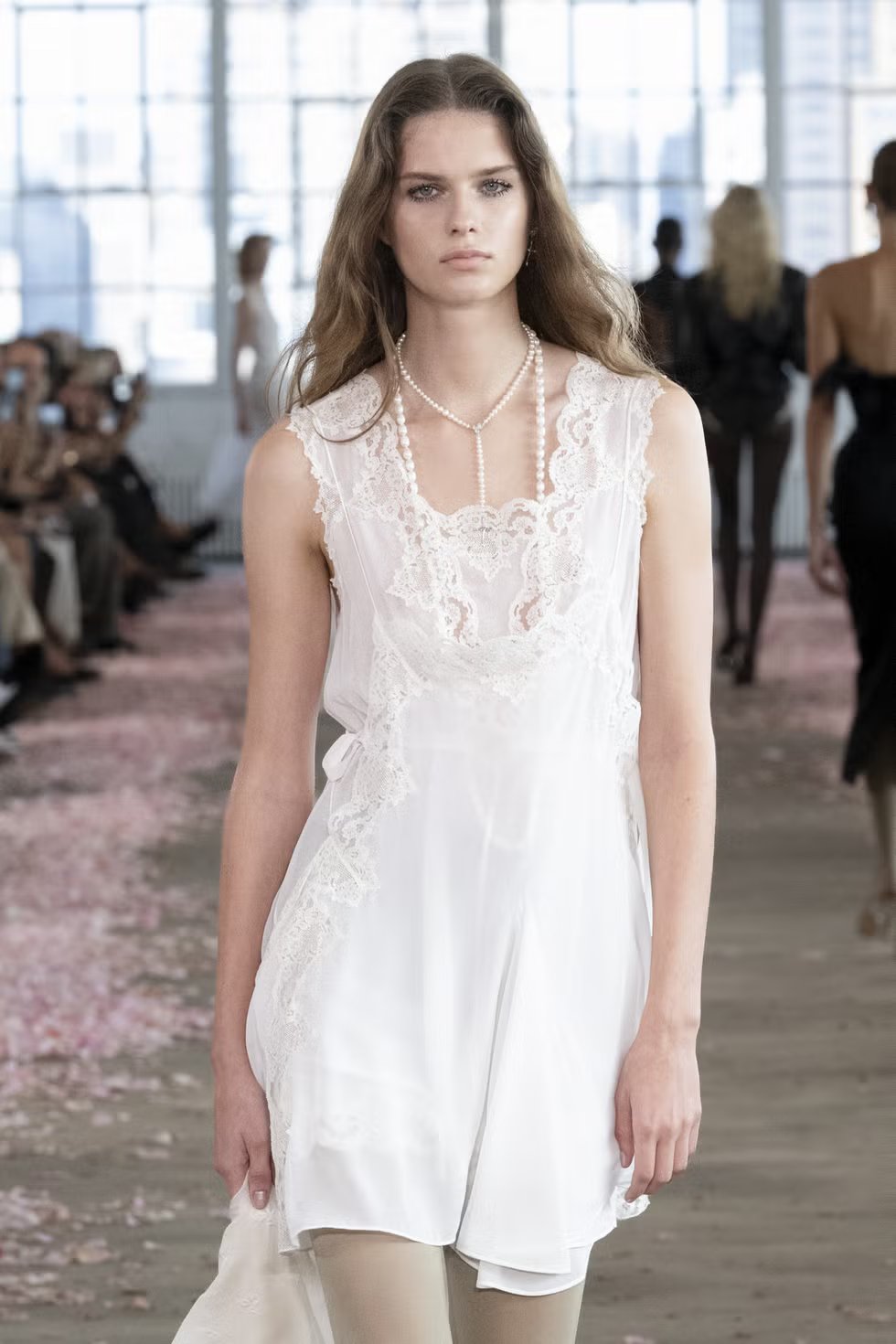
Inspired by Rumi, the 13th-century Persian poet, Sufi philosopher, and founder of the Whirling Dervishes – a dance form Ağış herself practiced for six years – the collection possessed a gentle, almost ethereal grace, with clothes full of dexterous lace and transparency. The result was a new voice in Milan: Jane Austen on the Bosphorus.
It’s party time – with a retro twist – again in Milan

A half-dozen brands shook off last year’s blues to deliver clubbing clothes, Coachella cool, and steamy lingerie-fuelled desire.
Dolce & Gabbana was all about raiding your Sicilian granny’s wardrobe – or, as Domenico and Stefano christened it, “an intimate and familial archive.” Bodices and hand-crafted trousseaus were resewn and reinvented as antique-lace skirts and blouses, lingerie topped cocktail dresses, and strass-covered slip dresses. Day and night merged in a collection the duo called ‘Stravaganza Siciliana’.
The show drew a large audience, including Jennifer Lopez who sat in the front row wearing a tuxedo-and-velvet-beret combination. Her arrival was heralded by 5,000 fans, who brought the tramlines outside to a standstill.

At Roberto Cavalli, designer Fausto Puglisi’s muse was a nepo-baby groupie following a stadium-filling rock band. Founder Roberto Cavalli was Italian fashion’s great printmaker, and Puglisi continued that rich tradition with sensational, hyper-magnified leopard and cheetah-head prints on asymmetric cocktail dresses, trompe-l’oeil denim designs, and dazzling coral blazers. Everything looked gloriously upbeat, riffing on the devilment and desire of the movie capital.
Taller Marmo called its show ‘Mediterranea’ and staged a decadent Seventies revival party inside a bizarre underground apartment complete with a swimming pool and Bond villain screening room. Design duo Riccardo Audisio and Yago Goicoechea whipped up evening kaftans, side-slit cocktail dresses, deep-gorge cloqué gowns, and metallic-organza frocks for women. For men, there were disco-dragoon tuxedos, while their dates wore bandanas and drank champagne straight from the bottle.
Meanwhile at Dsquared2, designer twins Dean and Dan Caten took the party theme literally, getting behind the mixing desk themselves and DJing at a bash inside their Via Verri flagship.
Massimo Giorgetti channeled the legendary postmodern Italian Pop artist Mario Schifano, a handsome blade who dated rock goddesses Anita Pallenberg and Marianne Faithfull. His fun color palette of enamel paint, wax crayons, and gouache was translated into leggings, tops, and striped men’s shirts for cocktail hour. It was optimism personified.
A season of surrealism
Guests at the fashion summit dinner moved upstairs in the Palazzo Reale to discover Dalí et la Moda, a remarkable exhibition exploring the Spanish painter’s many connections with fashion. The influence of surrealism was also apparent at shoemaker Gianvito Rossi’s 30th anniversary celebration, staged inside the Renaissance palazzo where Napoleon wintered in 1797. Five pairs of beautifully sculpted legs, encased in Rossi shoes, appeared to march out from gilt picture frames.
And it surfaced again at Kering, where a group of young talents presented some gloriously outlandish ideas. Cameroon’s Nathalie Chebou-Moth recycled shoes into sculptural, masked, totemic heels. India’s Srushti Patil used reproductive enzymes to develop a Chapman Brothers-esque gown, from which five human forms appeared to emerge. From Palestine, Ayham Hassan fused traditional local draping with the precision of British tailoring in a bravura study of layered silhouettes.