Emboldened by the results of this month’s U.S. midterm elections, hundreds of migrants are making their way from southern Mexico to the border with the United States.
The Mexican government, facing a threat from the U.S. president, has downplayed the situation and is trying to persuade them to go home.
The caravan of about 800 people, the largest to the U.S. this year, is made up of migrants from several Central American and Caribbean countries, including Honduras, El Salvador and the Dominican Republic.
Many of them believe the shift in Congress, with Democrats taking control of both the House of Representatives and the Senate from Republicans, could signal a softening of immigration enforcement — prompting them to undertake the difficult journey toward the U.S. border, despite having almost zero chance of entering the country.
U.S. President Donald Trump has threatened to double tariffs on Mexican imports if authorities in Mexico fail to halt the caravan’s advance. Hundreds of billions of dollars in trade are on the line.
“MEXICO MUST STOP THEM, NOW, and if they do not do so, the Tariffs on Mexico will be IMMEDIATELY DOUBLED,” Trump said on his social media platform Truth Social on Nov. 12.
“There will be no leniency!”
‘We don’t eat sometimes. We walk a lot’
This is not the first time Trump has threatened Mexico over migrant caravans. Back in 2018, during his first term, he urged the U.S. Congress to enact strict border legislation using the “nuclear option if necessary” to curb the ongoing flow of migration.
The Trump administration brought in tough border policies that essentially put a stop to the movement of caravans.
The current caravan, known as Dios con Nosotros (God With Us), is now in the southern Mexican state of Chiapas. The group is currently walking between 13 and 32 kilometres every day.
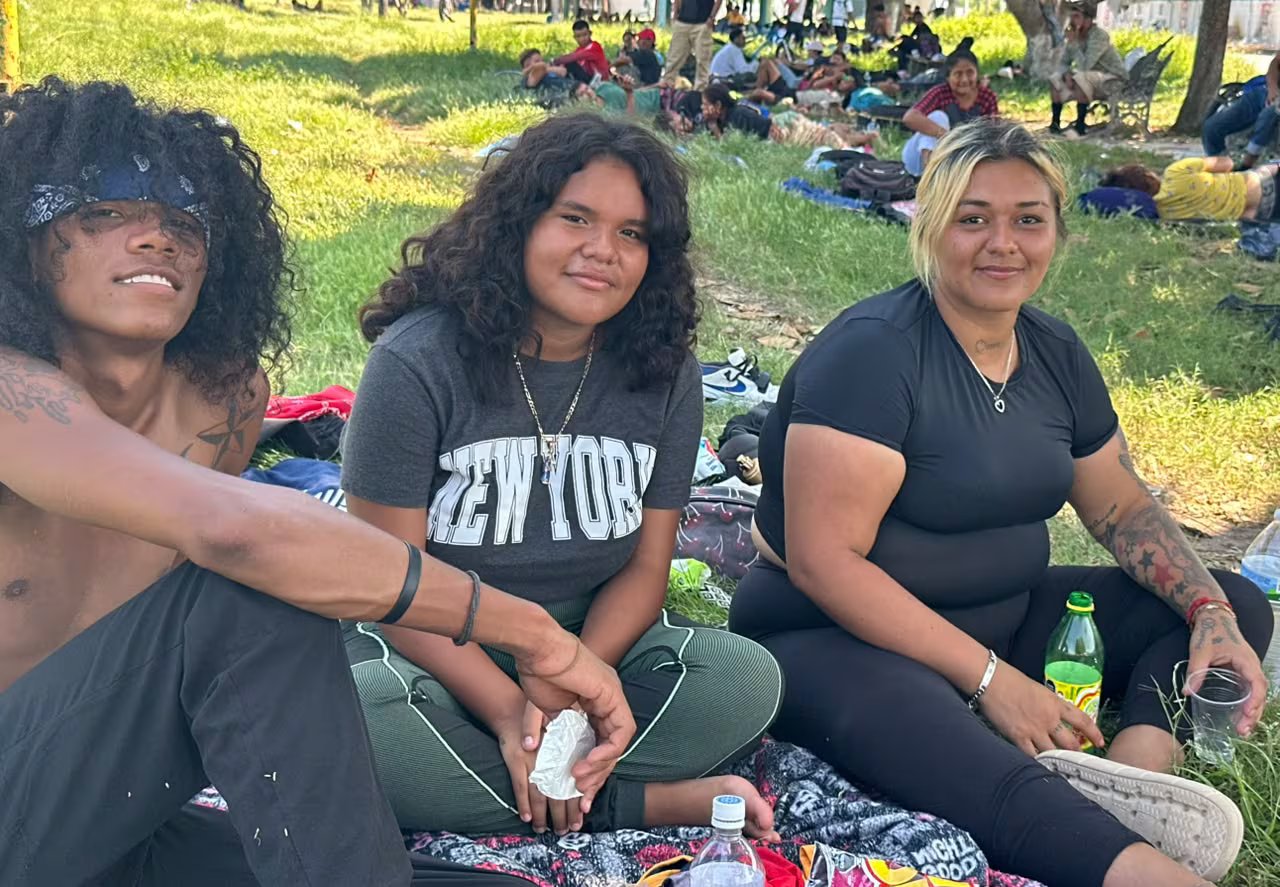
Katheryn Esmeralda, one of the people in the caravan, was deported from the U.S. six months ago following a raid on her workplace in Atlanta. She had lived in the U.S. since she was 15, and her entire family, including her three children, remain there.

Katheryn Esmeralda, right, rests with Esther María Aquino, centre, and an unidentified friend in Mapastepec, on their way to the Mexico-U.S. border. (Juan Manuel Blanco/CBC)
“I’m coming here because all my family is in the United States. And I have all my kids over there” Esmeralda, originally from El Salvador, told CBC News in Mapastepec, in the state of Chiapas.
Esther Maria Aquino, from Tela Atlántida in Honduras, was also recently deported from the U.S. and hopes to reunite with her parents in Texas. She has already walked roughly 180 kilometres from the Guatemalan border to Pijijiapan in Chiapas.
Aquino said the journey has been difficult. “We don’t eat sometimes. We walk a lot, you know. It’s so bad,” she said.
The group still needs to cross about 2,000 kilometres before reaching the U.S. border.
Mexican President Claudia Sheinbaum said this week that since Trump took office in January 2025, 24 caravans had formed but never reached the U.S.-Mexico border.
“We inform the people in the caravan that it is very difficult to enter the United States, and if their goal is to reach the United States, they will not be able to do so because that possibility does not exist,” she said.

A migrant girl lies on a shopping cart with luggage while travelling toward northern Mexico on the way to the U.S. border, in Mapastepec on Tuesday. (Damian Sanchez/Reuters)
‘Humanitarian visas’ needed, advocate says
“People lack information and think that things are going to change immediately, simply because the Democrats won in several states and … in Congress,” immigration lawyer Soraya Vázquez said.
Vázquez, deputy director of the Tijuana office of Al Otro Lado, a binational non-profit organization, said the Mexican government should offer information to the migrants about the real situation when they attempt to cross — not just a strategy to prevent migrants from reaching the northern border by any means necessary.
“One key measure involves mandating bus operators to check for legal immigration documentation prior to selling tickets or boarding passengers,” she said. “Mexico would need to have a very good information campaign, but it should also, perhaps, provide them with humanitarian visas.”

Soraya Vázquez is an immigration lawyer and deputy director of the Tijuana office of the non-profit organization Al Otro Lado in Mexico. (Submitted by Al Otro Lado)
The visas would give migrants from outside Mexico a legal immigration status to allow them to settle in the country in areas with job opportunities while they wait for conditions to change so they can eventually reach the United States.
Advocates say that the main group in the caravan grows smaller day by day as some people get tired of the journey and return to their homes, while others approach Mexican authorities who offer them a chance to apply for asylum or a way back home.
“The Mexican government uses many euphemisms, but in the end, what it actually does is contain people and return them to the south of the country or to their place of their origin,” Vázquez said.
Travelling on foot across Mexico remains the sole option for migrants to reach the U.S. But even if they manage to reach the border, strict immigration enforcement leaves virtually no viable avenue for obtaining a visa.

Migrants in the caravan travelling through Mexico rest in Mapastepec. The caravan of about 800 people is made up of migrants from several Central American and Caribbean countries, including Honduras, El Salvador and the Dominican Republic. (Juan Manuel Blanco/CBC)
A federal Mexican official told CBC News that “migration is not criminalized, migrants are provided assistance, cases are analyzed depending on the vulnerable group they belong to, and many of them return to their countries.”
“Mexico would have to provide them an option, a humanitarian alternative,” Vázquez said. “A one-year humanitarian visa, with the possibility of renewing for a second year while waiting for changes in border policies.”
But migrants like Esmeralda are desperate to achieve their goal: reuniting with their families without having to wait.
“My little daughter is four years old right now. And she calls me and she says, ‘Mom, I miss you,'” she said. “I’m crying because she is a baby right now and she needs me.”